Hemp produces several dozen cannabinoids. CBD is the most abundant in the varieties grown for it, but it shares the plant with CBG, CBC, THC and other molecules present in small amounts. This guide explains where these compounds come from, how to tell them apart and what becomes of them between the plant and the bottle.
On this page
- What counts as a cannabinoid
- Where and how the plant makes them
- Acidic forms and neutral forms
- The main hemp cannabinoids
- Terpenes and flavonoids: the other compounds in the extract
- What Swiss law says
- From hemp to bottle
- The topics in detail
- An oil is defined by its profile
- Frequently asked questions
What counts as a cannabinoid
The word cannabinoid was proposed in 1967 by the chemists Raphael Mechoulam and Yehiel Gaoni to designate a family of compounds with 21 carbon atoms specific to hemp. The definition also covers their acidic forms, their homologues and the products of their transformation. The federal authorities use a similar wording: in their fact sheet on CBD products, the FSVO, the FOPH and Swissmedic describe cannabinoids as a group of substances structurally related to THC.
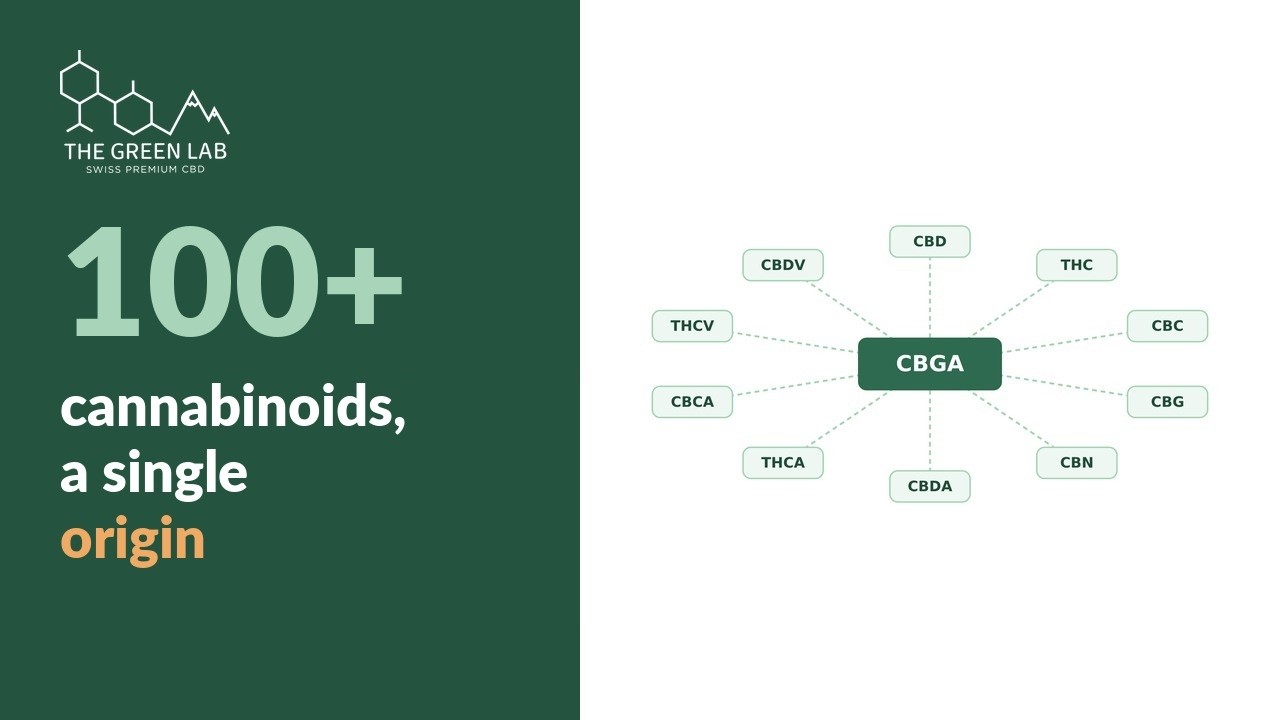
Their number varies from one source to another. The same fact sheet states that hemp produces between 80 and 100 cannabinoids and around 300 other compounds. Recent scientific literature lists more than a hundred, and nearly 150 according to a 2016 review. The gap comes mainly from the way they are counted: some authors list acidic forms and homologues separately, others group them together.
Cannabinoids made by the plant are called phytocannabinoids. There are also cannabinoids obtained by synthesis or by chemical conversion of an extract. This guide sticks to the former, those found in a hemp extract and in an oil.
Where and how the plant makes them
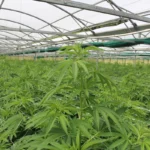
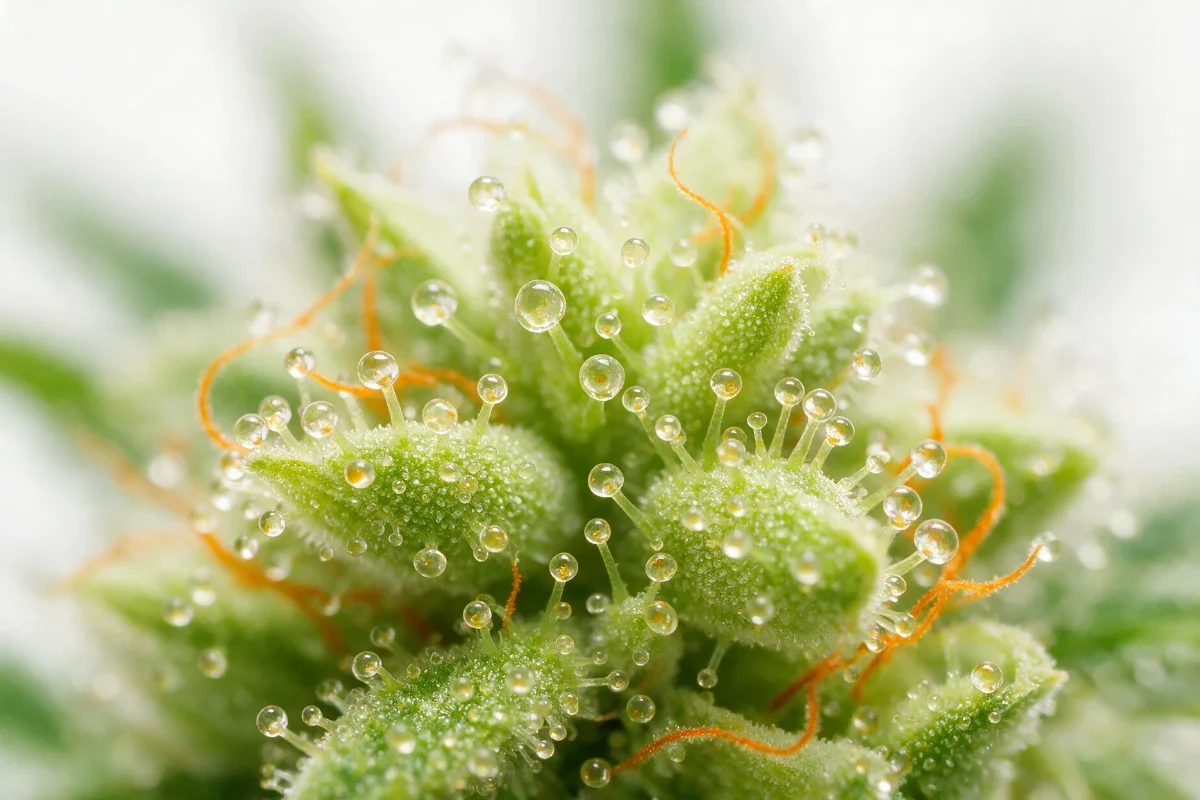
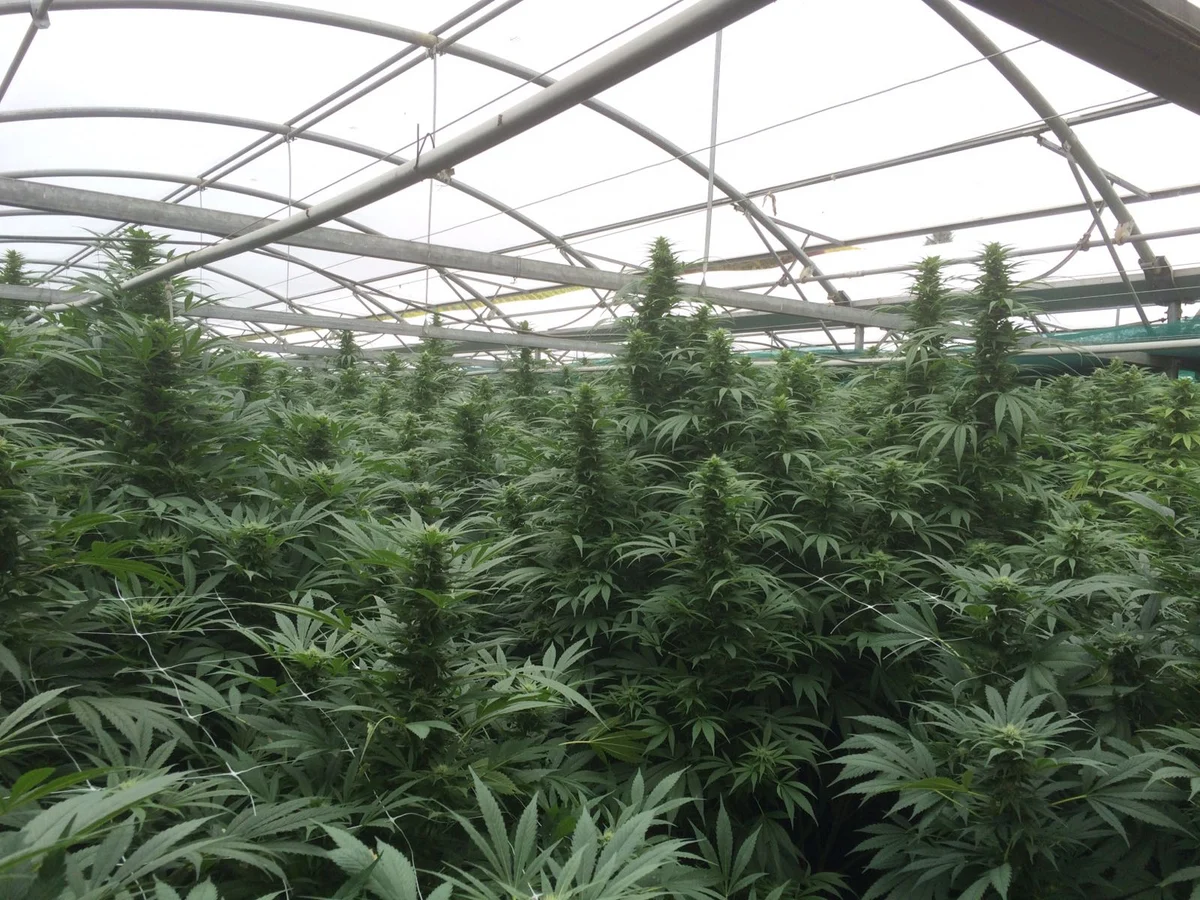
Cannabinoids form in the glandular trichomes, tiny hairs topped with a resin head that mainly cover the female flowers. This resin concentrates the cannabinoids, and also the terpenes that give the plant its smell.
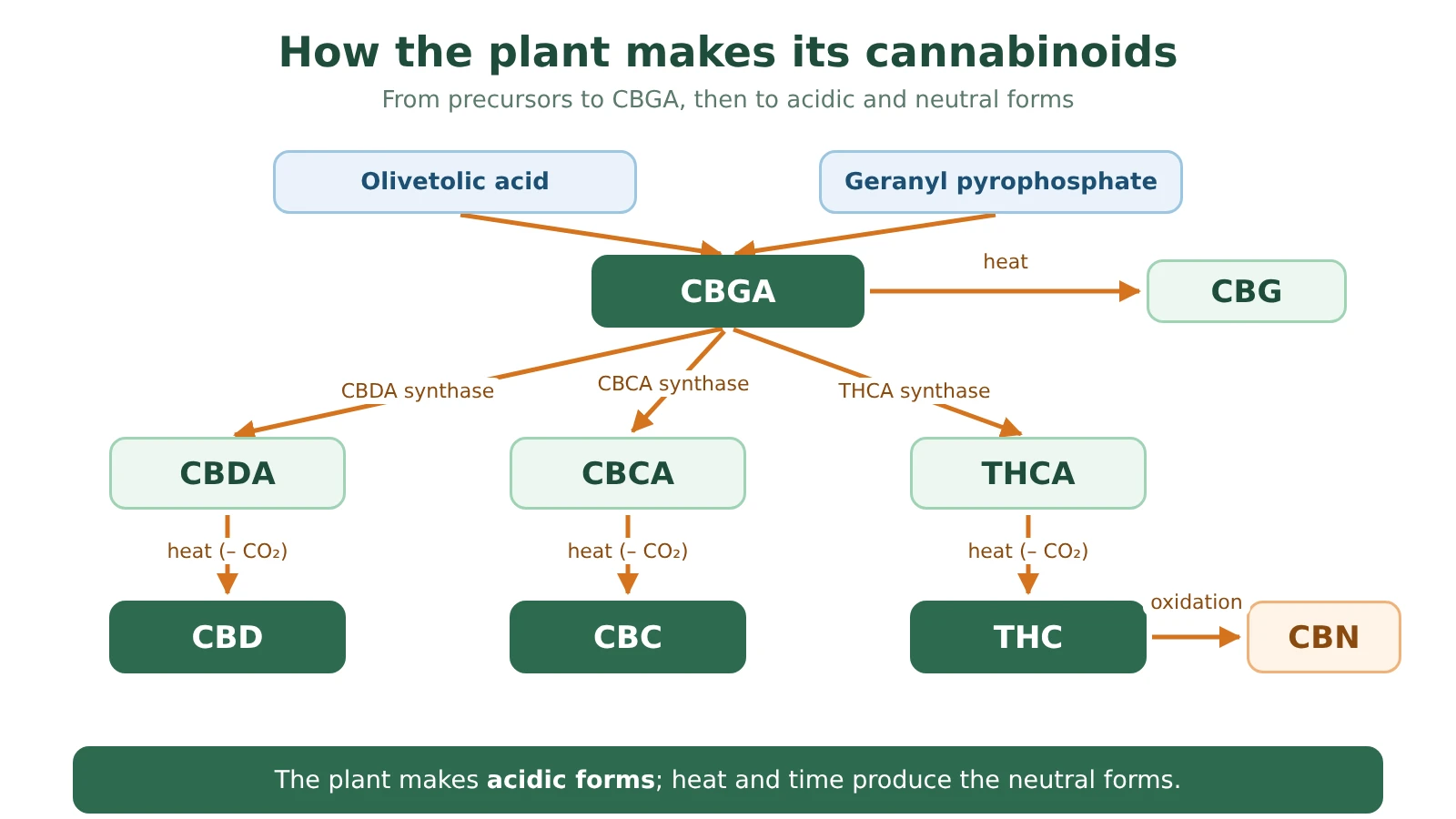
Production follows a well-established pathway. An enzyme first joins two precursors, olivetolic acid and geranyl pyrophosphate, to form CBGA, cannabigerolic acid. CBGA then serves as the starting point for three other enzymes, the synthases, which convert it into CBDA, THCA or CBCA. For this reason it is described as the “mother” cannabinoid, a role detailed in our article on CBG.
The synthases a plant has determine its profile. Geneticists classify hemp into five chemotypes: type I produces mainly THCA, type II a mix of THCA and CBDA, type III mainly CBDA, type IV mainly CBGA, and type V almost no cannabinoids. Varieties grown for CBD belong to type III.
Acidic forms and neutral forms
The plant makes its cannabinoids in acidic form: CBDA, THCA, CBGA, CBCA. The final “A” refers to a carboxylic acid group attached to the molecule. With heat, and more slowly over time, this group breaks away as carbon dioxide. This reaction, decarboxylation, converts CBDA into CBD and THCA into THC.
It matters when reading an analysis. Laboratories often report a total CBD, which adds the CBD present to the share of CBDA able to convert, with that share multiplied by 0.877 to account for the CO₂ lost. The same calculation applies to THC: in Switzerland, the 1% limit refers to total THC content, acidic forms included, as explained in our article on the 1% THC limit. The acidic forms have their own article, devoted to CBDA, THCA and CBGA.
The main hemp cannabinoids
In CBD-rich hemp, a few molecules dominate the profile and many others remain at trace levels. The table sets out the main ones.
| Cannabinoid | Form in the plant | Origin | In CBD-rich hemp |
|---|---|---|---|
| CBD (cannabidiol) | CBDA | CBGA converted by CBDA synthase | Main cannabinoid |
| CBG (cannabigerol) | CBGA | Precursor of the other cannabinoids | Minor, more abundant in chemotype IV varieties |
| CBC (cannabichromene) | CBCA | CBGA converted by CBCA synthase | Minor, rarely above 0.2 to 0.3% |
| THC (tetrahydrocannabinol) | THCA | CBGA converted by THCA synthase | Less than 1% total THC, Swiss legal limit |
| CBN (cannabinol) | No enzyme | Oxidation of THC over time | Traces |
| THCV and CBDV | THCVA, CBDVA | Short-chain homologues | Generally less than 2% of cannabinoids |
CBD is the main cannabinoid of type III varieties. First isolated in 1940 from wild Minnesota hemp, it had to wait until 1963 for its structure to be established. Our article on CBD traces this history.
CBG remains rare in a mature plant, because the synthases convert almost all of the CBGA. CBC, discovered in 1966, has the same molecular formula as CBD and THC but a different structure, with a chromene ring that gives it its name. It is more abundant in young plants, as our article on cannabichromene shows.
CBN stands apart. The first cannabinoid to be isolated, at the end of the 19th century, it is not made by any enzyme: it forms when THC oxidises over time. THCV and CBDV are short-chain cousins of THC and CBD, abundant only in certain hemp populations, often originating from China or southern Africa. Our article on minor cannabinoids presents them.
Terpenes and flavonoids: the other compounds in the extract
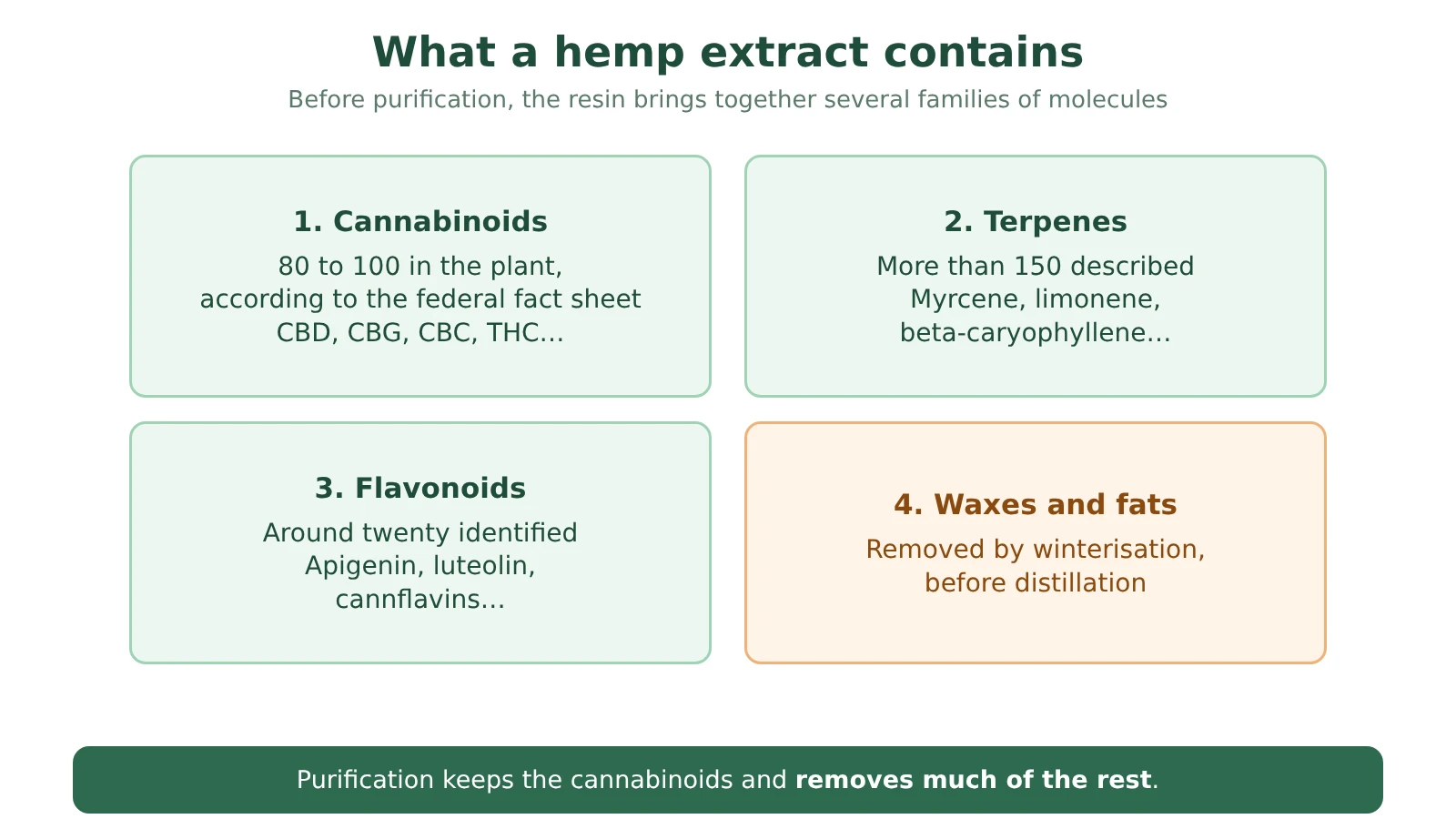
A hemp extract contains many molecules besides cannabinoids. Terpenes, built from five-carbon building blocks, give each variety its smell. Myrcene, beta-caryophyllene and humulene are found in most hemp plants, pinene, limonene and linalool in many of them. More than 150 different terpenes have been described in cannabis resin, and the differences between varieties can be smelt when opening two bags of CBD flowers.
Flavonoids form another family, that of plant pigments. Around twenty have been identified in hemp, including the cannflavins, particular flavones first described in the 1980s. Our article on terpenes and flavonoids explains why these compounds, more volatile or more fragile than cannabinoids, are partly lost during drying and distillation.
What Swiss law says
The Swiss list of narcotics covers THC itself, as well as hemp and products with a total THC content of at least 1%. CBD, CBG, CBC and CBDV are not on it. CBN and THCV, however, belong to derivative group no. 303 (“cannabinoids”) in Annex 6 of the FDHA Narcotics Lists Ordinance (BetmVV-EDI), which covers a family of molecules defined by their chemical structure: only their industrial or scientific use is exempt from controls. Swissmedic specifies that CBN occurring naturally in hemp is not affected, as long as it is neither added nor enriched.
The rules that apply to these cannabinoids depend on the category under which the product is sold. The federal authorities' fact sheet makes this clear: it applies to CBD as well as to the other cannabinoids not subject to narcotics legislation, which must meet the requirements specific to their intended use. Our oils are declared as cosmetics, our flowers and vapes fall under the Tobacco Products Act, and our guide to Swiss CBD law details each category.
For a cosmetic, the fact sheet sets two requirements that apply to all cannabinoids. No intermediate product in the manufacturing process may exceed 1% THC, and the safety of the cannabinoids used must be demonstrated in the product's safety report, whatever their origin. Each of our oils has its own product information file.
From hemp to bottle
Between the plant and the oil, the cannabinoid profile changes. Extraction collects the resin, winterisation removes the waxes and fats, decarboxylation converts the acidic forms and vacuum short-path distillation separates the cannabinoids from a large share of the other compounds. Each step alters the initial balance, as described in our article on how a CBD oil is made.
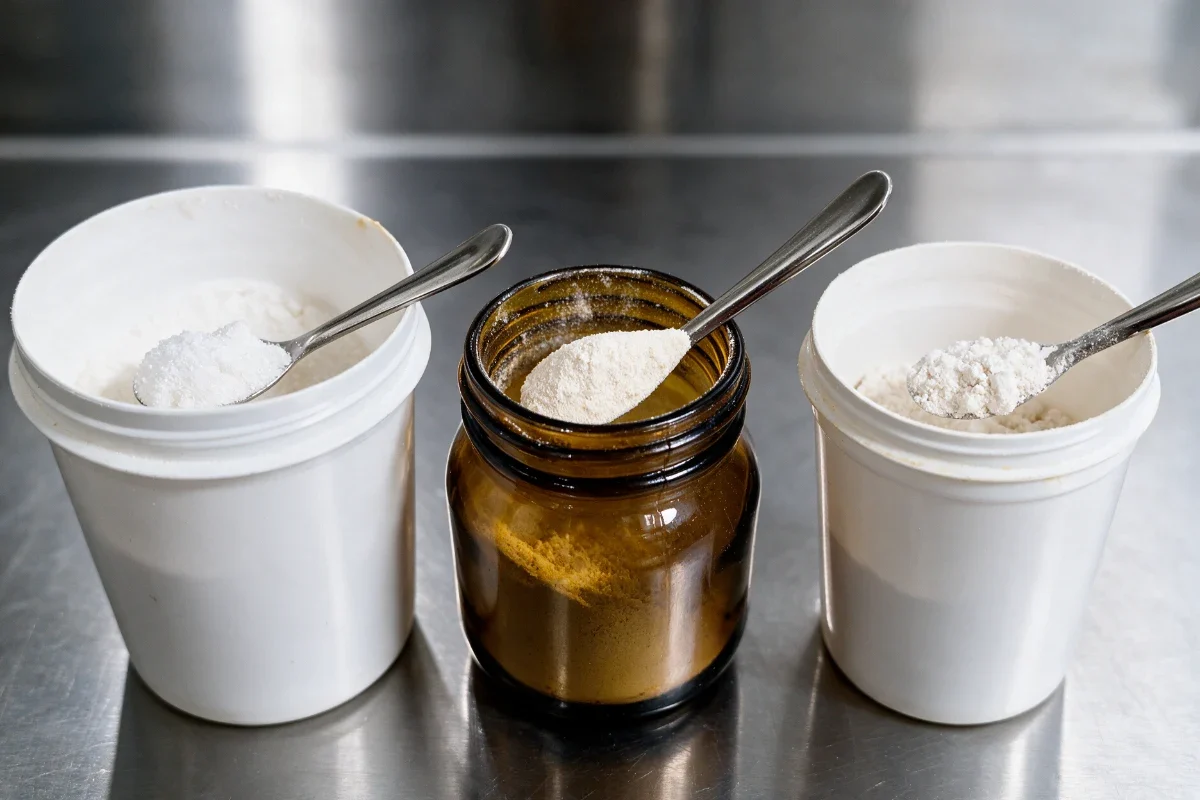
The final spectrum depends on what is kept. A Full Spectrum extract retains all the cannabinoids of the extract, THC included below the legal limit; a Broad Spectrum extract has the THC removed; an isolate contains only one purified cannabinoid. Our article on Full Spectrum, Broad Spectrum and isolate clarifies what these terms cover in practice.
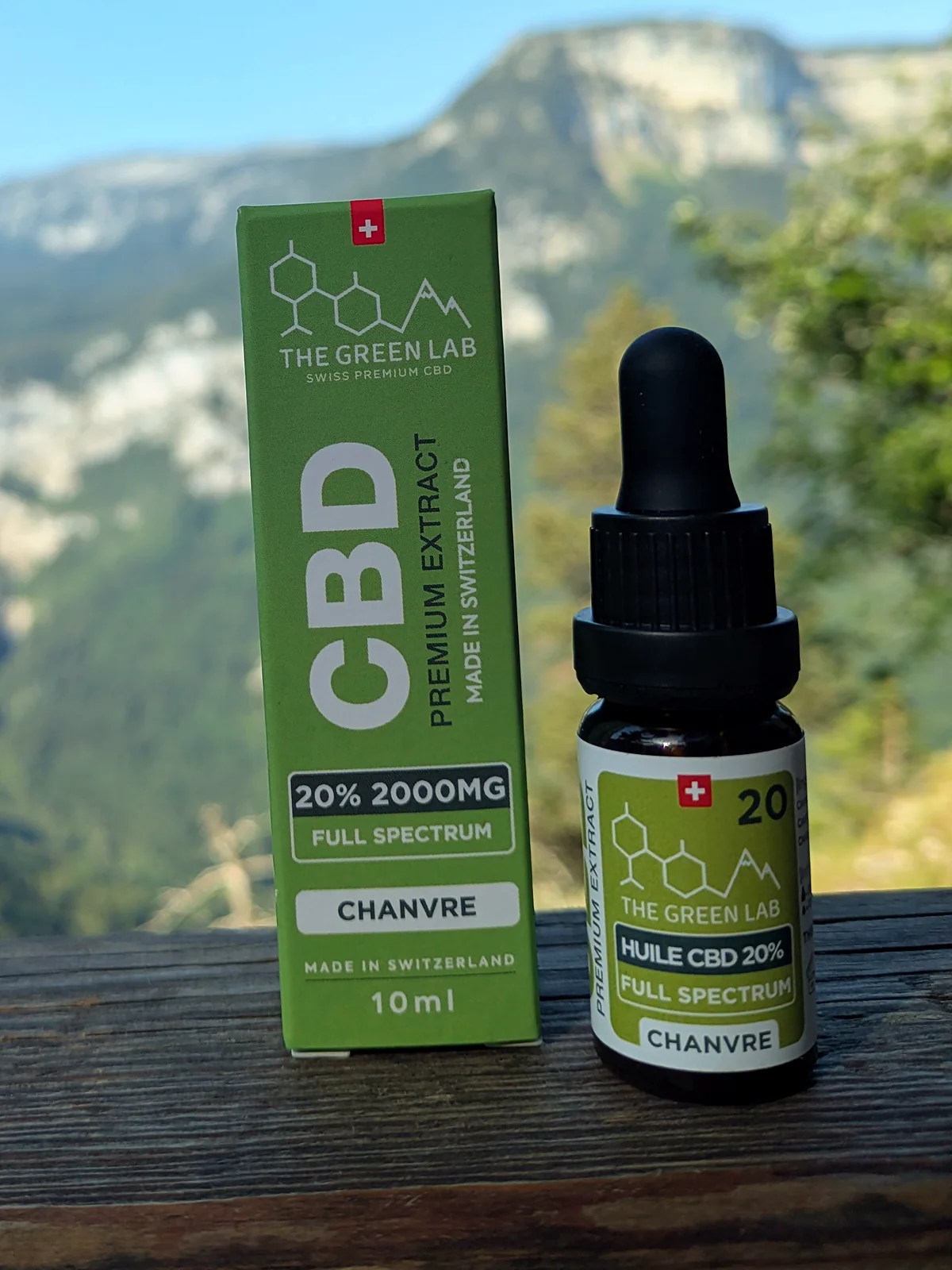
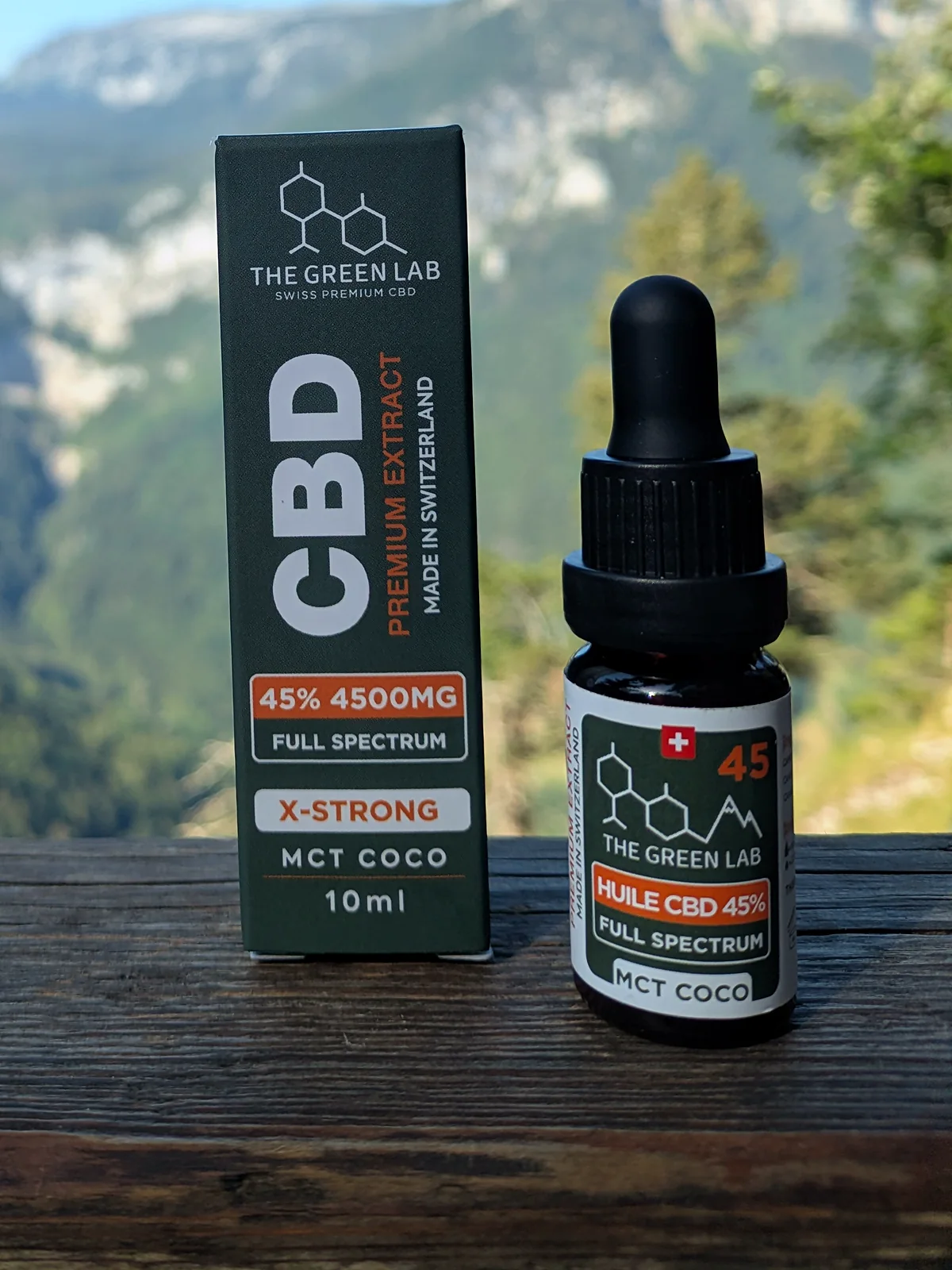
Our ranges reflect these choices. The Sublime range on MCT coconut oil and the Hemp oil are Full Spectrum, as is the X-Strong 45%. Our Broad Spectrum oils, including the range on olive oil, are formulated from an extract from which the THC has been removed.
Point to watch
The percentage shown on a CBD oil refers to CBD alone. The other cannabinoids in a Full Spectrum extract are present in small amounts and are not added to this figure.
The topics in detail
CBD, history and structure. Isolated in 1940 from wild Minnesota hemp, its structure established in 1963, made in the flower by CBDA synthase: the fact file on the main molecule of hemp grown for CBD, with its formula and its place in Swiss law. Read the full article →
CBG, the “mother” cannabinoid. Its acidic form, CBGA, is the starting point for CBD, THC and CBC. Why CBG remains rare in a mature plant, what chemotype IV varieties are and how a CBG isolate is obtained. Read the full article →
CBC, a lesser-known cannabinoid. Discovered twice in 1966, it has the same formula as CBD and THC, dominates the profile of young plants, then declines at maturity. Its chemistry, its levels and its sensitivity to light. Read the full article →
Acidic forms: CBDA, THCA, CBGA. What the A stands for, how heat converts these acids, why GC and HPLC do not give the same figures and how total CBD is calculated. Read the full article →
Terpenes and flavonoids. Myrcene, limonene, beta-caryophyllene, cannflavins: the compounds that accompany cannabinoids in the resin, the way the plant makes them and what drying and distillation do to them. Read the full article →
CBN, THCV and CBDV. CBN, the first cannabinoid to be isolated, forms as THC ages; THCV and CBDV are short-chain homologues, found mainly in certain hemp populations. Origin, levels and status in Switzerland. Read the full article →
An oil is defined by its profile
Two oils with the same CBD percentage can have very different profiles. The minor cannabinoids, the remaining acidic forms and the terpenes vary with the variety, the process and the age of the extract. It is this balance, more than the CBD figure alone, that gives an oil its character, as our article on the ratio between cannabinoids shows. All our oils are presented on the CBD oils page.
Our laboratory
We process our extracts in Gland, from crude extract to bottle: winterisation at −80 °C, decarboxylation, vacuum short-path distillation, then adjustment of the spectrum with purchased isolates. The crude extracts we use contain less than 1% total THC, and the cannabinoid levels of our oils are regularly checked by an external laboratory. Discover the laboratory →
Frequently asked questions
How many cannabinoids does hemp contain?
According to the federal authorities' fact sheet, hemp produces between 80 and 100 cannabinoids and around 300 other compounds. Recent scientific reviews list more than a hundred. In a CBD-rich variety, a few dominate and most remain at trace levels.
What is the difference between CBD and CBDA?
CBDA is the acidic form made by the plant. With heat, and slowly over time, it loses a carboxyl group as CO₂ and becomes CBD. An analysis may show both separately, or a total CBD that adds the CBD to the convertible share of CBDA.
Are CBG and CBC on the list of narcotics?
No. The Swiss list of narcotics covers THC as well as hemp and products containing 1% total THC or more, and CBG and CBC fall outside the “cannabinoids” derivative group (no. 303) of the BetmVV-EDI, which covers CBN and THCV among others. Like CBD, CBG and CBC follow the rules of the category under which the product is sold: cosmetic, tobacco product or other.
Where does CBN come from?
No enzyme in the plant makes CBN. It forms when THC oxidises, through contact with air, light and heat, during storage. Fresh, well-dried material contains practically none, and its level increases with age.
What does Full Spectrum mean for cannabinoids?
A Full Spectrum oil retains all the cannabinoids of its starting extract, including traces of THC below the legal limit. A Broad Spectrum oil has the THC removed, and an isolate keeps only a single purified cannabinoid.
Are terpenes cannabinoids?
No. Terpenes belong to another chemical family, built from five-carbon building blocks. They are produced in the same trichomes as cannabinoids and give each variety its smell. Being more volatile, they are partly lost during drying and distillation.
Does an oil's percentage include CBG or CBC?
No. On our oils, the percentage refers to CBD, by mass per volume. The other cannabinoids in a Full Spectrum extract are present in small amounts and are not added to this figure.