In this trial carried out in San Diego, migraine attacks treated with four inhalations of a cannabis flower combining THC and CBD were relieved at 2 hours in 67% of cases, versus 47% with a placebo. Pain had gone in 35% of attacks versus 16%, and some differences were still measurable at 24 and 48 hours. With the CBD-dominant flower, the difference from placebo was significant at 1 hour, but no longer at 2 hours, the primary outcome. It is the first randomised placebo-controlled trial on this question: double-blind and of decent size, but conducted at a single centre, with a single dose of a cannabis containing THC. This summary belongs to our “What the science says” series; our method is explained in how to read a scientific study on CBD.
| The study at a glance | |
|---|---|
| Original title | Vaporized cannabis versus placebo for acute migraine: A randomized, double-blind, placebo-controlled crossover trial |
| Journal | Headache: The Journal of Head and Face Pain, vol. 66, no. 2, pp. 365-376 |
| Date | 30 December 2025 online; February 2026 issue |
| Authors | Nathaniel M. Schuster, Mark S. Wallace, Thomas D. Marcotte, Dawn C. Buse et al. (University of California San Diego and Albert Einstein College of Medicine in New York, United States) |
| Type | Randomised, double-blind, placebo-controlled crossover trial |
| Funding | Migraine Research Foundation, with partial support from the university, the US National Institutes of Health (NIH) and private donors. No industry involvement according to the authors. Two of the seven authors report consulting activities for healthcare companies |
| Level of evidence | ●●●○ 3 out of 4: a randomised, double-blind trial of decent size, but at a single centre and with a single dose |
| Full text | Open access on PubMed Central |
On this page
Migraine and cannabis: widespread use, no controlled trial until now
According to its authors, no randomised trial had yet tested cannabinoids against a placebo on migraine attacks. The topic is nonetheless closely watched: migraine is the second leading cause of years lived with disability worldwide, and in a survey cited by the authors, 35.5% of 1,429 people using medical cannabis did so for headaches or migraines, mostly by inhalation.
Laboratory work suggests that cannabinoids might slow the release of CGRP, a small protein involved in migraine pain. Until now, only surveys and retrospective studies had looked at the question. In the United States, no cannabinoid-based medicine is approved for migraine. For one of the molecules tested, see our article on the history of CBD.
How the trial was conducted
The trial took place at the University of California San Diego. Of 678 candidates, 92 adults aged 21 to 65 were enrolled. Median age: 41 years; 83% women; 30% with chronic migraine; 36% had never used cannabis.
Four dried flowers, supplied by the US National Institute on Drug Abuse (NIDA), were compared: a THC-dominant one (5.62% THC), a CBD-dominant one (11.27% CBD and 0.35% THC), one combining both (6.16% THC and 10.77% CBD), and a placebo, a flower from which THC and CBD had been removed. None contained terpenes. This design makes it possible to measure each molecule alone, then combined, in the same people.
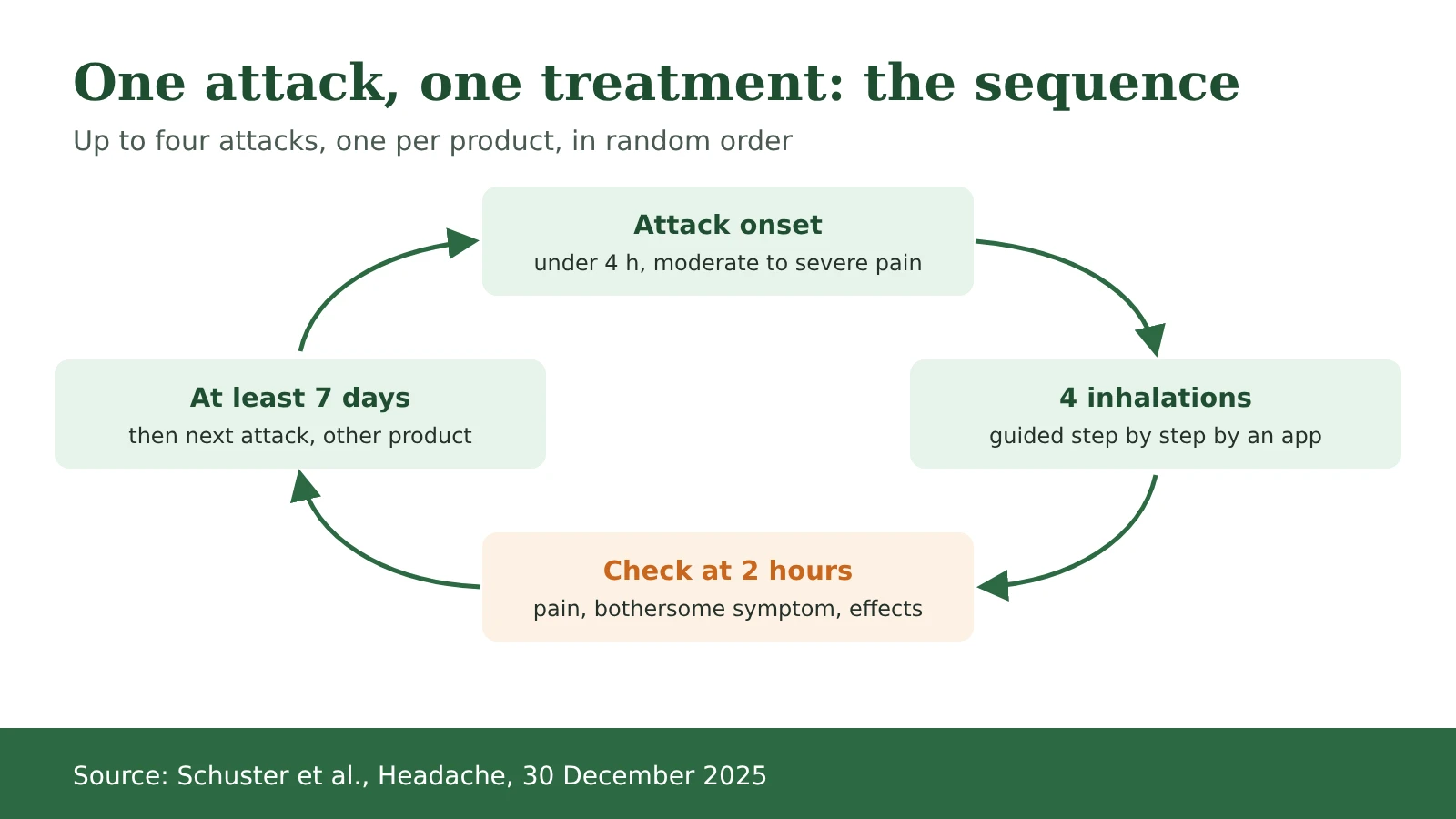
The trial was a crossover: each participant treated up to four attacks, one with each flower, in a randomly drawn order, at least seven days apart. It was double-blind: neither participants nor researchers knew which product was being used. Within four hours of the start of a moderate or severe attack, an app guided four inhalations with a portable vaporiser set to 180 °C. No other treatment was allowed for two hours.
Results at 2 hours, arm by arm
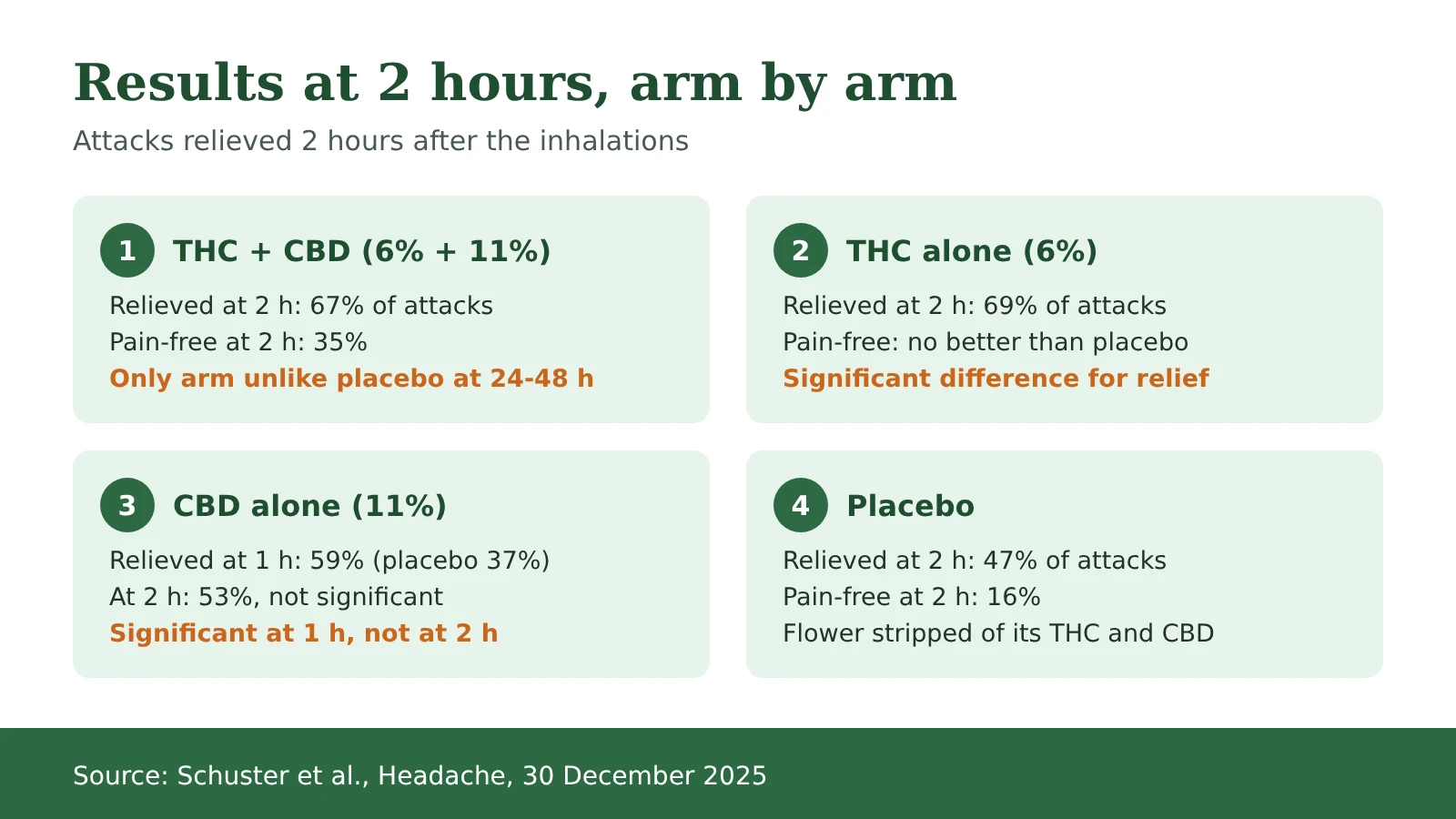
At 2 hours, attacks treated with the THC + CBD combination had been relieved in 67% of cases, versus 47% with placebo. Pain had gone in 35% of attacks versus 16%, and the most bothersome symptom in 60% versus 34%. All three differences are statistically significant, meaning they are unlikely to be due to chance.
The primary outcome was relief: going from moderate or severe pain to mild or no pain. The two other outcomes were pain freedom and disappearance of the most bothersome symptom (light, sound or nausea), chosen before treatment. In all, 73 participants treated 247 attacks. Results were similar with all three calculation methods planned by the authors.
In a subgroup analysis, pain had gone at 2 hours with the combination in a similar proportion of attacks among people with episodic migraine and among those with chronic migraine (34% and 37%).
With the THC-dominant flower, 69% of attacks had been relieved, a significant difference from placebo; pain freedom and disappearance of the bothersome symptom were, however, no more frequent. With the CBD-dominant flower, none of the three outcomes differed significantly from placebo at 2 hours.
| Trial arm | Flower composition | Pain relieved at 2 h | Better than placebo at 2 h? |
|---|---|---|---|
| THC + CBD | 6.16% THC and 10.77% CBD | 67% of attacks | Yes, on all three outcomes |
| THC alone | 5.62% THC and 0.03% CBD | 69% of attacks | Yes, for relief only |
| CBD alone | 11.27% CBD and 0.35% THC | 53% of attacks | No at 2 h (yes at 1 h) |
| Placebo | Less than 0.025% THC and 0.14% CBD | 47% of attacks | Point of comparison |
At 1 hour, then at 24 and 48 hours
At 1 hour, attacks were relieved more often than with placebo in all three active arms: 66% with THC alone, 59% with CBD alone, 54% with the combination, versus 37%. With CBD alone, the most bothersome symptom had also gone more often (41% versus 22%). For this arm, the difference was no longer significant at 2 hours.
Over time, only the combination differed from placebo. At 24 hours, pain was still absent, with no recurrence and no rescue medication, in 28% of attacks versus 11%. The most bothersome symptom was still absent in 46% of attacks at 24 hours (versus 25%) and in 40% at 48 hours (versus 18%).
At the outset, sensitivity to light and sound was present in 92% and 87% of attacks. With the combination, it eased more often than with placebo, which was not the case for nausea, which also eased considerably with placebo. The authors conclude that the observed difference is not explained solely by the known anti-nausea effect of THC.
Side effects and psychoactive effects
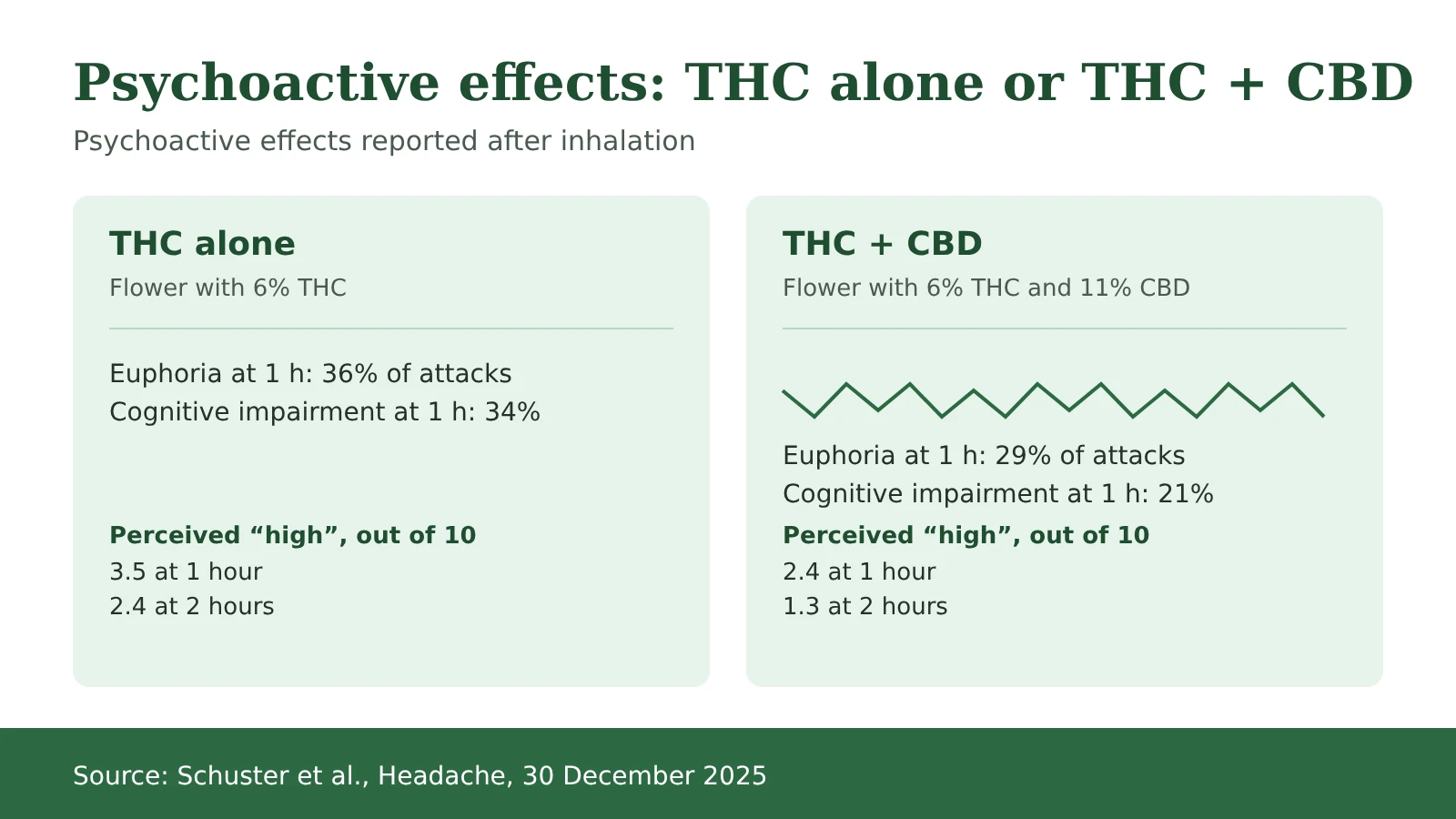
No serious side effects were reported in any arm. One hour after the inhalations, the perceived psychoactive effect (the “high”), rated from 0 to 10, averaged 3.5 with THC alone, 2.4 with the combination, 1.5 with CBD alone and 0.6 with placebo. According to the authors, the value recorded with the combination is roughly half of what participants in other studies report when using cannabis freely. Euphoria and cognitive impairment followed the same order. Drowsiness was common in all arms, placebo included.
The authors attribute the difference between THC alone and the combination to the action of CBD on the CB1 receptor, which is thought to attenuate the psychoactive effects of THC. Blinding was broadly maintained, and the results remained significant once euphoria and the “high” were taken into account in the calculations.
What the trial shows and does not show
The trial shows that, in these participants and with the dose tested, attacks treated with the THC + CBD combination were relieved more often than with a placebo at 2 hours, with differences still measurable at 24 and 48 hours. It shows no significant difference at 2 hours for the CBD-dominant flower. The authors point out their own limitations: a single centre, a single THC and CBD content, a research-grade cannabis without terpenes, unlike products used in practice, and selected participants, not necessarily representative.
The trial covered a single dose per attack. It provides no information on repeated use: medication-overuse headache, cannabis use disorder, effects on memory or mental health. The authors call for multi-centre trials and long-term follow-up.
Point to watch
Cannabis was compared with a placebo, not with usual migraine treatments. The trial used dried flowers containing THC, heated in a medical vaporiser, not vaping liquids.
And in Switzerland?
The preparations tested (research cannabis flowers supplied by NIDA, vaporised at 180 °C, two of which contained about 6% THC) bear no comparison with the CBD products sold freely in Switzerland, which are not medicines: in Switzerland, cannabis with 1% total THC or more is classed as a narcotic, and its non-medical use is prohibited (see what the 1% threshold measures). Freely sold CBD products fall under other laws, set out in our guide to Swiss legislation.
For medical use, doctors have been able since 1 August 2022 to prescribe cannabis-based medicines without an exceptional authorisation from the Federal Office of Public Health (FOPH); Swissmedic oversees production and trade, and basic health insurance reimburses them only in exceptional cases. The blood THC limit for driving is also set at 1.5 µg/L (see travelling and driving with CBD).
In summary
In this first randomised placebo-controlled trial, migraine attacks treated with four inhalations of a flower with 6% THC and 11% CBD were relieved more often than with placebo at 2 hours (67% versus 47%), and pain went more often (35% versus 16%), with differences still measurable at 24 and 48 hours. No serious side effects were reported, and the perceived “high” was lower than with THC alone. With the CBD-dominant flower, the difference from placebo was significant at 1 hour, but not at 2 hours. Obtained at a single centre with a single dose of a cannabis containing THC, these results remain to be confirmed in several centres and over the long term.
What the science says
Independent summary of a scientific publication. It does not describe The Green Lab products and is not health advice.
Frequently asked questions
What did the trial measure with the CBD-dominant flower?
At 1 hour, 59% of attacks treated with the CBD-dominant flower were relieved, versus 37% with placebo, and the most bothersome symptom had gone in 41% of attacks versus 22%. At 2 hours, the primary outcome, the difference was no longer significant: 53% of attacks relieved versus 47%. A single dose was tested, at a single centre.
What does the trial show for the THC + CBD combination?
With the combination, attacks were relieved more often than with placebo on all three outcomes measured at 2 hours, with differences still visible at 24 and 48 hours and fewer psychoactive effects than with THC alone. Main limitation: a single centre and a single dose of a research cannabis containing THC, with no comparison against usual treatments.
What is a double-blind crossover trial?
In a crossover trial, each participant receives the treatments being compared one after another, in a randomly drawn order, and so serves as their own point of comparison. In a double-blind trial, neither the participant nor the researchers know which product is being used, which limits the influence of expectations. Here, at least seven days separated two treatments.
What side effects were observed?
No serious side effects. The arms containing THC caused more euphoria, cognitive impairment and perceived psychoactive effect, especially THC alone: 3.5 out of 10 at 1 hour, versus 2.4 with the combination and 0.6 with placebo. Drowsiness was common in all arms.
Is this cannabis available in Switzerland?
Not on open sale. The flowers with 6% THC tested exceed the 1% total THC threshold: in Switzerland, they are narcotics, prohibited outside medical use. Since 1 August 2022, a doctor can prescribe cannabis-based medicines without an exceptional authorisation from the FOPH. Reimbursement remains exceptional.