Understanding a study on CBD is not always easy. In our “What the science says” series, we summarise studies published around the world and always present them in the same way, so that anyone can read them. This page explains why we do it, how each article is built and how to read a study, then brings all our summaries together.
| The series at a glance | |
|---|---|
| What it is | A blog series that summarises and explains recent scientific studies on CBD or cannabis |
| Where the studies come from | Scientific journals from around the world, reviewed by other researchers before publication |
| What you will find | The key points of the study, its fact sheet, its results explained, its level of evidence out of 4 and its limitations |
| What it is not | Neither health advice nor a description of The Green Lab products |
| Languages | French, English and German |
On this page
- Why this series?
- How we present each study
- Reading the study fact sheet
- The types of study we summarise
- The level of evidence out of 4
- How to read a study on CBD
- A study does not describe a product on the market
- The Swiss and European framework
- The topics in detail
- Further reading on our blog
- In summary
- Frequently asked questions
Why this series?
On CBD, you read everything and its opposite: spectacular promises on one side, distrust on principle on the other. To see clearly, the simplest way is to go back to the studies themselves.
The problem is that a scientific study is long, written in English and full of technical terms. Nearly a thousand publications on CBD appeared in 2026 alone, and they do not all carry the same weight.
Our series does this reading for you. We choose recent studies, carried out in the United States, Europe, Australia or Switzerland, read them in full and explain them simply. Article after article, this shows where the science stands: what is established, what remains a lead, and what no one has measured yet.
How we present each study
All the articles in the series follow the same plan. Once you know it, you quickly find the information you are looking for.
| Part of the article | What you will find |
|---|---|
| The introduction | The key points in a few lines: the question asked, who took part, the main result |
| The study fact sheet | The study’s identity card: journal, date, authors, country, study type, funding, level of evidence, link to the original |
| The results | What was measured, explained simply and illustrated with diagrams |
| What the study shows and does not show | The study’s limitations, gathered in one place |
| And in Switzerland? | What the topic changes, or does not change, within the Swiss framework |
| Frequently asked questions | Short answers to the questions people ask most often |
Why this plan? Because a result without its context can mislead. By always putting the fact sheet, the level of evidence and the limitations in the same place, we show what the study brings without exaggerating or downplaying it.
Reading the study fact sheet
The fact sheet, at the top of each article, tells you at a glance what you are dealing with:
- The journal: the scientific journal that published the study. The studies we select were reviewed by other researchers before publication.
- The authors and the country: who carried out the study, and where. Results often depend on the country and the participants.
- The study type: survey, trial, review… This is the most important information, because it tells you what the study can show.
- The funding: who paid. Funding from a manufacturer does not invalidate a study, but it should be known.
- The level of evidence: our score out of 4, explained below.
- The full text: the link to the original publication, for anyone who wants to go further.
The types of study we summarise
The type of study tells you what a publication can show. A survey describes habits; only a controlled trial can measure an effect, by comparing a group that receives the product studied with a group that receives a placebo.
| Study type | What it provides | Example in the series |
|---|---|---|
| Expert opinion, letter | Reviews existing studies, without new data | Cannabis and sleep after 50 |
| Survey | Describes who uses CBD and how; measures no effect | CBD users in the UK |
| Meta-analysis of surveys | Pools surveys to estimate the share of users | CBD use in Europe and North America |
| Observational study | Compares existing groups; shows an association, not a cause | Cannabis and testosterone, UNIGE-SCAHT study |
| Systematic review | Gathers all the studies on a question, using a method set in advance | CBD and drug tests |
| Randomised controlled trial | Compares a product with a placebo, assigned at random | Migraine and vaporised cannabis |
We favour studies carried out in humans. Studies on cells or animals are only cited to place a line of research in context, never as a result that applies to humans. When a study finds no effect, we say so as clearly as when it finds one.
The level of evidence out of 4
Each study fact sheet in the series gives a level of evidence scored from 1 to 4. This is our reading, not an official scale: it takes into account the type of study, its size, whether there is a placebo group and how consistent the results are.
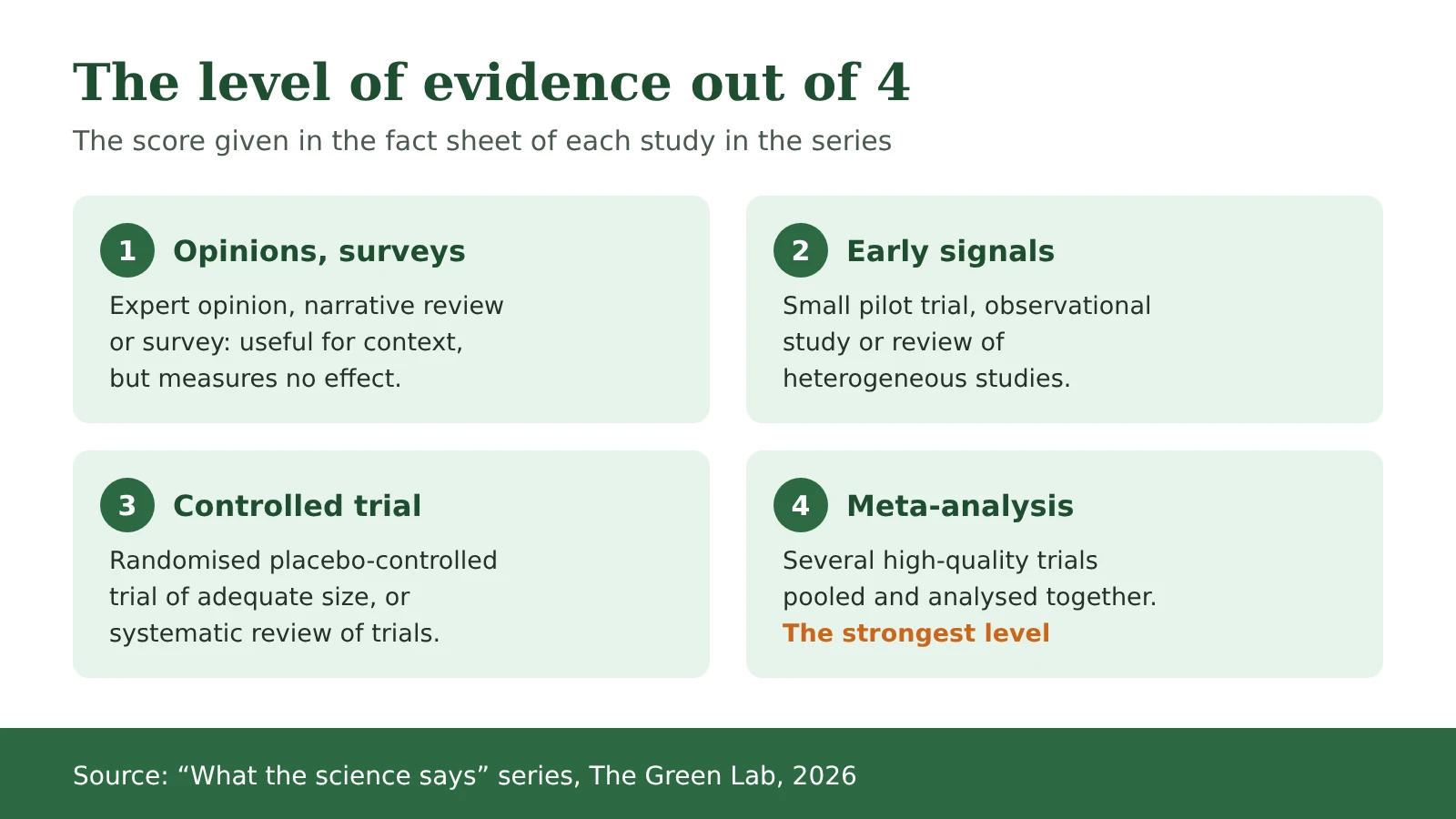
This level does not judge the quality of the researchers’ work. A well-conducted national survey stays at level 1 because it measures no effect; a placebo-controlled trial can score 3 out of 4 and still be small, run in a single centre or with a single dose. The fact sheet explains the score in one sentence each time.
How to read a study on CBD
Before you rely on a result, four questions are enough to put it in context.
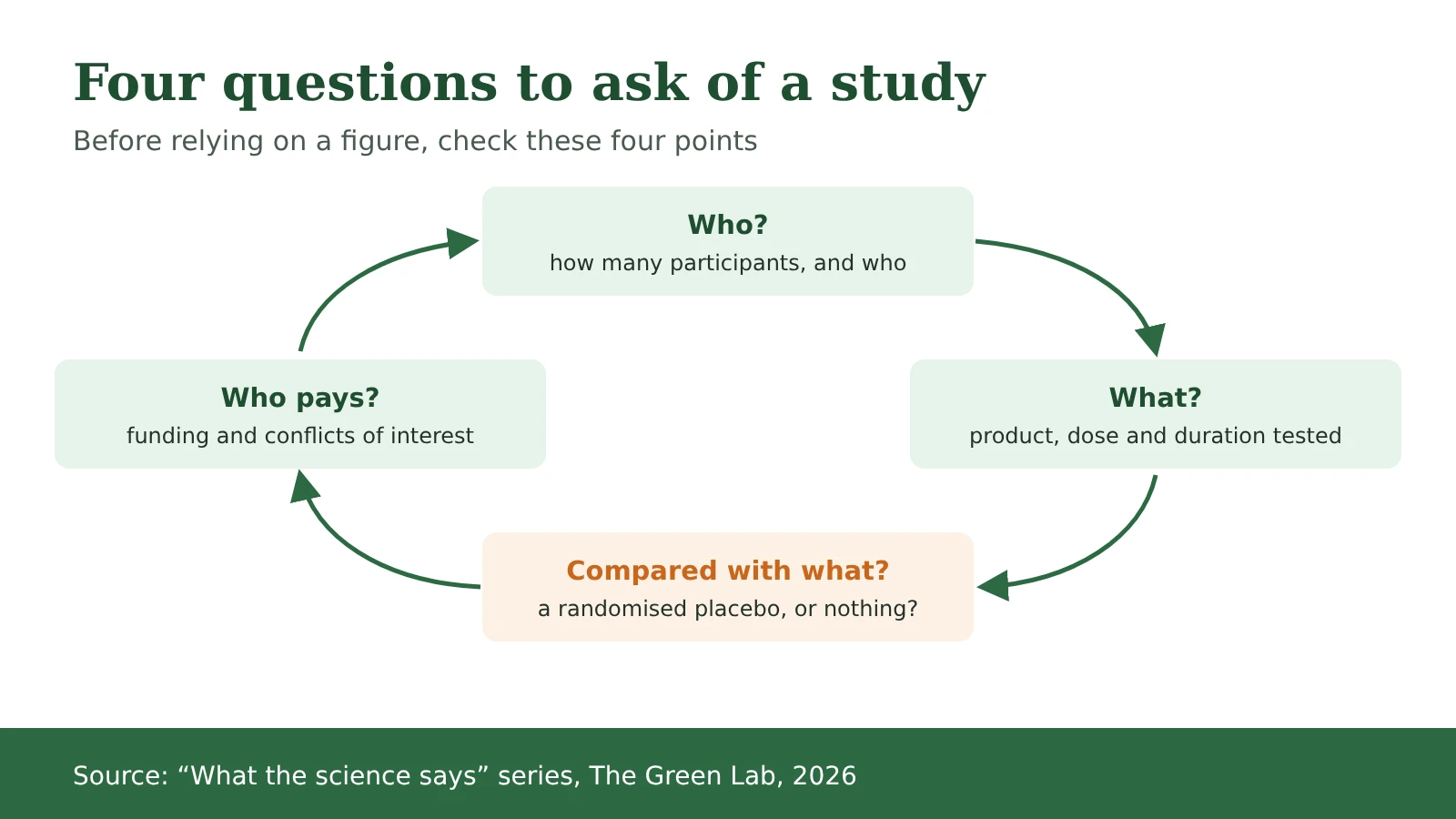
- Who took part? How many people, and who. With around twenty participants, a difference can appear by chance; with thousands, the result is more stable. Healthy volunteers do not necessarily react like patients.
- What was tested? CBD alone, CBD with THC, or cannabis? In what form, at what dose and for how long? These details change everything.
- Compared with what? This is the decisive question. Part of the improvement comes simply from being followed up: this is the placebo effect. Only the difference from a placebo group, assigned at random, measures the effect of the product studied.
- Who pays? The funding and any conflicts of interest are stated in the fact sheet.
- What does “significant” mean? A statistically significant difference is unlikely to be due to chance. That does not necessarily make it important: a small difference can be significant yet barely noticeable in everyday life.
Two reflexes complete these questions: go back to the original publication rather than a press article, and do not confuse a study with an agency opinion, which belongs to regulation.
A study does not describe a product on the market
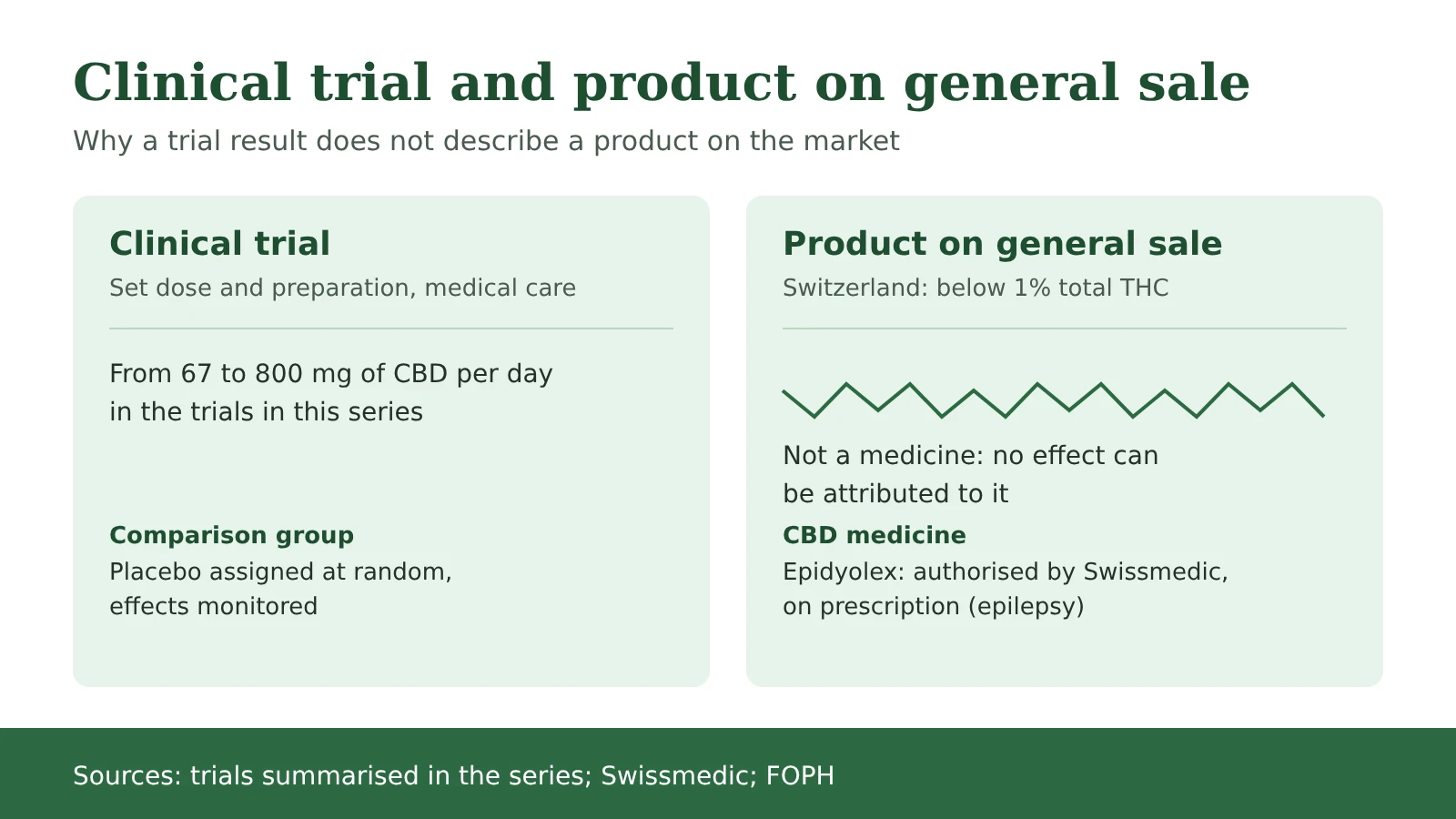
Clinical trials use specific preparations, often at high doses set by the protocol, with medical follow-up. Their results apply to those conditions. They bear no comparison with the CBD products on general sale in Switzerland, which are not medicines.
CBD is broken down by liver enzymes (CYP2C19 and CYP3A4) that are also used to eliminate many medicines: taking it alongside a treatment is something to discuss with your doctor.
The Swiss and European framework
In Switzerland, products containing 1% total THC or more are narcotics. CBD products on general sale stay below this threshold. A product presented as having an effect on a disease or symptom becomes a therapeutic product, requiring authorisation from Swissmedic: this is the case of Epidyolex, a CBD medicine authorised on prescription for certain forms of epilepsy.
In the European Union, the European Food Safety Authority (EFSA) set a provisional safe daily intake for pure CBD in food supplements in February 2026: about 2 mg per day for a 70 kg adult. This opinion falls under European food law, not Swiss law.
The topics in detail
All the studies summarised so far, with their country of origin, type and level of evidence:
| Study summarised | Country | Study type | Evidence |
|---|---|---|---|
| Cannabis and sleep after 50 | United States | Expert opinion | 1 of 4 |
| CBD: panacea, placebo or problem? | United States | Expert opinion | 1 of 4 |
| How many people use CBD? | Spain | Meta-analysis of 43 surveys | 2 of 4 |
| Migraine and vaporised cannabis | United States | Randomised controlled trial | 3 of 4 |
| Can CBD make a drug test positive? | Turkey | Systematic review of 12 studies | 2 of 4 |
| Recovery after intense exercise | United States | Placebo-controlled pilot trial | 2 of 4 |
| Does CBD lower blood pressure? | United Kingdom | Review of 4 controlled trials | 3 of 4 |
| Neuropathic pain and high-dose CBD | Australia | Randomised controlled trial | 3 of 4 |
| Who uses CBD in the UK? | United Kingdom | Official survey | 1 of 4 |
| Cannabis and testosterone, UNIGE-SCAHT study | Switzerland | Observational study | 2 of 4 |
The list grows with each new summary.
Further reading on our blog
The “What the science says” series complements the guides on our blog, which explain the plant, the law and the products without discussing health. A few starting points:
- The state of research: scientific research on CBD, where the literature stands in 2026
- The molecule: CBD (cannabidiol): history, structure and origin in the plant
- The other hemp compounds: hemp cannabinoids, from CBG to CBN and terpenes and flavonoids
- The law: CBD in Switzerland, what the law says product by product, what the 1% THC threshold really measures and travelling and driving with CBD
- Use: using a CBD product according to its form
All our articles, sorted by theme, are gathered on our blog home page.
In summary
You can read a study on CBD through four questions: who took part, what was tested, compared with what, and who paid for it. The type of study and the level of evidence then tell you how much weight to give it. Our series applies this method to every summary, to show where the science stands without promises or rejection on principle. It is not health advice and does not discuss our products.
What the science says
Independent summaries of scientific publications. They do not describe The Green Lab products and are not health advice.
Frequently asked questions
What is the “What the science says” series?
It is a series on our blog that summarises and explains recent scientific studies on CBD, published around the world. Each article follows the same plan: the key points, the study fact sheet, the results, the level of evidence out of 4 and the limitations. It does not give health advice and does not discuss our products.
How do you read a study on CBD?
Ask four questions. Who took part, and how many people? What was tested, in what form and at what dose? Is the result compared with a placebo group assigned at random? Who funded the study? Then check the type of study: a survey describes habits, and only a controlled trial can measure an effect.
What does the level of evidence out of 4 mean?
It is the score given in the fact sheet of each study in the series. Level 1 covers expert opinions and surveys, level 2 small trials and observational studies, level 3 adequately sized controlled trials and systematic reviews, and level 4 meta-analyses of good-quality trials. It is our reading, not an official scale.
Why does a trial result not apply to products on general sale?
Trials use specific preparations, often at high doses set by the protocol, with medical follow-up. Their results apply to those conditions. CBD products on general sale in Switzerland are not medicines, and no effect can be attributed to them on the basis of a study.
What is a placebo group, and why does it matter?
A placebo group receives a product that looks identical, but without the substance being studied. Participants are assigned at random and, in a double-blind trial, neither they nor the researchers know who receives what. Part of the improvement comes simply from being followed up: only the difference from this group measures the effect of the substance.