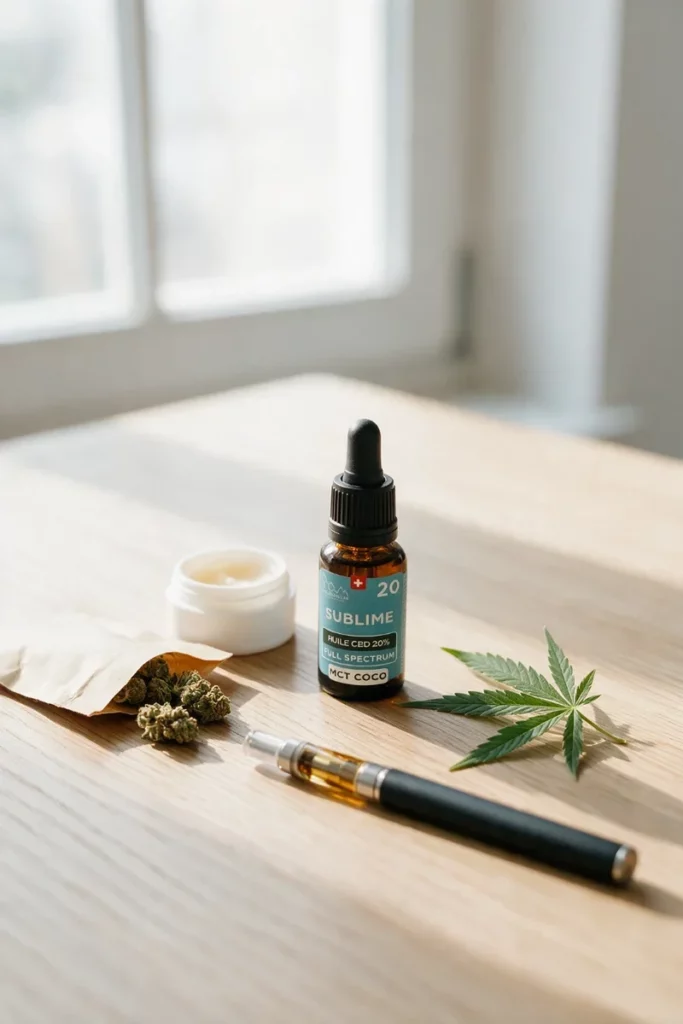
A CBD product is used according to the category under which it is sold. An oil declared as a cosmetic is applied to the skin, a flower or a piece of hash is a product for smoking, and a cartridge or an e-liquid is vaporised in a device designed for it. The packaging and the product’s legal framework are what tell you how to use it.
On this page
- One product, one framework, one intended use
- CBD oils: a cosmetic, so for use on the skin
- CBD balms: a texture, a gesture
- Flowers and hash: products for smoking or heating
- Vapes: cartridge, battery, e-liquid, booster and distillate
- Storing your CBD products
- In-depth topics
- Beyond the gesture: composition
- Frequently asked questions
One product, one framework, one intended use
In Switzerland, CBD has no status of its own. Every product that contains it is attached to a category (cosmetic, product for smoking, electronic cigarette), and that category sets the intended use, what the label must say and who the product may be sold to. The 1% total THC threshold applies to all of them; everything else depends on the use, as our guide to Swiss CBD law explains.
| Product | Framework | Intended use | What to look at |
|---|---|---|---|
| CBD oil | Cosmetic | Application to the skin | Intended use, directions, period after opening |
| CBD balm | Cosmetic | Application to the skin | Ingredients, date or period after opening |
| Flowers and hash | Herbal product for smoking | Smoking or heating, 18 and over | Warnings, variety, growing method |
| Cartridge | Electronic cigarette | Vaporising on a compatible battery, 18 and over | Capacity, thread, CBD content |
| E-liquid and booster | Refill liquid | Vaporising in a refillable e-cigarette, 18 and over | CBD content, capacity, warning |
| Distillate | Vaping product, presented like e-liquids | Vaporising in a device for concentrates, 18 and over | CBD content, storage |
This table shows why two products containing the same molecule are not used in the same way. An oil and an e-liquid can start from a comparable extract, but one is a cosmetic and the other a vaping liquid: their rules, their labelling and their buyers differ.
CBD oils: a cosmetic, so for use on the skin
Our CBD oils are declared as cosmetics. A cosmetic is used on the skin, so for a CBD oil, application to the skin is the intended use.
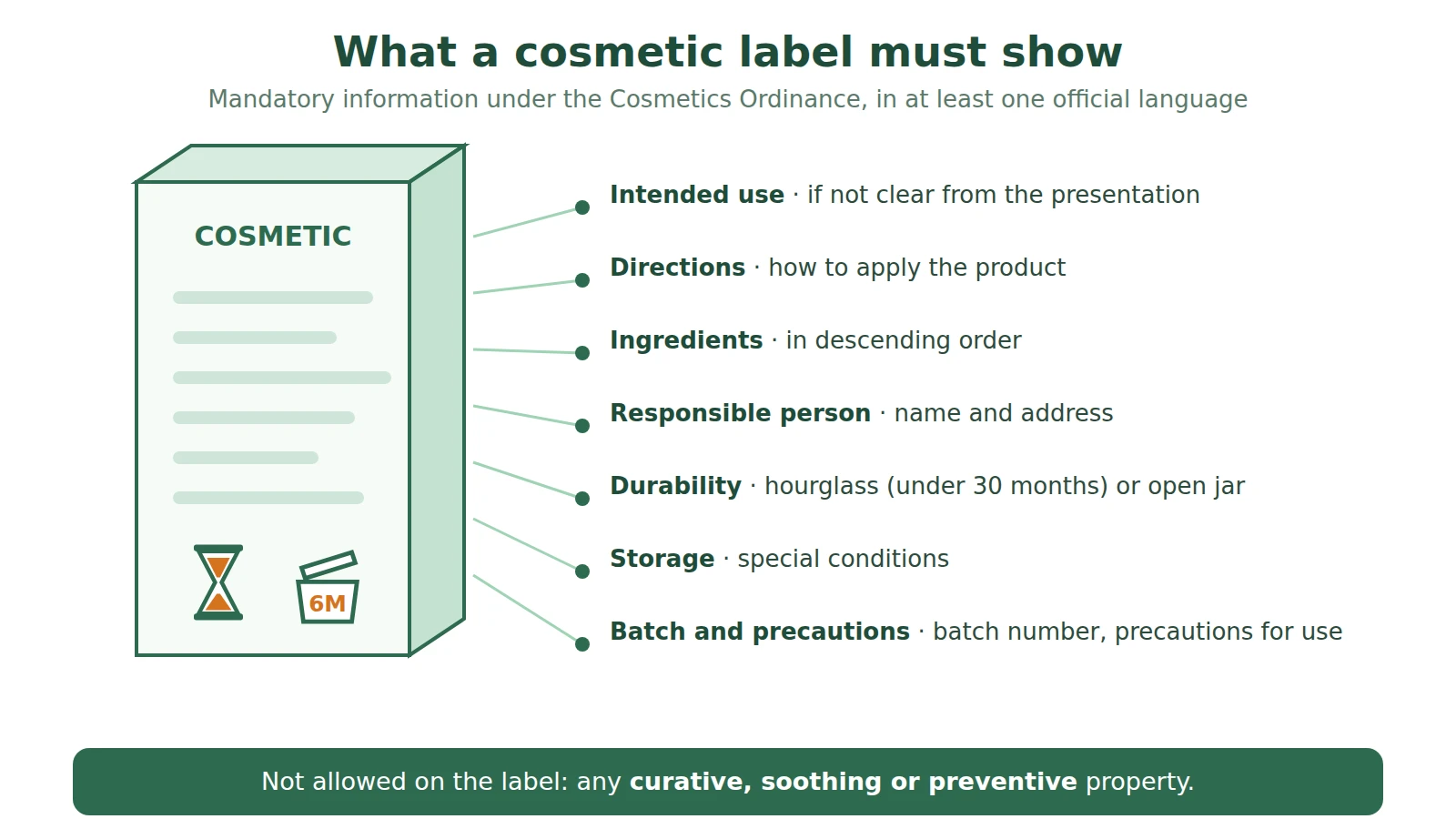
This status requires precise labelling, set by the Swiss Cosmetics Ordinance and summarised in the cantonal laboratories’ guidance sheets. The packaging must show, in at least one official language:
- the intended use, where it is not clear from the way the product is presented;
- the list of ingredients, preceded by the word “Ingredients”, in descending order;
- the name and address of the person responsible for placing the product on the market;
- durability: a “best before end” date if the product keeps for less than 30 months, otherwise an open-jar symbol followed by a period in months;
- any special storage conditions, the batch number and precautions for use.
In everyday use, two of these items matter more than the others. The directions for use tell you how to apply the product, and the period after opening tells you how long it keeps its qualities once opened. The label of a cosmetic may not, however, attribute any curative, soothing or preventive property to the product.
Two figures then set one oil apart from another. The percentage gives the amount of CBD: on our bottles it is expressed as mass per volume, so an oil at 20% contains 200 mg of CBD per millilitre, or 2,000 mg in a 10 ml bottle. Our article CBD oil at 10, 20 or 45%: how to read a concentration explains this in detail.
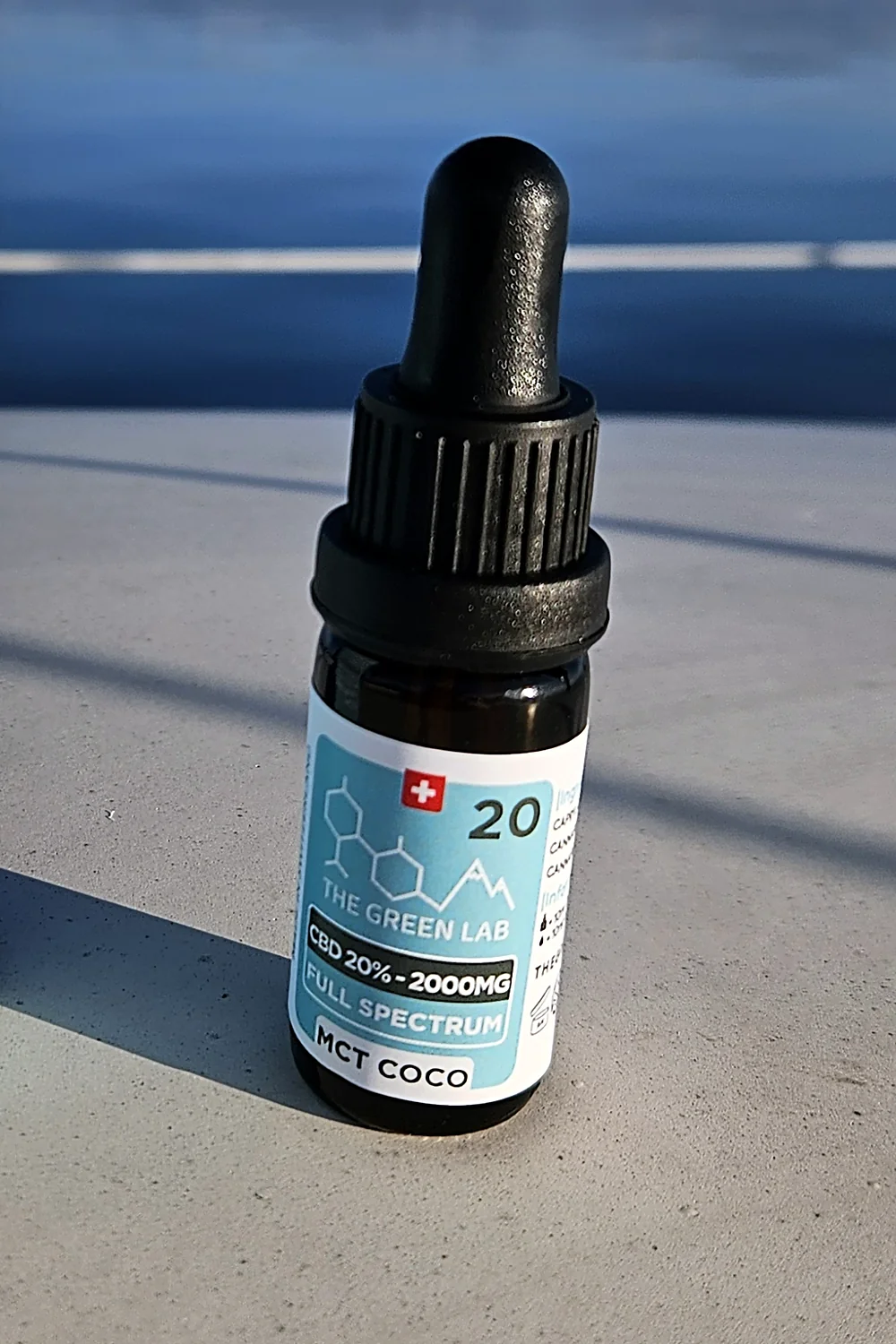
The carrier oil gives the product its texture on the skin. MCT coconut oil is the most fluid, hemp seed oil slightly thicker, olive oil thicker still. It also sets a ceiling: our most concentrated oil, the X-Strong at 45%, is made with MCT coconut oil because it is the base that dissolves the most CBD. The role of the carrier oil is covered in a separate article.
Our range falls into three families: Sublime on MCT coconut oil and Hemp on hemp seed oil, both Full Spectrum, and Broad Spectrum, mostly on olive oil. They are all on our CBD oils page, and our guide to choosing a Swiss CBD oil compares concentrations and spectrums.
CBD balms: a texture, a gesture
A CBD balm is a cosmetic too, but its form changes the way it is used. A balm usually combines plant waxes and butters with oils: it stays solid at room temperature and melts on contact with the skin. You take a little with your fingertips and work it in with a light massage on the chosen area.
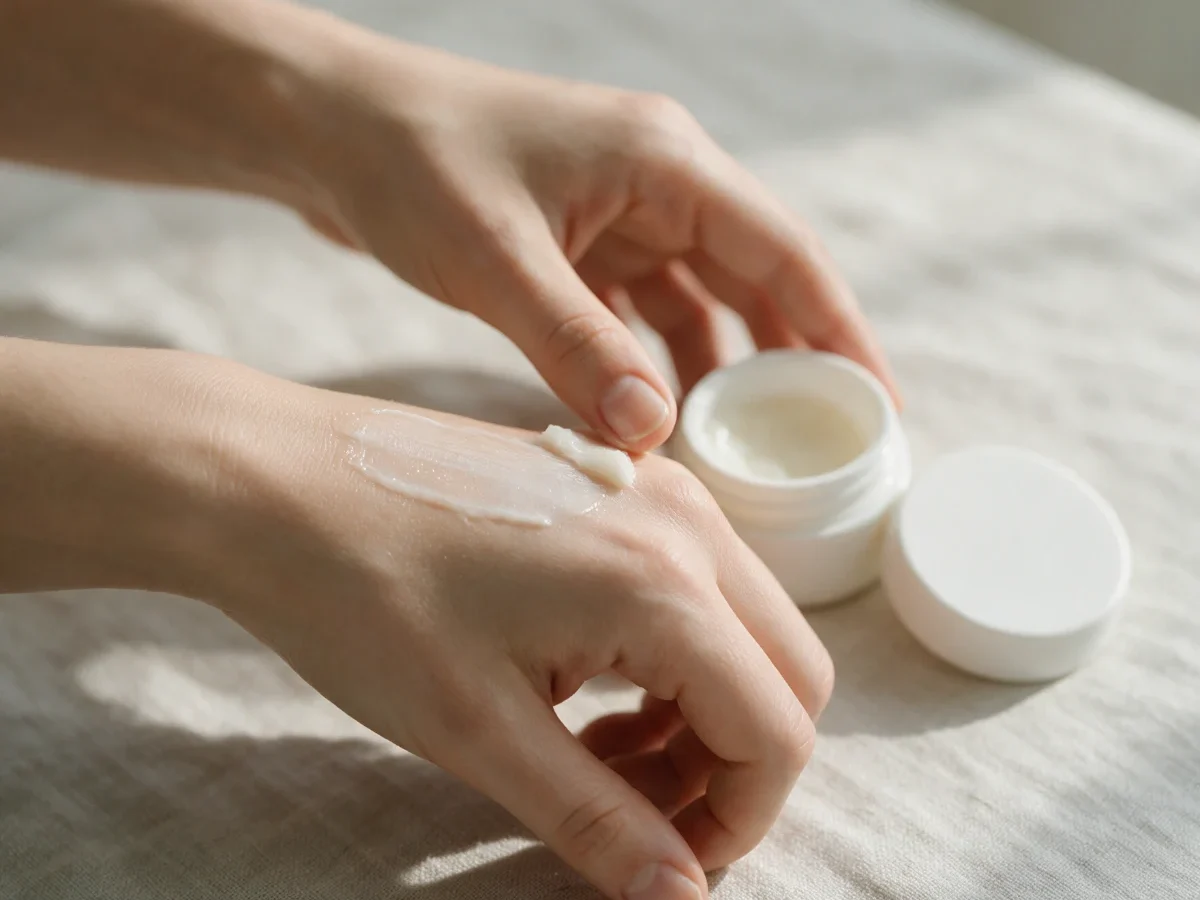
The same labelling rules apply: intended use, ingredients, durability, batch number and responsible person. As with an oil, no curative or soothing property may be attributed to it.
A jar is opened often and touched with the fingers. Clean hands, a lid closed after each use and respect for the period after opening keep it from deteriorating. Our balms are not made in our laboratory in Gland, unlike our oils.
Flowers and hash: products for smoking or heating
CBD flowers and hash are not cosmetics. They fall under the Federal Tobacco Products Act, which since 1 October 2024 has covered herbal products for smoking, even without tobacco or nicotine. They must contain less than 1% total THC and may only be sold to people aged 18 or over, in shops and online.
This framework provides for two ways of using them: smoking them, or heating them in a dry herb vaporiser, which brings them to a temperature high enough to release their volatile compounds without burning them. Their packaging carries official warnings in French, German and Italian. One of them concerns driving: the product may impair your ability to drive. Our article on travelling and driving with CBD explains what this warning means.
The other obligations under the Act (notification to the Federal Office of Public Health, advertising rules, cantonal sales licences) are set out in our article on the Tobacco Products Act. Sold without tobacco, CBD flowers are also exempt from tobacco tax.
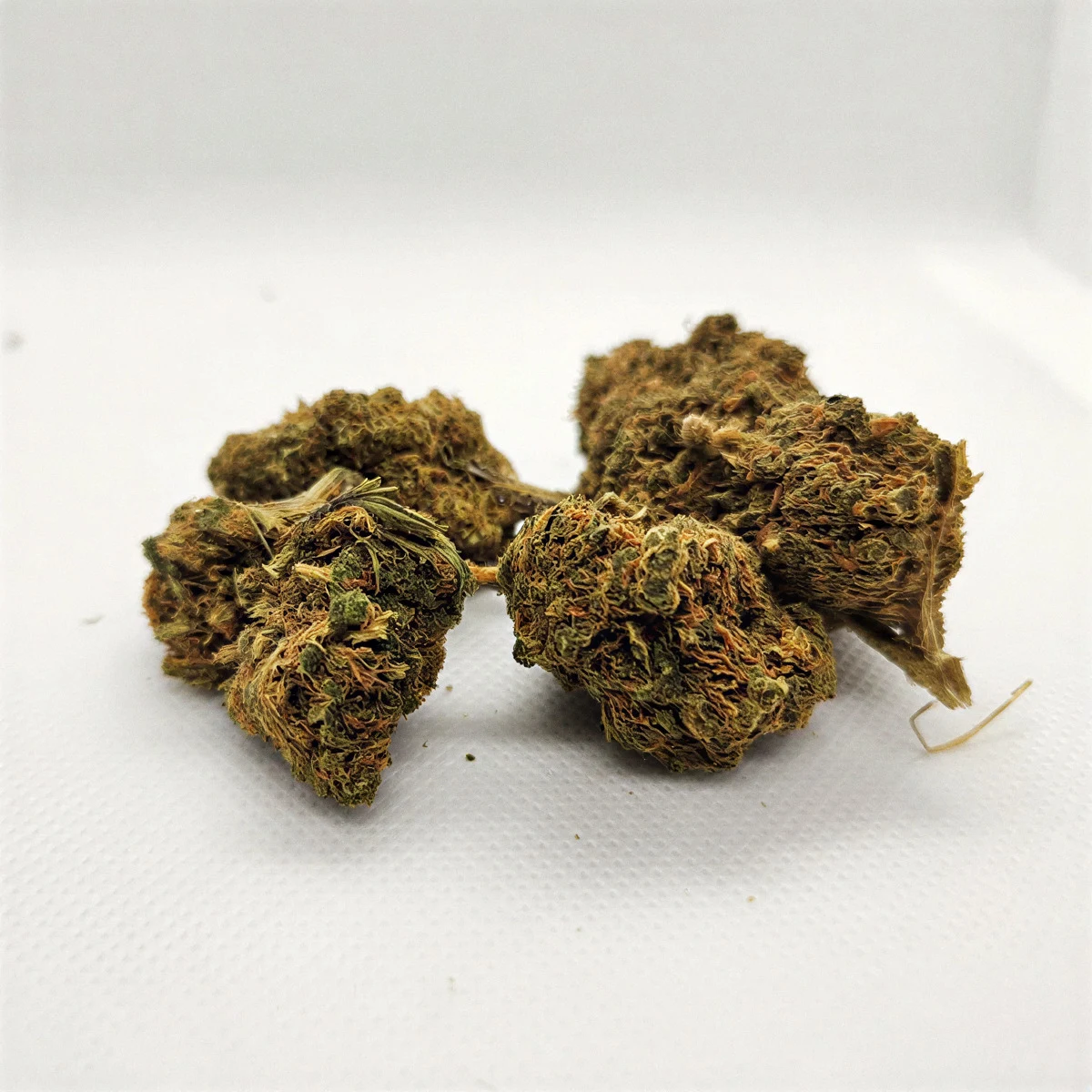
To choose a flower, the product page gives the variety and the growing method: indoor, greenhouse or outdoor. Growing conditions change the flower’s appearance, its density and its aroma profile. Our CBD flowers are sorted by this criterion.
Hash is made from the resin of the flowers, separated from the plant and then pressed. Depending on the method (dry sifting, ice water extraction, pollen), its texture ranges from crumbly to compact, and its aroma changes with it.
Vapes: cartridge, battery, e-liquid, booster and distillate
CBD vapes also fall under the Tobacco Products Act, whether or not they contain nicotine. They are reserved for people aged 18 or over, notified to the Federal Office of Public Health, and come with a leaflet in three languages and an official warning.
A cartridge is a small 1 ml tank holding a liquid with 50% CBD, like our 1 ml Broad Spectrum cartridge. It has a mouthpiece at one end and, at the other, an atomiser with a standard screw thread known as 510. It screws onto a battery with the same thread, such as our 900 mAh cartridge battery, which charges via a USB cable and works with a single button. Once the cartridge is empty, you replace it and keep the battery.
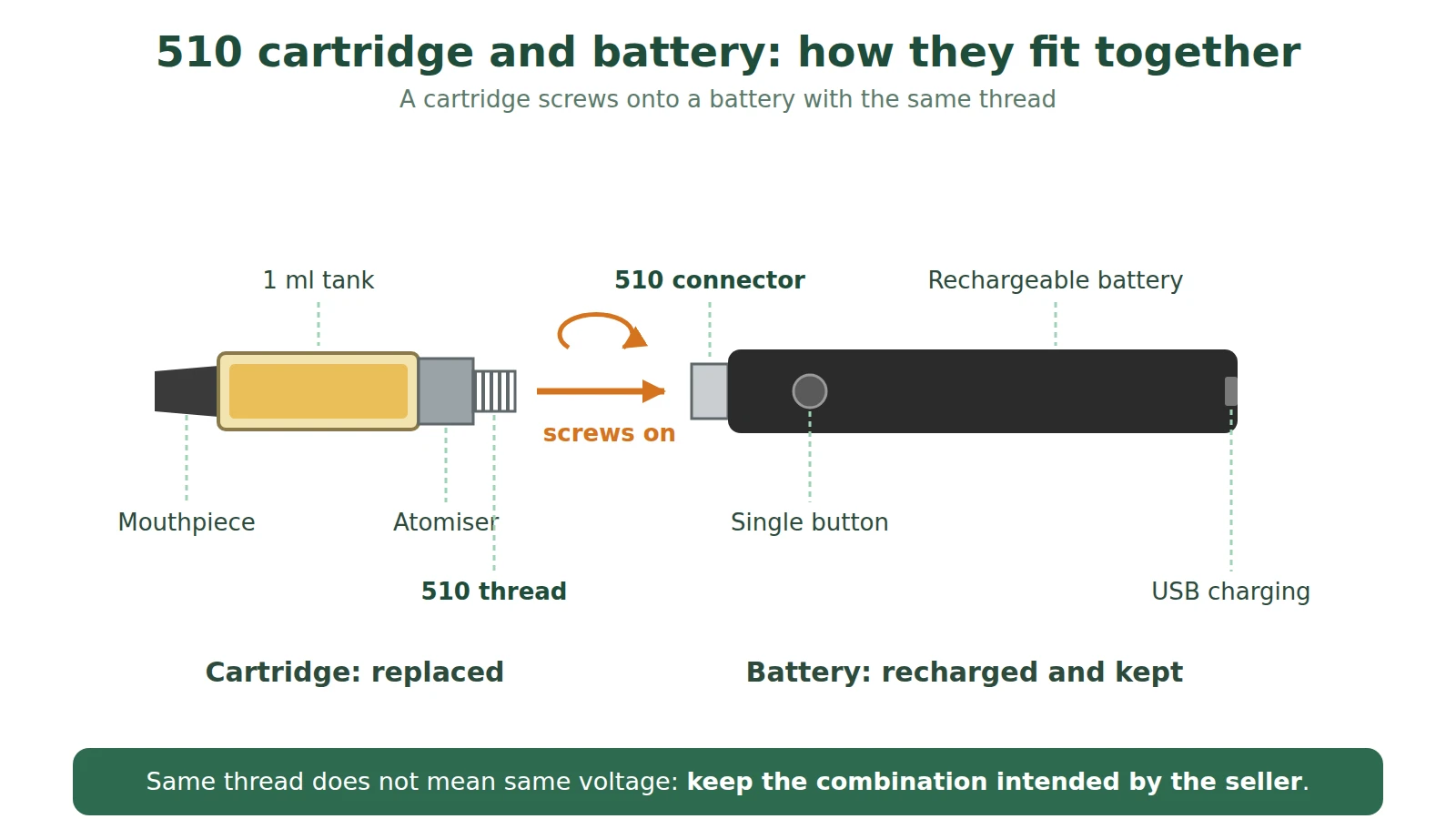
The 510 thread is very common, but battery voltage and shape vary from one model to another. The combination intended by the seller remains the safest.
E-liquids are poured into the tank of a refillable electronic cigarette. Ours contain 5% CBD and come in 10 and 30 ml, like the Stonerstyle Amnesia e-liquid. If you prefer to keep your usual e-liquid, the 30% CBD e-liquid booster raises its CBD content: it is mixed into a nicotine-free e-liquid and has a neutral taste.

The yellow distillate with 89% CBD is a concentrate intended for vaporisation, in a device designed for concentrates. We present it like our e-liquids: a vaping product, reserved for adults.
A vape contains a battery. Every shop that sells batteries must take back used batteries free of charge, and electronic devices are taken back free of charge too, financed by an advance recycling fee. Disposable vapes, for their part, are banned in Geneva and Valais and subject to tobacco tax even without nicotine. With a cartridge and a rechargeable battery, only the cartridge is replaced. The whole range is on our CBD vapes page.
Storing your CBD products
Cannabinoids and terpenes break down under light, heat and oxygen. Our article on the stability of CBD and THC explains what temperature does to extracts. From one product to another, the rule varies little: away from light, away from heat, and tightly closed.
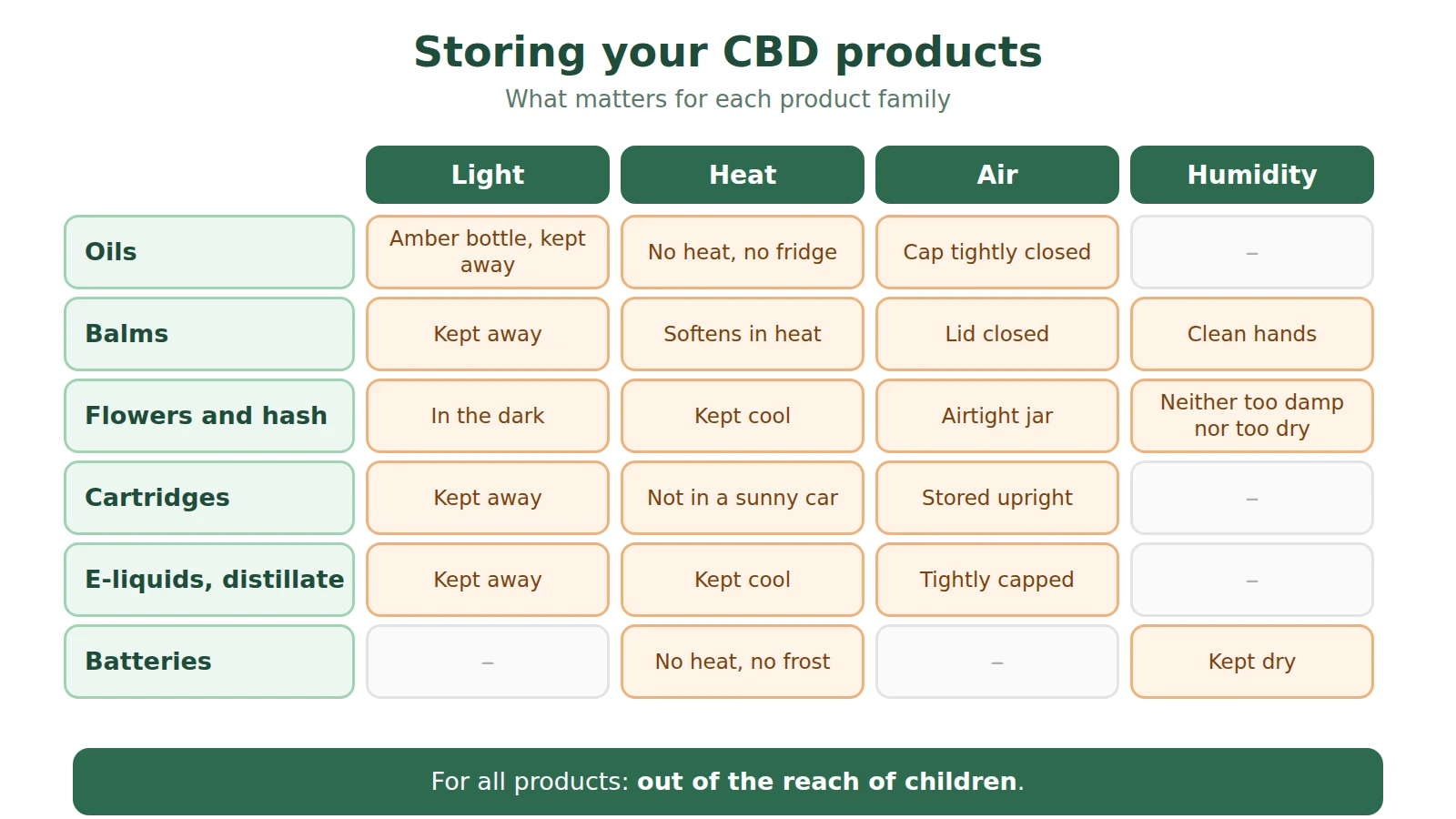
For an oil, the amber glass bottle already protects the contents from light. All that remains is to close it after use, keep it away from a radiator or a sunny window, and respect the period after opening. Cold does not suit it either: below 15 °C, an oil rich in CBD can crystallise, especially on hemp seed or olive oil. It is therefore not kept in the fridge and not left in a car in winter. Crystals redissolve if the tightly closed bottle is warmed in a water bath and shaken. Carrier oils do not all age at the same rate: hemp seed oil, richer in unsaturated fatty acids, is the most exposed to oxidation.
Flowers and hash keep best in an airtight jar, dry and in the dark. Too much moisture encourages mould; air that is too dry makes the flower brittle and costs it part of its aroma.
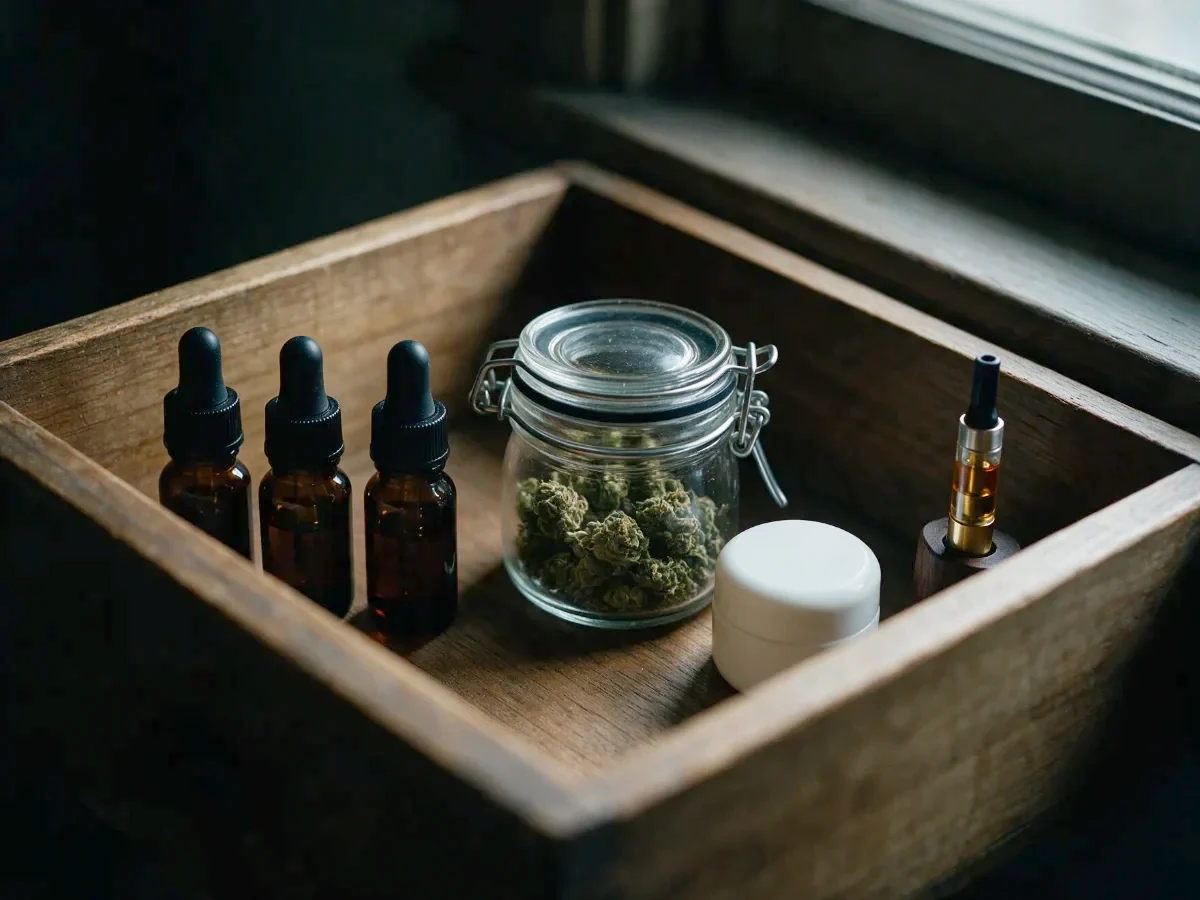
Cartridges are stored upright, mouthpiece up, at room temperature. A car in midsummer or a sunny windowsill does them no good. E-liquids and distillate are kept capped and away from light. Batteries cope poorly with both heat and frost, and should not be left charging unattended. A balm, finally, is most sensitive to heat, which softens it.
Point to watch
Keep each product’s packaging for as long as you use it: it carries the directions, the batch number and the period after opening. And keep all these products out of the reach of children.
In-depth topics
The label of a CBD cosmetic. Intended use, INCI list, hourglass or open jar, batch and responsible person: what the packaging of an oil or balm must show, and what it cannot say. Read the full article →
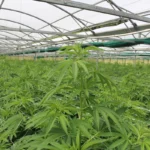
Flowers: indoor, greenhouse or outdoor. What the growing method changes in a flower’s density, colour and aroma, and how to read a flower page, with our 2017 greenhouse crops. Read the full article →
Hash: pollen, ice-o-lator, hot-pressed. How resin is separated from the plant and then pressed, and why the method decides texture and aroma. Read the full article →
Vapes: cartridge, 510 battery, e-liquid and booster. How these parts fit together, how to work out the content of a mix with the booster and what to do with used batteries. Read the full article →
CBD distillate at 89%. An extract purified by distillation, long sold under the name crumble, presented as a vaping product for adults. Read the full article →
Storing your products. Light, heat, cold, air and humidity: product by product, how to keep an oil, a flower, hash or a cartridge in good condition. Read the full article →
Beyond the gesture: composition
The framework decides how a product is used. What then sets two products of the same category apart is their composition. Two oils at 20% can have a very different character depending on the share of CBD, CBG, CBC and terpenes in the starting extract, and on the balance between these cannabinoids. It is this balance of ratios, more than the percentage on the label, that we work on in the laboratory.
Our laboratory
Our oils, cartridges and e-liquids are prepared in our laboratory in Gland, from crude extracts containing less than 1% total THC. Their cannabinoid levels are checked regularly by an external laboratory. Discover the laboratory →
Frequently asked questions
How is a CBD oil used?
Our CBD oils are declared as cosmetics: they are applied to the skin. You place the oil on the chosen area and work it in with a light massage, following the directions on the packaging. Each oil in our range comes with its directions for use.
Can you vape a CBD oil?
No. A cosmetic oil is formulated for the skin, in a vegetable oil that is not meant to be heated in an electronic cigarette. For vaping, there are products designed for that use: cartridges, CBD e-liquids, a booster to mix into a nicotine-free e-liquid, and distillate for concentrate devices.
Do you have to be 18 to buy CBD flowers or a vape?
Yes. Flowers, hash, cartridges, e-liquids and distillate fall under the Tobacco Products Act, which restricts their sale to people aged 18 or over, in shops and online. Our flowers, hash and vaping products are therefore reserved for adults.
Can you drive after using a CBD product?
Flowers and hash carry an official warning that the product may impair your ability to drive. Even below 1% total THC, a product for smoking can leave THC in the blood, and the limit used for driving is 1.5 micrograms per litre of blood. Our article on travelling and driving covers these rules in detail.
How should a CBD oil be stored?
Tightly closed, away from light, at room temperature, neither in the fridge nor in a car in winter: below 15 °C, an oil rich in CBD can crystallise, especially on hemp or olive oil. Once the bottle is open, the period after opening shown on the packaging applies. Of the carrier oils we use, hemp seed oil is the most sensitive to oxidation.
What should I do with a used vape battery?
Take it back to a shop. Every seller of batteries must take back used batteries free of charge, and electronic devices are taken back free of charge too, financed by an advance recycling fee. A battery does not go in the household bin. For empty cartridges, follow your municipality’s sorting rules.
Can I take my CBD products abroad?
The 1% total THC threshold only applies in Switzerland. Neighbouring countries apply other rules, often stricter ones, and some ban the sale of flowers. Before travelling, check the rules of your destination and of any country you pass through; our article on travelling and driving gives an overview.