CBD is now sold in many shops and online, yet little is known about how many people actually use it. Each country runs its own surveys, with its own questions and its own target groups, and their figures are hard to compare. A team from the University of Oviedo, Spain, brought 43 of these surveys together to produce a first estimate for Europe and North America. We start with its method and its results by continent, then look at who the users are, the explanations put forward by the authors and what the study says about Switzerland. We end with its limitations, which mean these figures should be read as orders of magnitude. To see where this type of study fits among others, see our guide to understanding a scientific study on CBD.
| The study at a glance | |
|---|---|
| Original title | The prevalence of cannabidiol (CBD) use in North America and Europe: A meta-analysis |
| Journal | Addiction, vol. 121, no. 7, pp. 1653-1670 |
| Date | 22 February 2026 (online), July 2026 issue |
| Authors | Sara Weidberg, Clara Iza-Fernández, Layla Alemán-Moussa, Andrea Krotter et al. (University of Oviedo and International University of La Rioja, Spain) |
| Type | Systematic review and meta-analysis of 43 surveys (388,447 people), protocol registered in advance |
| Funding | Spanish National Plan on Drugs and grants from the Principality of Asturias, with no role in the study. No conflicts of interest declared |
| Level of evidence | ●●○○ 2 out of 4: rigorous method, but surveys that differ widely from one another; the study describes use, not effects |
| Full text | Open access on PubMed Central |
On this page
How CBD use is measured
To find out how many people use a product, researchers rely on surveys: a sample of people is asked whether they have ever used CBD, and how often. The result is expressed as prevalence, the share of people concerned. It is calculated over several periods: at least once in a lifetime, in the past year, month or week, or daily. Each period says something different: use “at least once” measures curiosity, daily use an established habit.
A single survey depends heavily on who it questions: students, patients or randomly selected adults do not give the same figures. A meta-analysis combines several studies to produce a common estimate. The Spanish team included 43 surveys published up to March 2025, 30 from North America and 13 from Europe, covering nearly 390,000 people questioned between 2018 and 2025.
According to its authors, it is the first synthesis of its kind. It appeared in Addiction, one of the leading journals on substance use, which now treats CBD as a mass-market product.
Europe and North America: up to three times more use
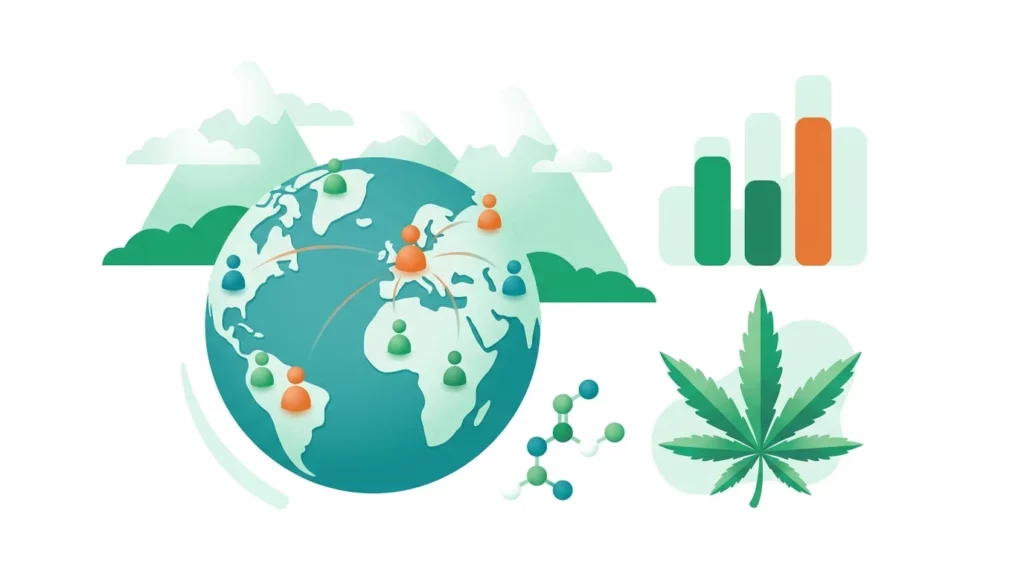
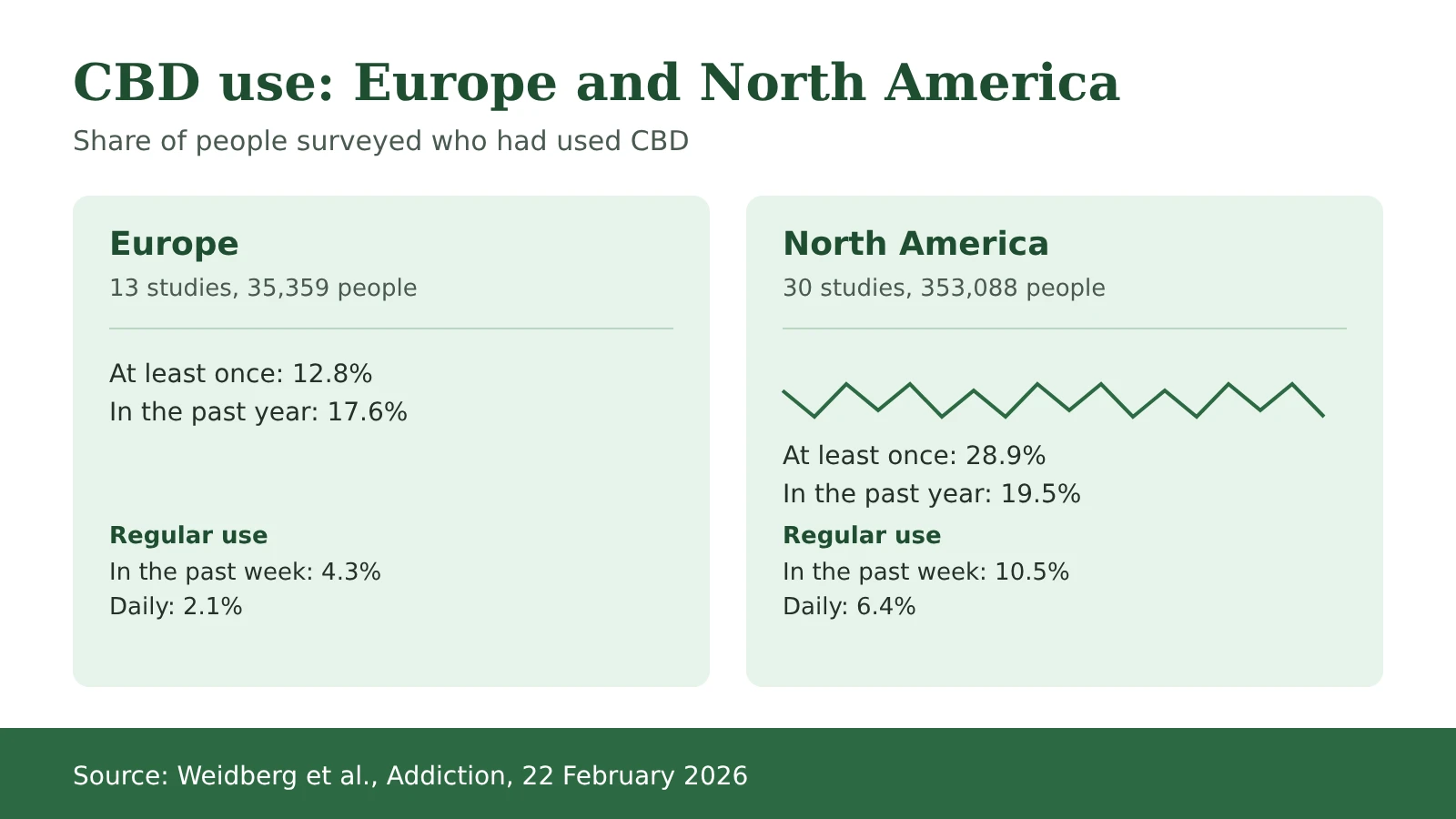
The two continents turned out to be so different that the researchers analysed them separately. In Europe, 12.8% of people surveyed had used CBD at least once, about one in eight. In North America, the figure rises to 28.9%, a little more than one in four.
The gap widens when it comes to habits. In the month before the survey, 7.2% of Europeans surveyed had used CBD, compared with 12.0% of North Americans. Daily use stands at 2.1% in Europe, about one person in fifty, and at 6.4% in North America, three times as high. Across the Atlantic, CBD is therefore more often an everyday product than an occasional try.
Who the users are
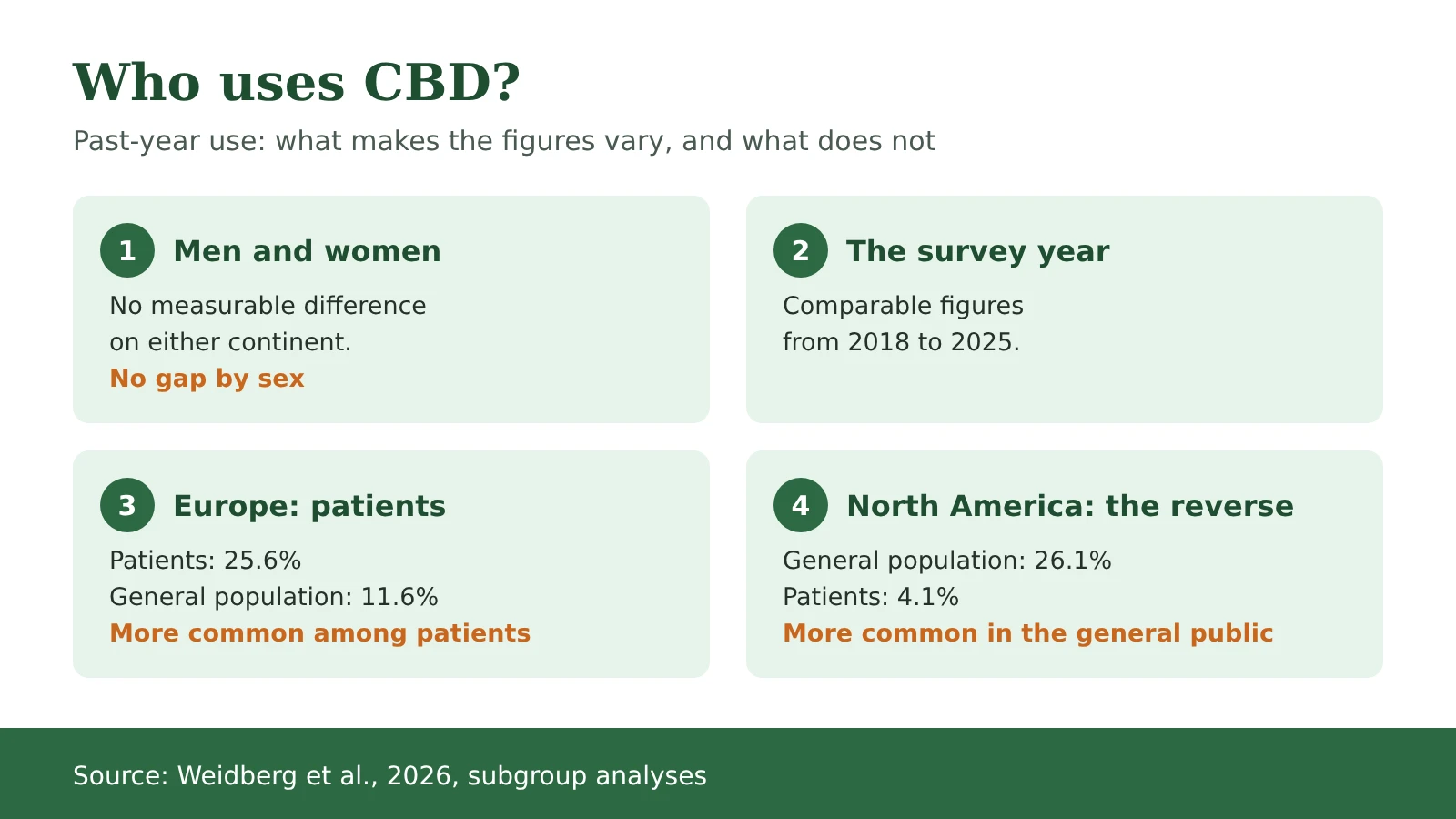
One might have expected the same profile as people who use cannabis, who are mostly men. Yet on both continents, the proportion of women in the samples did not change the usage figures. The authors attribute this to marketing that also targets women. The survey year, between 2018 and 2025, made no difference either: the figures show no clear increase over the period.
The type of population, on the other hand, does change the results, and not in the same direction on each continent. In Europe, 25.6% of patients being followed for an illness had used CBD in the past year, compared with 11.6% of the general population. In North America, it is the reverse: 26.1% in the general population, 4.1% among patients. The authors put forward a hypothesis: in Europe, where access to cannabis, including medical cannabis, remains more restricted, some patients may turn to CBD. They would like these patients to talk to a healthcare professional, because CBD can alter how the liver eliminates certain medicines: this is something to discuss with your doctor.
Drops, vaping or smoking
Over a lifetime, drops placed under the tongue are the most frequently cited form, by 61.4% of users, ahead of vaping (52.8%) and smoking (43%). The same person has often tried several forms, hence a total above 100%. Over the past year and month, inhalation comes first, based on a smaller number of studies. The authors see this as a sign of marketing that increasingly presents CBD as a recreational product.
Why North America is ahead
The two markets did not develop under the same conditions. In the United States, a 2018 federal law removed low-THC hemp from the list of controlled substances, and CBD products multiplied within a few years. In Europe, each country sets its own rules. The authors propose three explanations for the gap, without having tested them.
The first is marketing: advertising mainly highlights promises of wellbeing and health, and according to the authors, perceived benefits often exceed what studies have shown. The second is supply: North America offers a much wider range, including forms that cannot be sold legally in Europe.
The third concerns THC. Legal limits apply to the plant and not always to the finished product. A US analysis cited by the authors found THC in 21 of 80 products sold as “THC-free”. In Europe, almost all the products analysed in a comparable study remained below the legal limit.
The authors draw recommendations for the authorities from this: accurate labels, a THC limit set on the finished product, rules harmonised between countries, since many products are bought online, and better regulated advertising, especially where it may reach minors.
And in Switzerland?
Two of the 13 European studies come from Switzerland, and both concern very specific groups. The first surveyed 5,233 young men aged 28 on average, in 2019 and 2020: 32.4% had used CBD at least once, 18.5% in the past year and 0.6% daily, most often by inhaling it. That is well above the European estimate, but this group does not represent the population. The second covered 469 patients followed in 2019 for a substance use disorder: 34.3% had used CBD at least once, 25.2% in the past year. Neither of them therefore makes it possible to estimate use across the Swiss population as a whole.
In Switzerland, CBD products sold freely contain less than 1% total THC (see what the 1% threshold measures). Depending on their form, they fall under different rules, set out in our guide to Swiss legislation; flowers and vapes, for example, come under the Tobacco Products Act. The products covered by these surveys, prescribed or sold freely, are not all comparable to those sold freely in Switzerland, which are not medicines.
What the meta-analysis shows and does not show
The meta-analysis gives a first order of magnitude for CBD use on two continents, using a sound method: a protocol registered in advance, studies selected by two researchers working independently, and 30 of the 43 surveys rated at low risk of bias.
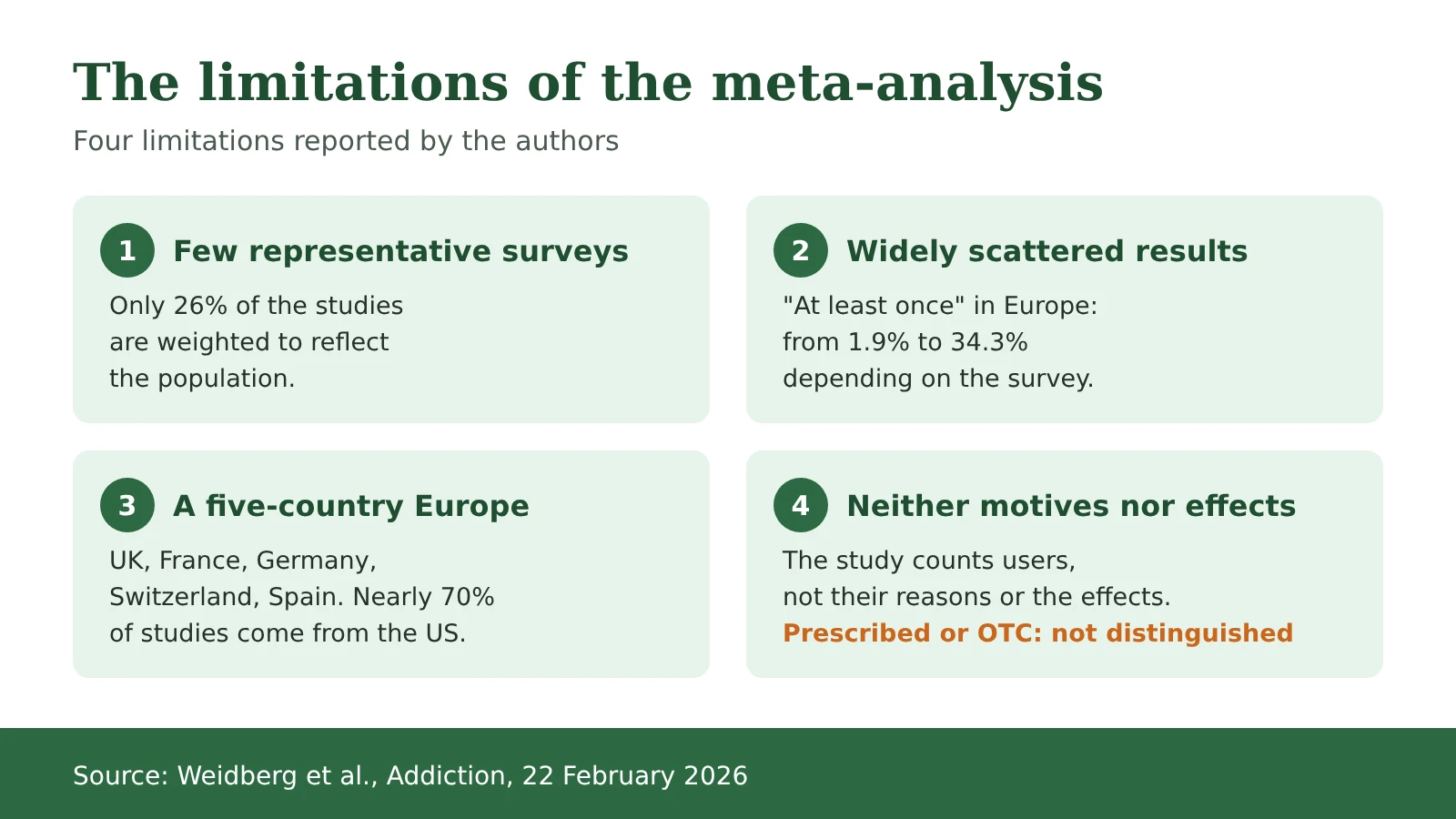
The figures nonetheless remain fragile, as the authors themselves acknowledge. Only 26% of the surveys were weighted to represent the population, and results vary enormously from one to another: use “at least once” ranges from 1.9% to 34.3% across European surveys, and from 7.1% to 73.1% across North American ones.
The study’s “Europe” is limited to five countries: the United Kingdom, France, Germany, Switzerland and Spain, and nearly 70% of the studies come from the United States. Prescribed CBD is not distinguished from CBD sold freely. Finally, the study counts users without measuring their motives or the effects they experience; the authors call on the large national surveys to collect these data.
What the science says
Independent summary of a scientific publication. It does not describe The Green Lab products and is not health advice.
Frequently asked questions
What does the margin of uncertainty around an estimate mean?
A meta-analysis gives an estimate surrounded by a 95% confidence interval. For CBD use at least once in Europe, the average estimate is 12.8%, but the true value probably lies between 6 and 25%. The wider the interval, the less precise the estimate: here, it reflects how different the pooled surveys are.
How can past-year use exceed use at least once in a lifetime?
In Europe, the study estimates past-year use at 17.6% and use at least once at 12.8%, which would be impossible within a single population. Each figure is in fact based on a different group of surveys: 8 surveys for the past year, 10 for lifetime use. The two estimates therefore do not describe exactly the same people.
What is a weighted survey?
A sample never perfectly mirrors the population: it may include too many young people, too many women or too many city dwellers. Weighting corrects these imbalances by giving each answer more or less weight, based on official population statistics. Without it, a survey mainly describes its participants, and the country less well.
What is publication bias?
It is the tendency to publish studies with striking results more readily than those with ordinary results. A synthesis that only pools published studies may then overestimate a phenomenon. Meta-analyses look for it with statistical tests; in this one, most of these tests did not detect any.
What is the difference between prescribed CBD and CBD sold freely in Switzerland?
Since 1 August 2022, Swiss doctors can prescribe cannabis-based medicines without an exceptional authorisation from the FOPH, and Swissmedic oversees their production and trade. CBD products sold freely contain less than 1% total THC and are not medicines: they cannot claim any effect on health.