In five of the eight human studies gathered in a systematic review, the use of CBD or hemp products produced no result above drug-test cut-offs; in the other three, tests came back positive. The review, carried out by toxicologists at Ege University in Turkey, covers ten years of research. According to the authors, a positive test is rare with a compliant product; when it does happen, it is mainly due to the THC actually present in the product, sometimes undeclared. The studies gathered are small and disparate, from 1 to 120 people: the level of evidence remains limited. To place this type of study and its level of evidence, see reading and understanding a CBD study.
| The study at a glance | |
|---|---|
| Original title | Impact of CBD and hemp oil use on drug test results: a systematic review |
| Journal | International Journal of Legal Medicine, vol. 140, no. 4, pp. 2065-2078 |
| Date | 7 April 2026 |
| Authors | Duygu Yeşim Ovat et al. (Institute of Toxicology, Ege University, Izmir, Turkey) |
| Type | Systematic review (PRISMA method) of 12 studies published between 2014 and 2024 |
| Funding | No research funding; open access funded by the Scientific and Technological Research Council of Turkey (TÜBİTAK). No conflicts of interest declared |
| Level of evidence | ●●○○ 2 out of 4: systematic review, but of small and disparate studies, including isolated cases and test-tube experiments |
| Full text | Open access on PubMed Central |
On this page
- A test looks for THC, not CBD
- Twelve studies selected out of 477, published over ten years
- Eight human studies: five below the cut-offs, three with positive tests
- Urine, saliva, blood, hair: what each analysis shows
- Does CBD turn into THC? What two trials measured
- What the review shows and does not show
- And in Switzerland?
- In summary
- Frequently asked questions
A test looks for THC, not CBD
A drug test does not look for CBD. It looks for THC, the molecule that alters perception and mood, and its breakdown products, including THC-COOH excreted in urine. CBD and THC are two distinct molecules (see where CBD comes from in the plant).
The question concerns many people: according to a survey cited by the authors, about 14% of Americans have used a CBD product. It matters at work, on the road and in sport.
The decisive point is therefore the THC a product may contain. The analyses cited in the review show that it is present in part of the market: of 80 CBD products tested in the United States, 51 contained THC. Of the 21 labelled “THC-free”, 5 contained some.
Twelve studies selected out of 477, published over ten years
The five authors searched three scientific databases. Of 477 references published between March 2014 and March 2024, they selected 12 studies that looked for cannabinoids in the body after the use of CBD products or food products made from hemp seeds.
The distinction matters. CBD products are extracts of flowers or leaves, rich in cannabinoids. Seeds contain few, but can be contaminated by resin, which contains THC.
Eight studies analyse the urine, blood, saliva or hair of people who had used these products. Four examine whether CBD can turn into THC. A test is often done in two stages: a rapid screen, positive above a cut-off, then a confirmation analysis in a laboratory.
Eight human studies: five below the cut-offs, three with positive tests
In five of the eight human studies, no result exceeds the test cut-offs, although traces close to the limits sometimes appear. In Korea, 32 participants took hemp seed products for one or twelve weeks: of 480 urine samples, the screen was negative every time. In Australia and New Zealand, 35 adults took a hemp-derived food product for three weeks: nothing in saliva, blood or urine, apart from traces of THC-COOH too small to be quantified.
Three studies report positive tests. In Italy, a child aged 2 years and 7 months was given a hemp seed product for three weeks, meant to strengthen his defences. Poisoned, he had 68 ng/mL of THC-COOH in his urine. The product contained 0.06% THC, below the Italian legal limit. In Slovenia, 12 elderly people went to the emergency department after eating hemp biscuits; their urine screen was positive, and two were admitted to intensive care.
In Germany, 22 volunteers took two tablespoons of hemp food products. Only the urine samples taken at eight hours contained traces: 1 ng/mL of THC-COOH and 0.7 ng/mL of THCA, the acidic form of THC. Nothing at 16 or 32 hours. For sport, 30% of the samples taken at eight hours contained prohibited cannabinoids.
| Study | Product and use | Participants | Result |
|---|---|---|---|
| Germany, 2017 | Hemp creams on the skin, 3 days | 3 | Nothing detected |
| Australia, 2018 | Hemp food product, 3 weeks | 35 | Below cut-offs; traces not quantifiable |
| United Kingdom, 2019 | Scalp cosmetic, 6 weeks | 10 | Hair below cut-offs; traces in 4 |
| Korea, 2019 | Seed-based products, 1 and 12 weeks | 32 | Urine screen always negative |
| Europe, 2021 | 17 seed-based products analysed | Not specified | No positives reported; THC in 14 products |
| Slovenia, 2016 | Hemp biscuits | 12 | Urine screen positive in all |
| Italy, 2017 | Seed-based product, 3 weeks | 1 child | Urine positive |
| Germany, 2022 | Hemp food products | 22 | Urinary traces at 8 hours only |
Urine, saliva, blood, hair: what each analysis shows
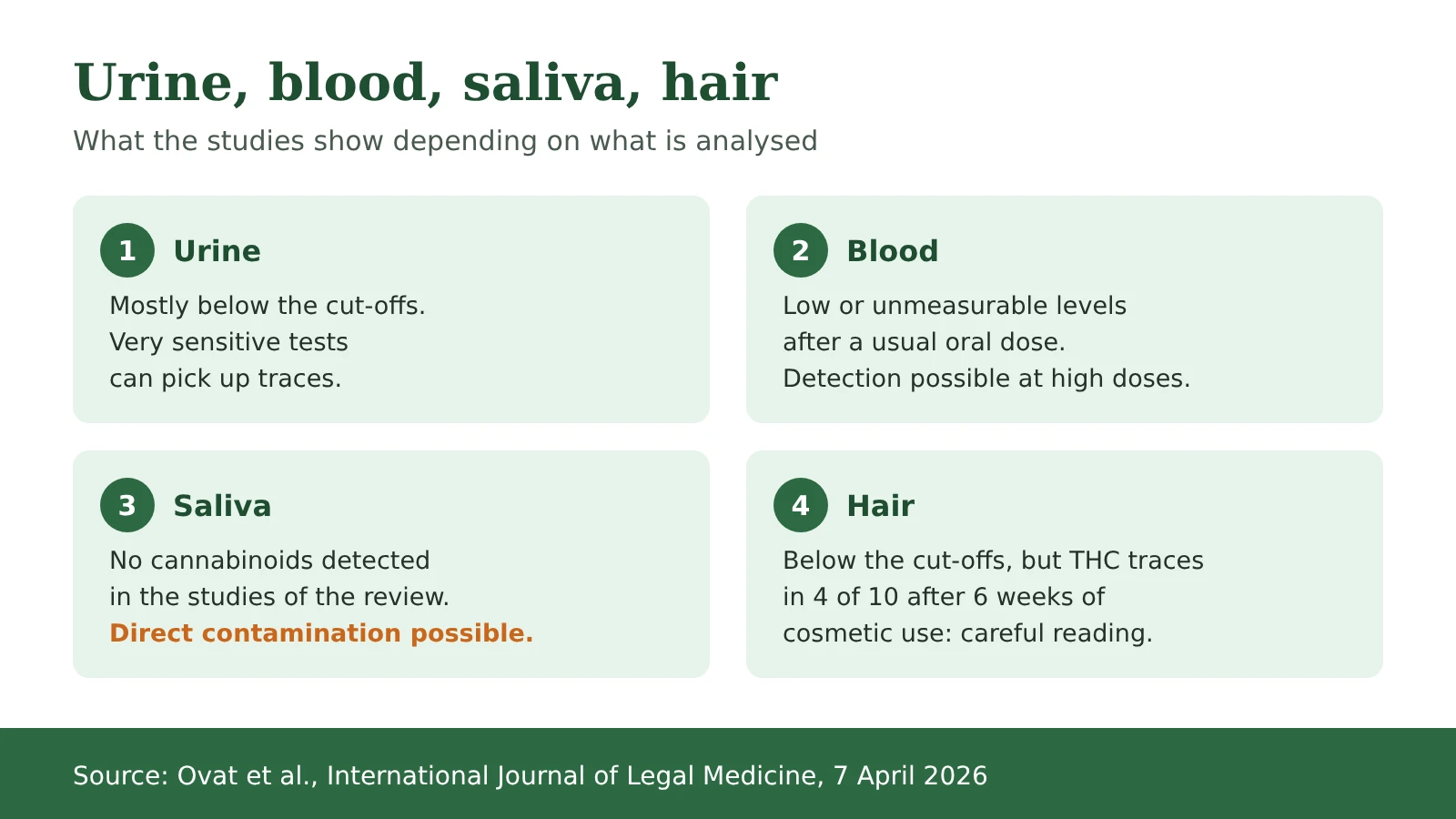
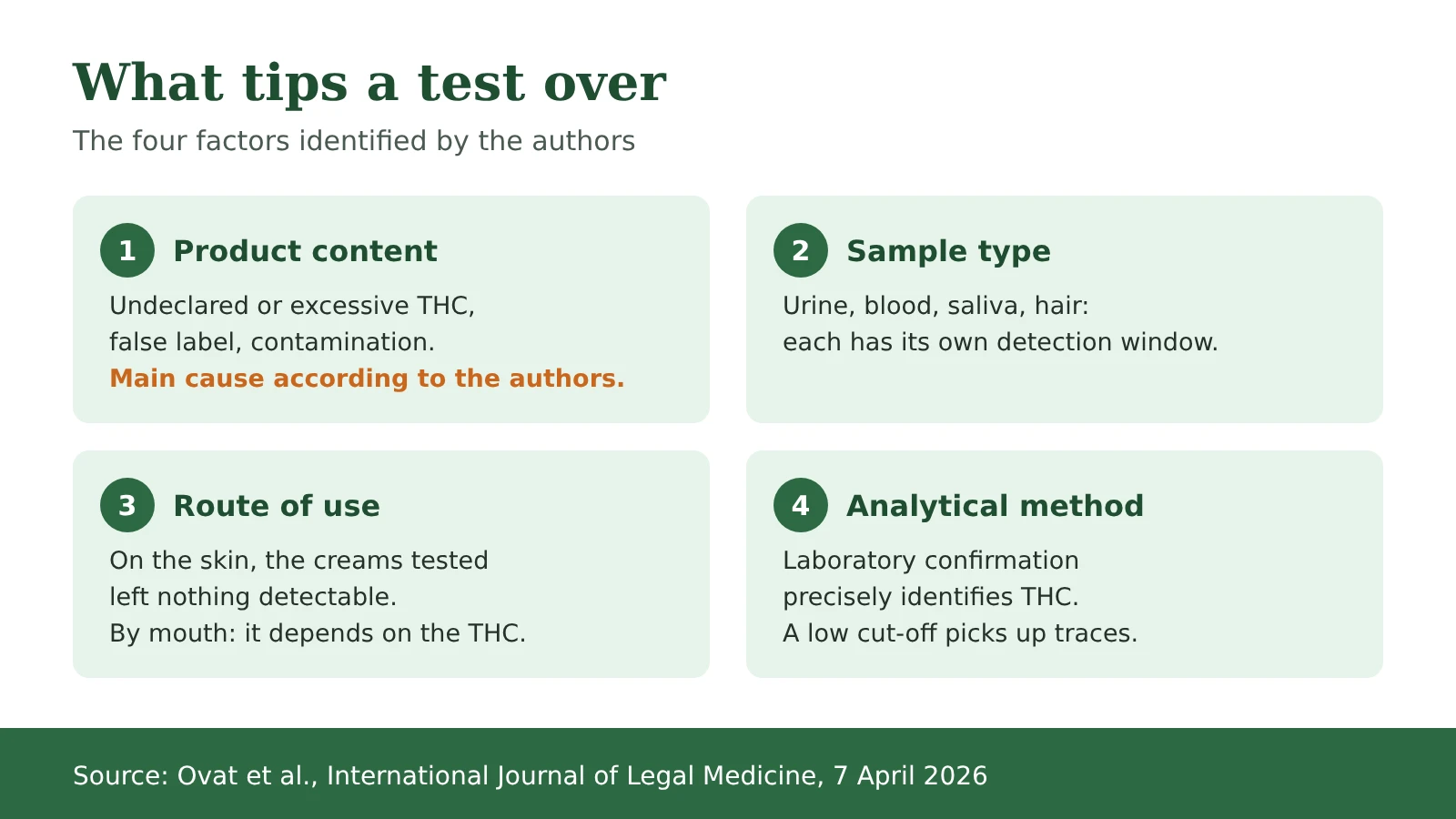
Results vary depending on what is analysed. In saliva, no study detected cannabinoids, but the authors note that a product taken by mouth can contaminate it directly. In blood, a usual oral dose gives low or unmeasurable levels; clearly positive results concern poisonings or mislabelled products, and the authors point to a risk of detection after prolonged or high-dose use. In urine, most results remain below the cut-offs, but very sensitive tests can pick up traces. The THCA traces sometimes found are not targeted by standard screening protocols.
Hair keeps a record of long exposures. After six weeks of cosmetic application, results remained below the cut-offs, with minimal traces of THC in 4 of 10 participants. According to the authors, such traces could be mistaken for cannabis use.
Does CBD turn into THC? What two trials measured
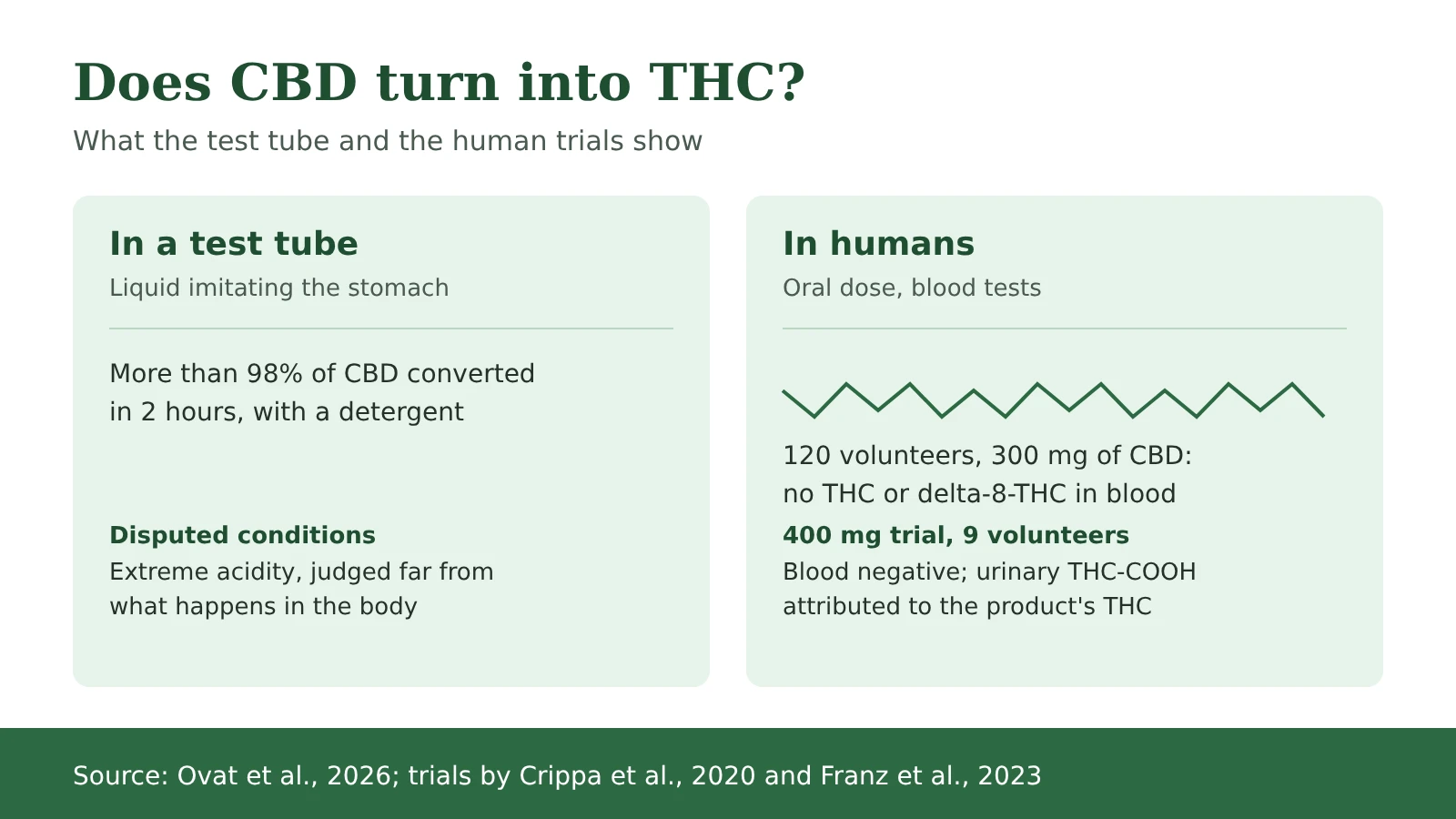
In a trial in Brazil, 120 volunteers were given 300 mg of CBD by mouth: neither THC nor delta-8-THC was measured in their blood 3 and 6 hours later, using a method able to detect THC from 1.5 ng/mL. In Germany, 9 volunteers took about 400 mg of water-soluble CBD. Their blood remained negative, but their urine contained THC-COOH, up to 17.9 ng/mL, and two participants remained positive for up to 24 hours. The researchers attribute this to the THC present in the liquid itself, about 0.24 mg per dose, and not to a conversion of CBD.
The conversion hypothesis comes from a test-tube experiment: in a liquid imitating the stomach, more than 98% of CBD turned into THC and delta-8-THC in two hours. However, this required a detergent and extreme acidity, conditions that other researchers consider far from those in the body. A second test-tube experiment judges the conversion insufficient to make a standard urine test positive, while noting that it varies with the preparation: up to 100 times higher with water-soluble CBD.
The review’s conclusion: significant conversion of CBD into THC in the body is unlikely under normal conditions.
What the review shows and does not show
The review first shows where positive tests come from: the content of the product. Undeclared or excessive THC, false labels, contamination. Sixteen other studies, on the products themselves, give a measure of this: of 726 products analysed in several countries, 62.7% contained THC.
It also examines the opposite argument, a “CBD defence” comparable to the poppy seed defence against opiate tests. A driver stopped with THC in his blood attributed it to hemp creams. Applied every 2 to 4 hours for three days by three volunteers, these creams left nothing detectable in blood or urine. The authors recommend confirming every screen with a precise analysis, and measuring the full range of cannabinoids in future to distinguish unintentional exposure from deliberate cannabis use.
The review does not show that a given product will never trigger a test. Most human studies concern hemp seed products or cosmetics; only two trials, at 300 and 400 mg, clearly concern CBD taken by mouth. The doses and preparations tested (300 to 400 mg of CBD in a single dose, as an oral solution or a water-soluble liquid) bear no comparison with CBD products sold freely in Switzerland, which are not medicines: their results do not apply to another product.
Point to watch
Sample sizes range from 1 to 120 people, and some figures differ between the text and the tables of the review. At work, in sport and in zero-tolerance testing, even concentrations close to the cut-offs can lead to sanctions, the authors point out.
And in Switzerland?
In Switzerland, hemp and products containing 1% total THC or more are narcotics, and their non-medical use is prohibited (see what the 1% threshold measures). Below this threshold does not mean THC-free: in the review, a product complying with the Italian limit was enough to make a child’s test positive. CBD products sold freely fall under other laws, presented in our guide to Swiss legislation: they are not medicines.
On the road, the Swiss limit concerns THC in the blood: 1.5 µg/L, or 1.5 ng/mL. It is a detection threshold: above it, inability to drive is presumed. The review does not make it possible to know whether a given product can push a driver above this threshold: THC content varies from one product to another, and products labelled “THC-free” contained some. See our article Travelling and driving with CBD.
In summary
The review concludes that with a compliant, correctly labelled product, a positive test is rare, but not ruled out: three of the eight human studies report one. Positive cases are mainly due to THC present in the product, sometimes undeclared, and to tests sensitive enough to pick up traces; the type of sample also matters. In the two trials of CBD taken by mouth, no THC was measured in the blood, but urine contained THC-COOH in one of them. In sport and zero-tolerance testing, even traces can count.
What the science says
Independent summary of a scientific publication. It does not describe The Green Lab products and is not health advice.
Frequently asked questions
Can a CBD product make a urine test positive?
It is possible. The review considers this result rare with a compliant product, but three of the eight human studies report positive tests. Tests look for THC and its breakdown products, not CBD. The positive cases come mainly from products containing more THC than declared, or from very sensitive tests that pick up traces.
Does CBD turn into THC in the body?
The two human trials did not measure this. In 120 volunteers given 300 mg of CBD by mouth, no THC was found in the blood. The conversion observed in a test tube required extreme acidity and a detergent. These trials concerned specific preparations and say nothing about the THC contained in another product.
Does an athlete risk a positive anti-doping test?
The authors consider it possible. CBD itself is not prohibited: the World Anti-Doping Agency (WADA) bans all cannabinoids except CBD. The risk comes from the product’s other cannabinoids. In a German study, 30% of urine samples taken eight hours after hemp food products contained them. Even traces can count.
Can hemp cosmetics distort a test?
Two studies in the review measured this. Creams applied every 2 to 4 hours for three days by three volunteers left nothing detectable in blood or urine. In hair, six weeks of application remained below the cut-offs, but traces of THC appeared in 4 of 10 participants. The sample sizes are very small.
What is the THC limit for driving in Switzerland?
It is 1.5 µg of THC per litre of blood, a detection threshold: above it, inability to drive is presumed. The review does not make it possible to know whether a given product can push a driver above this threshold: THC content varies from one product to another, and products labelled “THC-free” contained some.