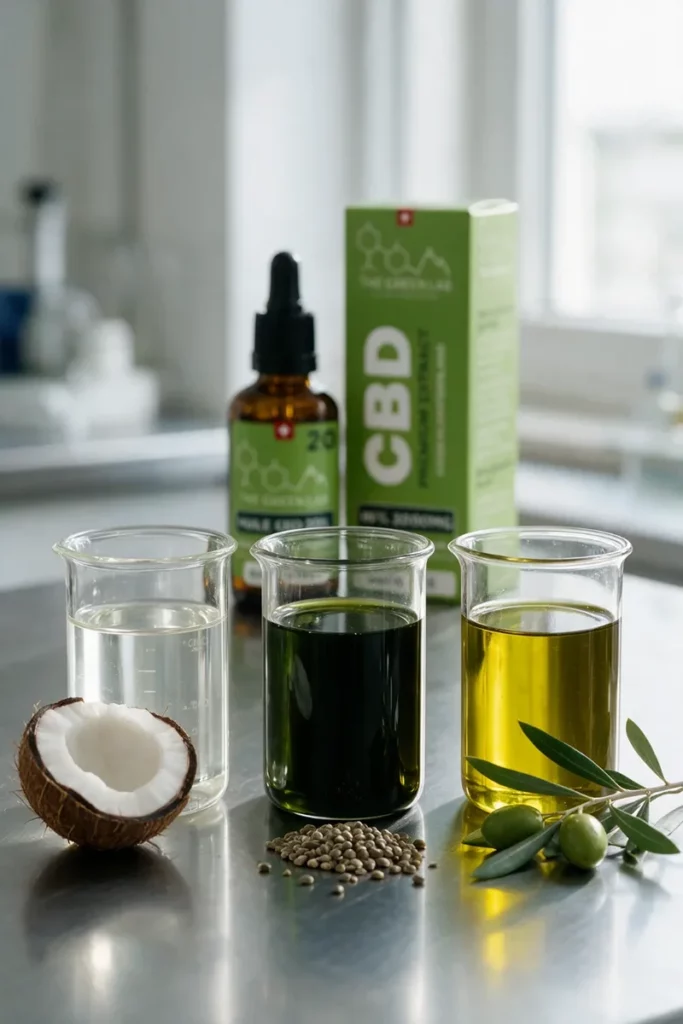
Vegetable oil makes up most of the volume of a CBD oil. It dissolves the hemp extract, sets the appearance and fluidity of the product, and determines how it keeps once the bottle is open. Our range relies on three carriers: coconut MCT, hemp seed oil and olive oil. Here is what each one actually changes in the bottle.
On this page
What the carrier oil does
Cannabidiol and the other cannabinoids are lipophilic molecules: they dissolve in fats and hardly at all in water. It would take nearly eighty litres of water to dissolve a single gram of CBD. To obtain a homogeneous liquid, which delivers the same amount of material from one drop to the next, the extract must therefore be diluted in an oil.
In formulation terms, this is known as ballast oil. It is what brings the concentrated extract to the strength printed on the label: a 20% oil contains 20 g of cannabidiol per 100 ml, and the carrier fills most of the remaining volume.
The carrier does not change the cannabidiol content at the time of bottling. It acts on everything else: colour, viscosity, stability over time, and even the maximum strength that can be formulated.
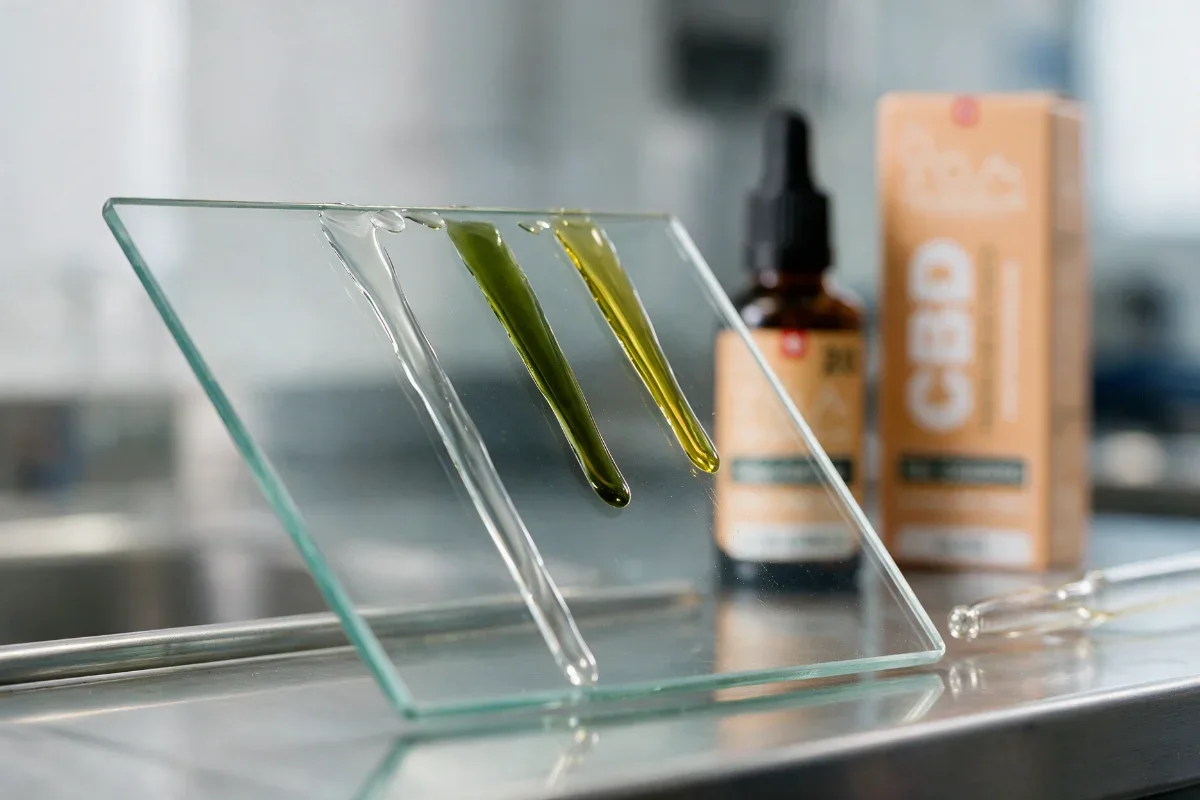
Three oils, three families of fatty acids
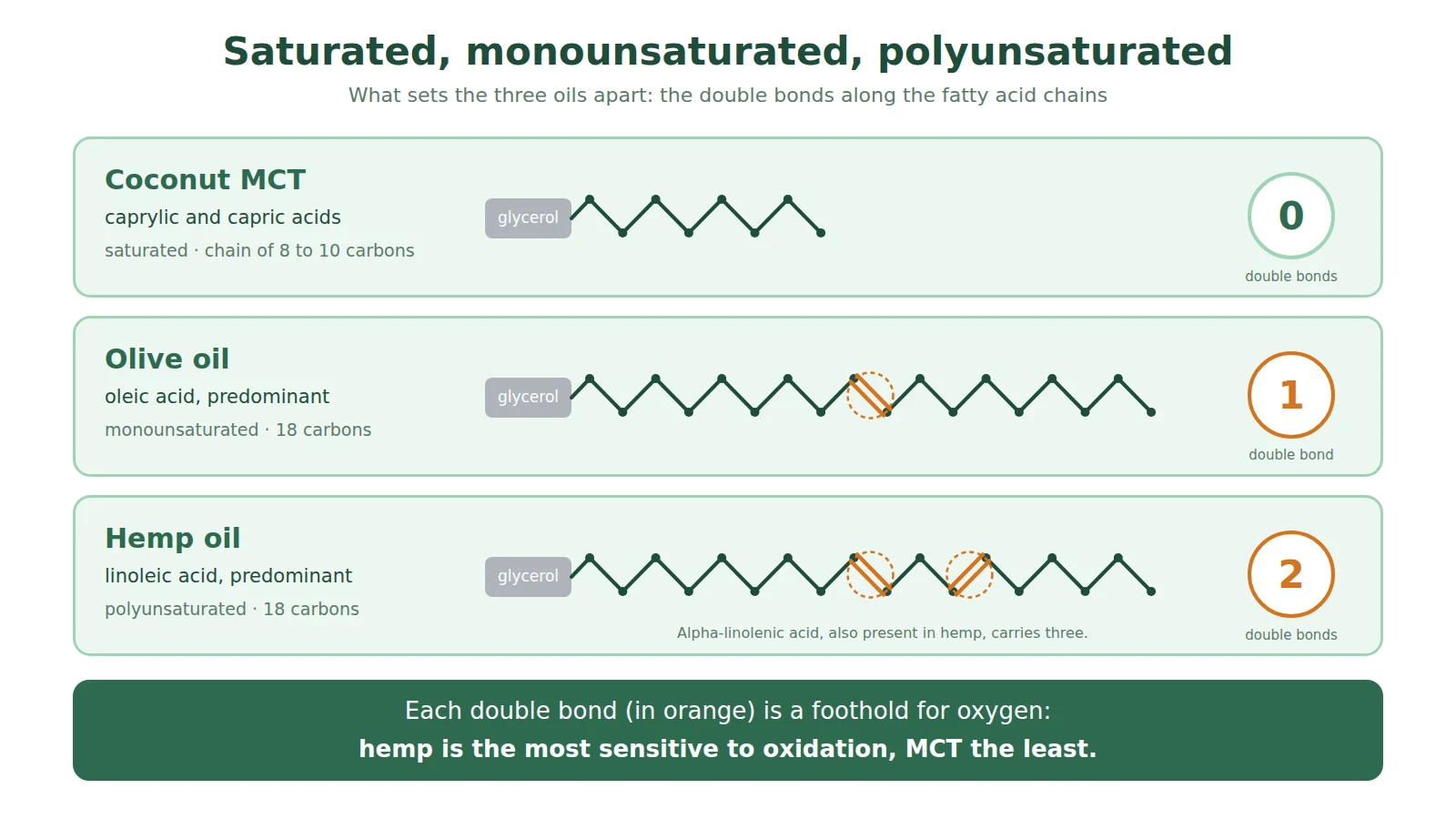
The three carriers in our range do not belong to the same chemical family. What sets them apart is the structure of their fatty acids, and more precisely the number of double bonds along each chain. This single difference explains most of their behaviour.
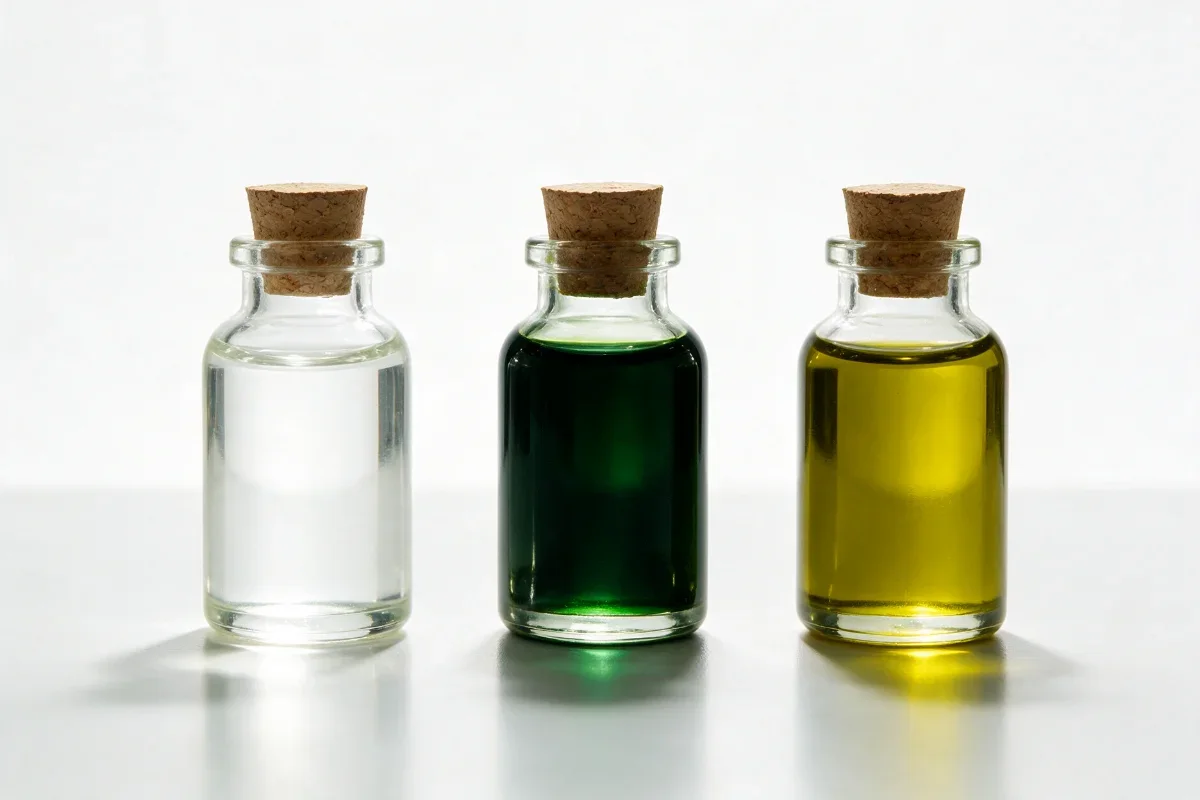
| Carrier | Dominant fatty acids | Appearance | Viscosity | Resistance to oxidation | In our range |
|---|---|---|---|---|---|
| Coconut MCT | Caprylic and capric, saturated | Colourless | Very fluid | High | Sublime, X-Strong, Broad Spectrum 40% |
| Hemp seed oil | Linoleic and alpha-linolenic, polyunsaturated | Deep green | Fluid | More sensitive | Hemp |
| Olive oil | Oleic, monounsaturated | Yellow-green | Thicker | High | Broad Spectrum 10 to 30% |
Coconut MCT
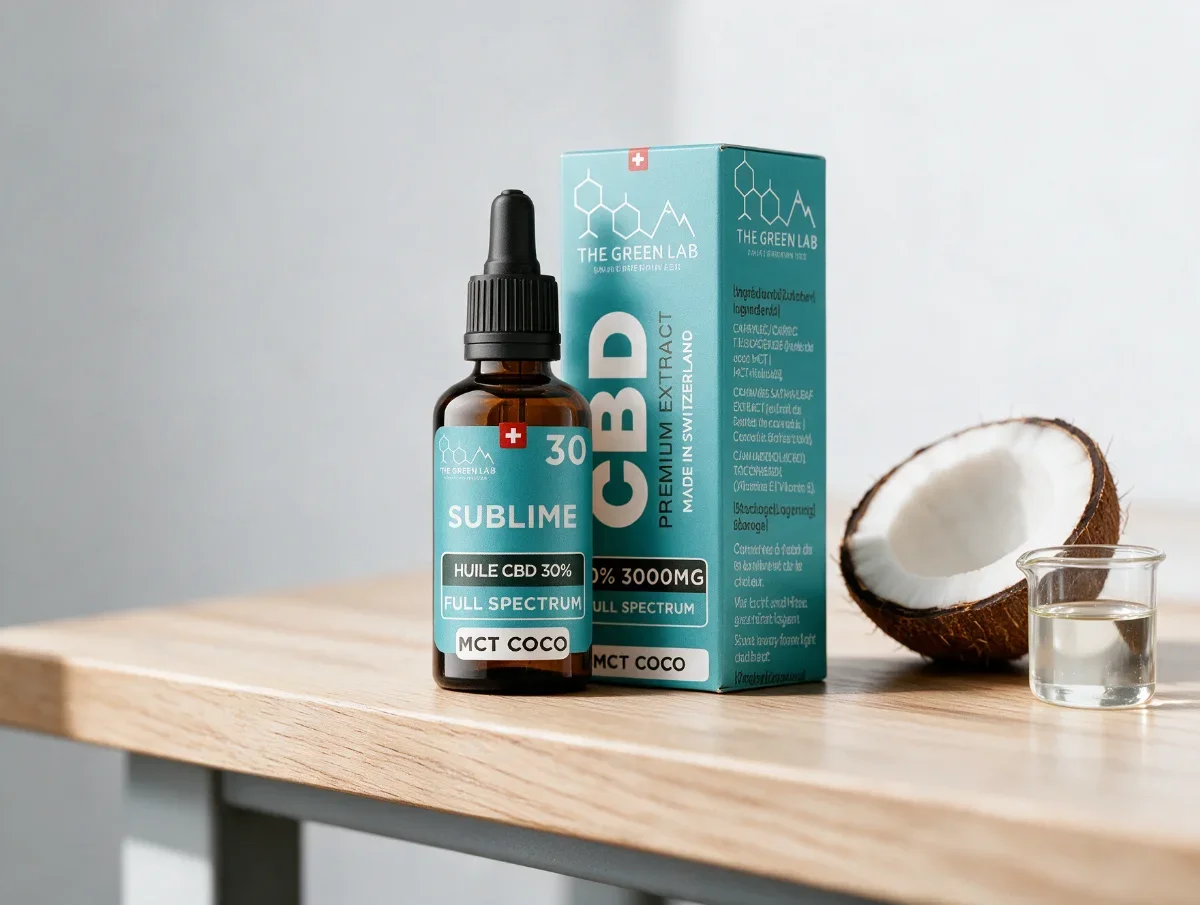
MCT, short for medium-chain triglycerides, is obtained by fractionating coconut oil. It retains only caprylic and capric acids, two saturated fatty acids with eight and ten carbon atoms. The result is a colourless and very fluid oil, with no character of its own to overlay that of the extract. From the dropper, it flows evenly.
It is the carrier of our Sublime range on coconut MCT, available from 10 to 40%, and of our highest strengths.
Hemp seed oil
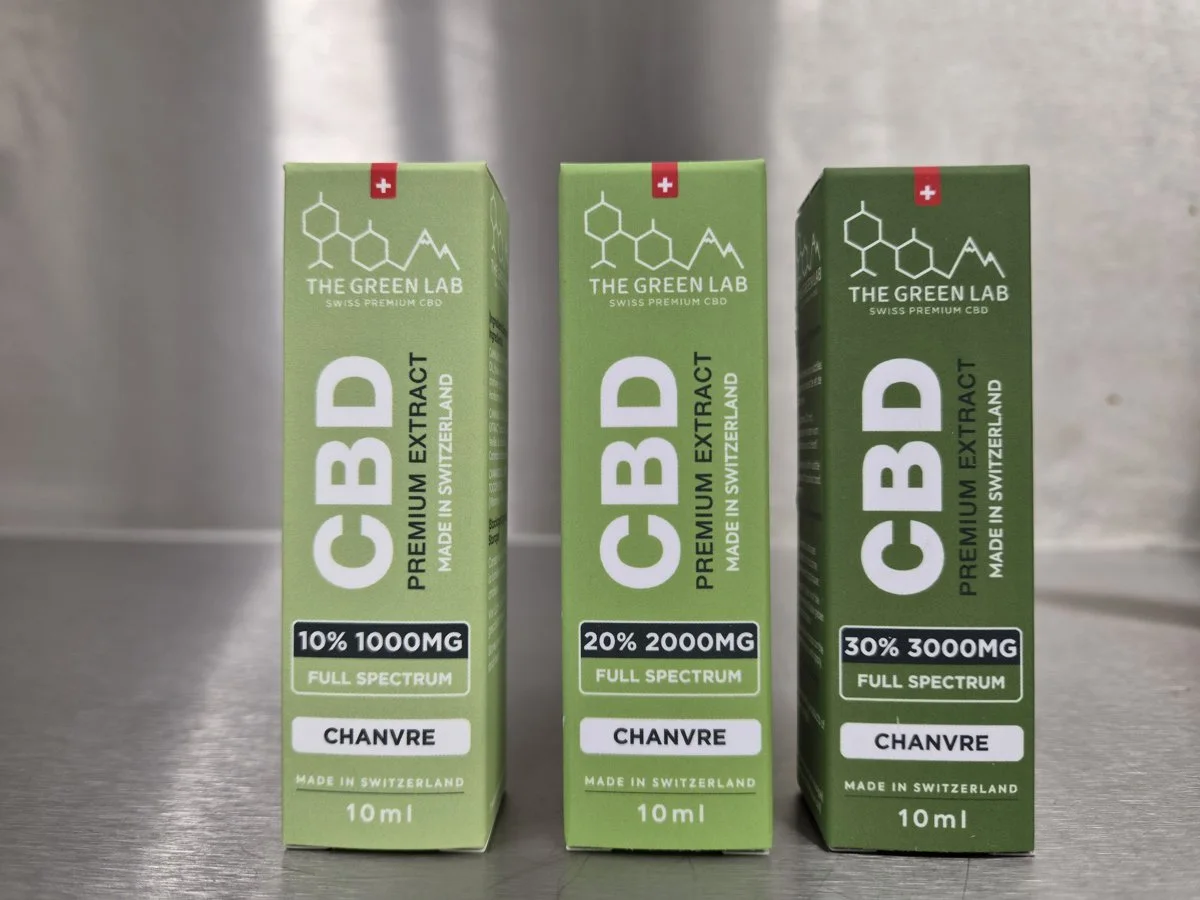
Pressed from the seeds of the plant, it consists mainly of polyunsaturated fatty acids, which make up 70 to 90% of the total. It is recognisable by its deep green colour, its fluid texture and a marked plant character, which remains noticeable in the finished product.
Its appeal lies in the consistency of the raw material: the carrier and the extract come from the same plant. It is the base of our hemp CBD oil, in 10, 20 and 30%.
Olive oil
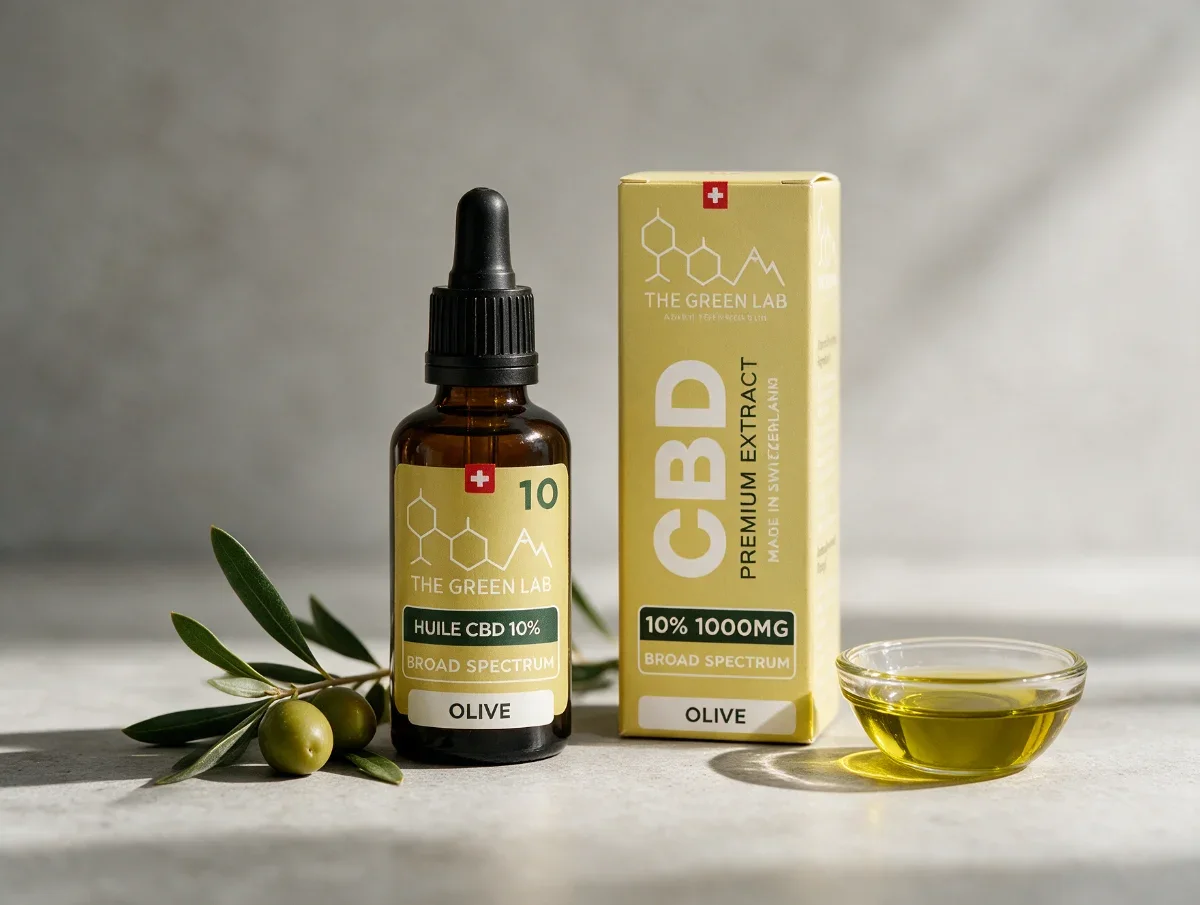
Its dominant fatty acid, oleic acid, is monounsaturated. Olive oil has its own profile: more coloured than MCT, slightly thicker than the other two carriers, and stable over time. It takes an added flavouring well, which makes it the base of our lemon version. It carries our Broad Spectrum range on olive oil in 10, 20 and 30%.
Watch point
Hemp seed oil contains no cannabinoids of its own. A bottle sold as “hemp oil” is therefore not a CBD oil. In our formulas, it serves only as a carrier: all the cannabidiol comes from the extract diluted in it.
Each carrier sets a maximum strength
Its role as a solvent has a direct consequence on the make-up of the range. An oil can only dissolve a limited amount of cannabidiol. Beyond that point, the material does not stay in solution and the product loses its homogeneity.
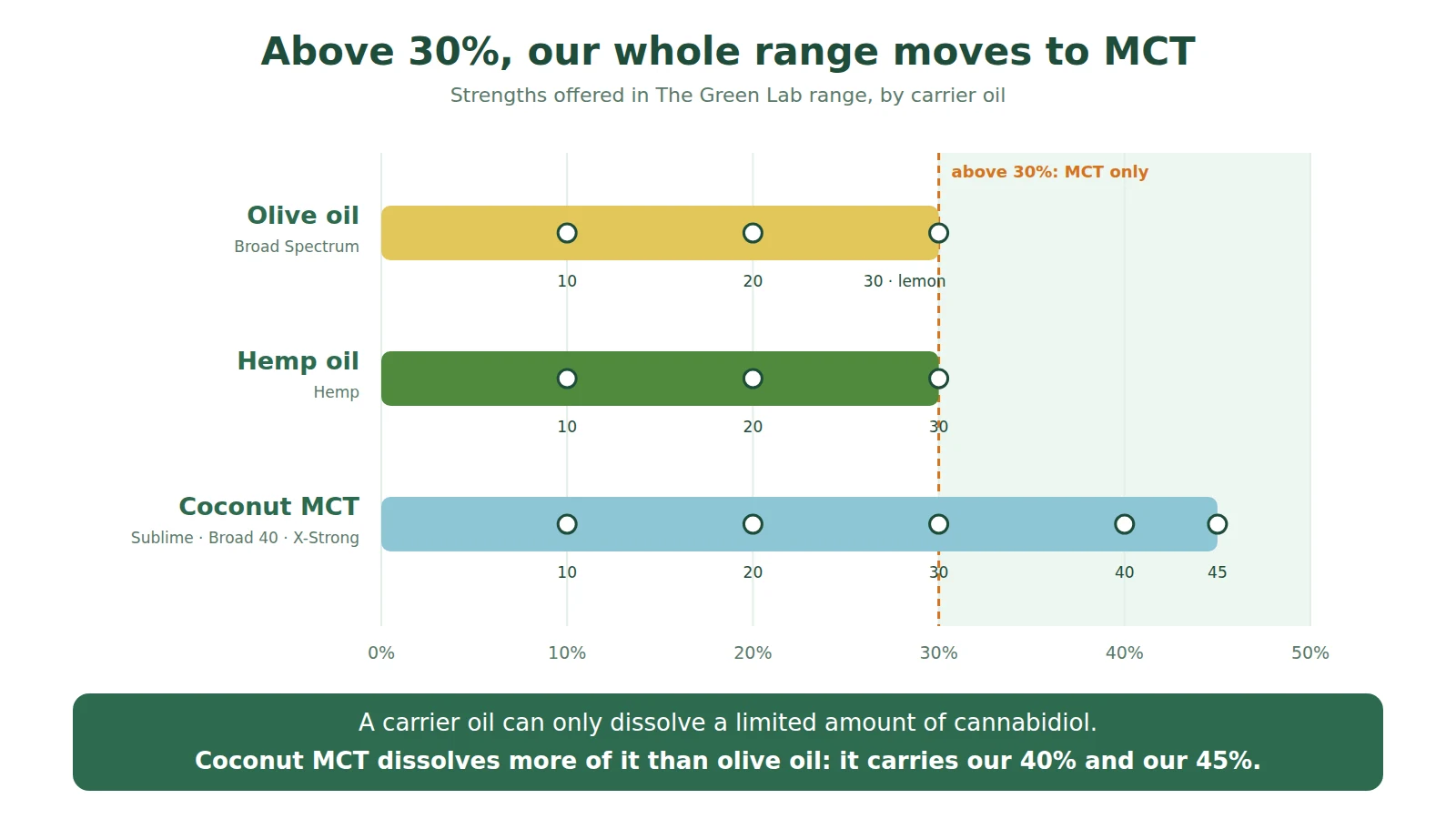
Coconut MCT dissolves more cannabidiol than olive oil. That is why the 40% in our Broad Spectrum range is formulated on MCT rather than on lemon olive oil, which does not allow this strength to be reached. Our X-Strong 45%, the highest strength in the range, is built on MCT for the same reason.
This ceiling is a matter of solution physics. It explains why a single range can change carrier as the concentration rises: in our catalogue, all strengths above 30% are based on MCT.
Storage and terpenes
Each double bond along a fatty acid chain is a point where oxygen can attack. The more unsaturated an oil, the more openings it offers to oxidation. MCT, being fully saturated, offers practically none. Olive oil, with one double bond per chain, holds up well. Hemp oil, rich in polyunsaturated fatty acids, is the most exposed.
This difference does not affect the cannabidiol content stated on the label. It affects how the product changes after opening. An oil formulated on hemp seed oil needs to be kept away from light and heat, with the bottle tightly closed.
The carrier also influences terpenes, the volatile aromatic molecules that accompany cannabinoids in an extract. Studies comparing MCT and olive oil as carriers for hemp extracts have shown that cannabinoids keep equally well in both over two months. Terpenes, however, remain stable in MCT and decline in olive oil after a few weeks.
How we choose the carrier
None of these three oils is superior to the others. The choice is made at the formulation stage, and the target strength comes first: above 30%, only MCT can hold the concentration in our range.
Next come the desired appearance, neutral with MCT or distinctly plant-like with hemp, the keeping quality of the product over time, and how much room is to be left for the terpenes of the extract.
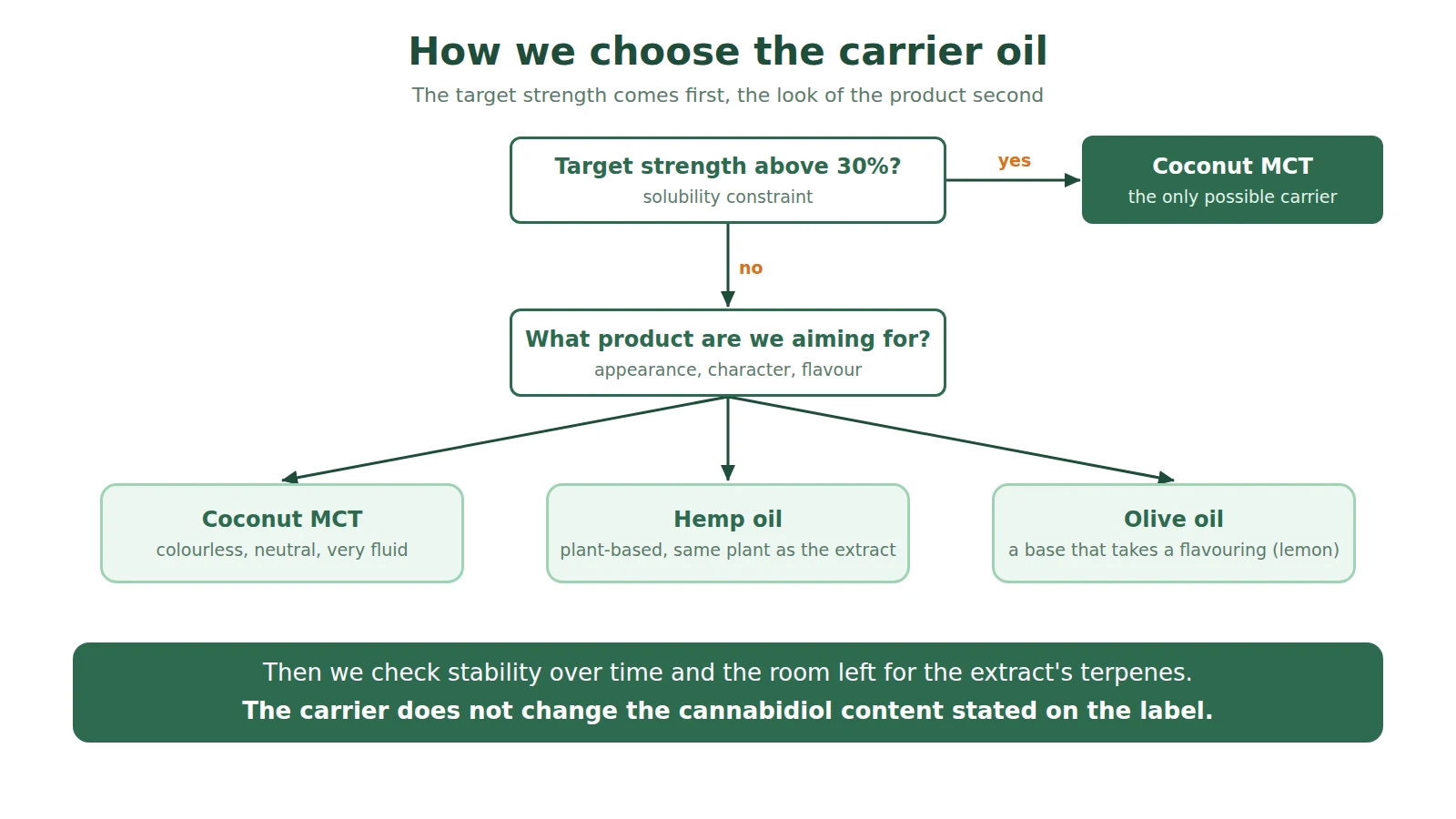
The carrier determines the appearance, the storage and the possible strength. It does not determine what really characterises an oil: the balance between cannabidiol, minor cannabinoids and terpenes. That ratio depends on the extract and the process, and it can be read on a certificate of analysis. To place the carrier among the other criteria, our guide to choosing a CBD oil also explains how to read a concentration.
Further reading: how a CBD oil is made.
Also in our shop: all our CBD oils.
Our laboratory
Our oils are formulated in our laboratory in Gland, where each extract is diluted in its carrier to the target strength. Their cannabinoid levels are tested regularly by an external laboratory. Discover the laboratory →
Frequently asked questions
What is a carrier oil?
It is the vegetable oil in which the hemp extract is diluted. Cannabinoids dissolve in fats and hardly at all in water: the carrier oil makes it possible to obtain a homogeneous liquid at the strength printed on the label. It is also called ballast oil. It makes up most of the volume of the bottle.
Does hemp seed oil contain CBD?
No. It is pressed from the seeds, which contain no cannabinoids. In a CBD oil formulated on hemp, all the cannabidiol comes from the added extract. A product sold as plain hemp oil is therefore not a CBD oil, however the label presents it.
Why is MCT oil colourless?
MCT is obtained by fractionating coconut oil and retains only two saturated fatty acids, caprylic and capric. The pigments and compounds that colour crude vegetable oils are removed in the process. The result is a colourless, fluid oil that shows the extract’s own colour.
Why are the highest strengths formulated on MCT?
Each oil can only dissolve a limited amount of cannabidiol. Coconut MCT dissolves more of it than olive oil. This is what makes it possible to formulate our Broad Spectrum 40% and our X-Strong 45% on MCT, whereas lemon olive oil does not allow these strengths to be reached.
How should you store an oil formulated on hemp seed oil?
Away from light and heat, with the bottle tightly closed after each opening. Rich in polyunsaturated fatty acids, hemp seed oil is more sensitive to oxidation than MCT or olive oil. The date shown on the bottle remains the reference.
Which carrier oil is best?
None is superior to the others. MCT is neutral, fluid and very stable. Hemp oil is a deep green and comes from the same plant as the extract. Olive oil is slightly thicker and takes a flavouring well. They differ in appearance, storage and the strength they make it possible to formulate.