Choosing a CBD oil comes down to three measurable elements: the concentration, expressed as a percentage and convertible into milligrams per drop; the vegetable oil that carries the extract; and the spectrum of cannabinoids that the extract has retained. This page covers the first two in detail and states which concentrate goes into each of our oils; the spectrum is the subject of a separate article.
On this page
What a CBD oil contains
A CBD oil combines two components. A hemp extract, which provides the cannabidiol and the other molecules derived from the plant. A vegetable oil, which dilutes that extract and takes up most of the volume in the bottle.
This vegetable oil is not a mere diluent. In formulation terms it is called the ballast oil, because it is what brings the extract to its final strength; in this article we refer to it as the carrier oil. It determines the appearance of the product, its viscosity and the way it changes once the bottle has been opened.
On the extract side, two production routes coexist in our laboratory in Gland. Crude extract retains all the compounds extracted from the plant, which gives it a dark colour, high viscosity and a pronounced organoleptic profile. Distilled extract goes through extensive purification that removes some of these compounds and leaves a clear, fluid material with a more neutral profile.
Neither route is better than the other. They meet different expectations, and the rest of this page describes what concretely separates them.
What a bottle actually contains is shown on the batch certificate of analysis. This document reports the cannabidiol content, the THC content and, depending on the protocols chosen, a breakdown of minor cannabinoids as well as testing for pesticides, heavy metals and residual solvents. Two products can carry the same commercial claim and show very different reports.
Reading a concentration
A percentage on a bottle looks like the simplest piece of information on the label. It is in fact the most ambiguous: no Swiss or European text states what it must mean on a CBD oil, and the industry’s quality standards do not agree with one another. Depending on the reading adopted, the same 10 ml bottle labelled 20% contains 1,880 or 2,000 mg of cannabidiol.
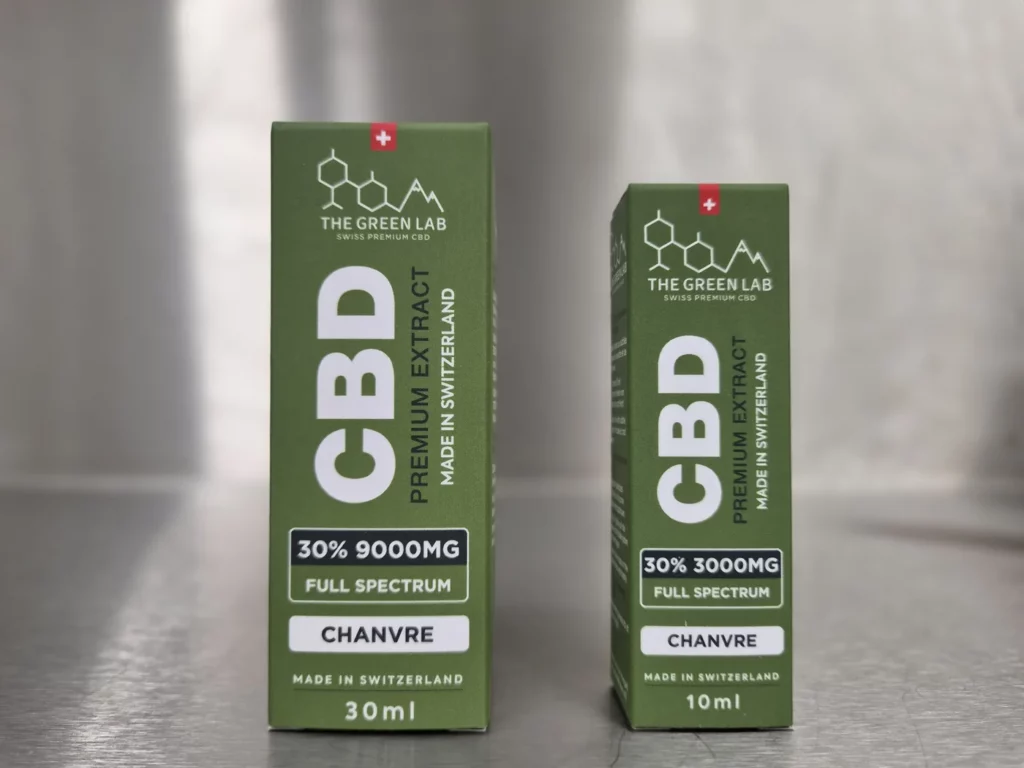
So we state ours, which few labels take the trouble to do: our percentages are expressed as mass per volume. A 10 ml bottle labelled 20% contains 2,000 mg.
That leaves the conversion into drops. A drop of oil does not have the volume of a drop of water: it is smaller, and it varies with the viscosity of the product and the dropper used. No published measurement gives the actual volume of drops of a vegetable oil, which means nobody can convert a percentage into milligrams per drop with demonstrated accuracy.
The table below applies the usual convention of 0.04 ml per drop, or 250 drops for a 10 ml bottle. It is a reliable reference for comparing concentrations with one another, not a measurement accurate to the milligram.
| Concentration | CBD per drop | 10 ml bottle 250 drops | 30 ml bottle 750 drops |
|---|---|---|---|
| 10% | 4 mg | 1,000 mg | 3,000 mg |
| 20% | 8 mg | 2,000 mg | 6,000 mg |
| 30% | 12 mg | 3,000 mg | 9,000 mg |
| 40% | 16 mg | 4,000 mg | 12,000 mg |
| 45% | 18 mg | 4,500 mg | 13,500 mg |
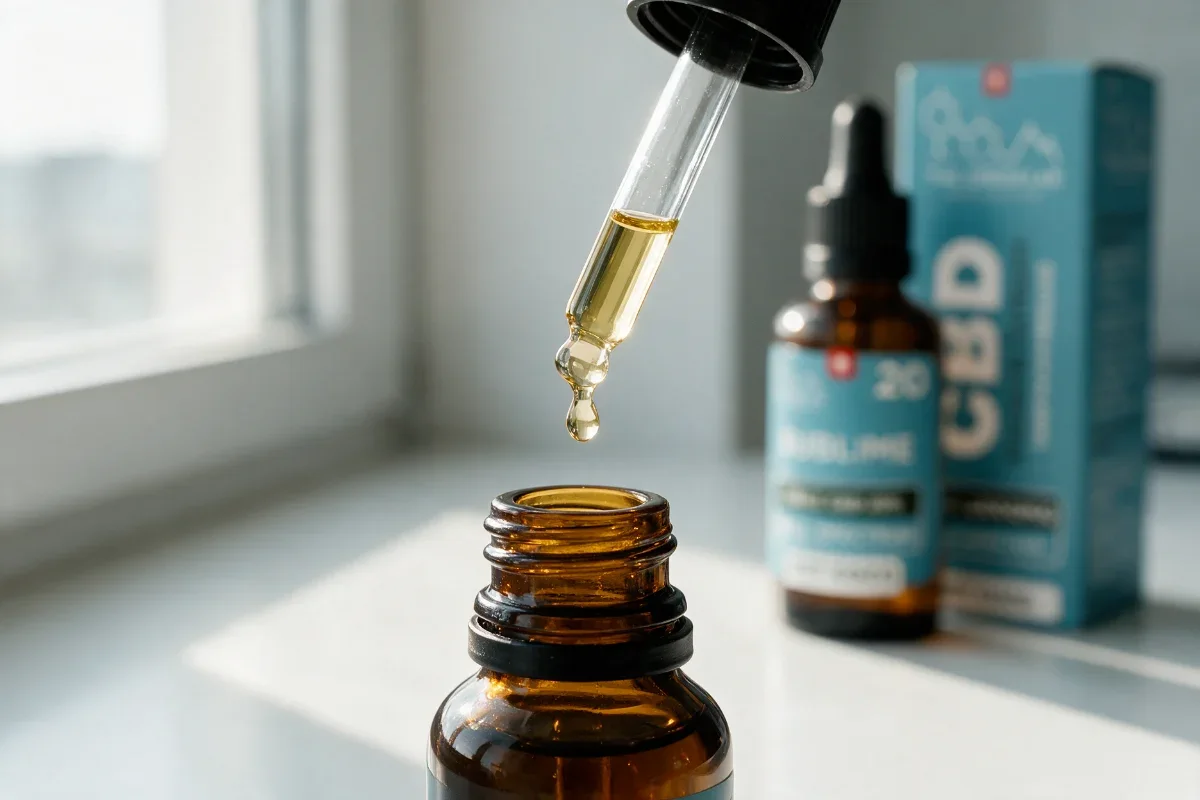
Two readings follow from this table. The amount of cannabidiol per drop depends only on the concentration: one drop of a 20% oil provides 8 mg, whether the bottle is 10 or 30 ml. The bottle volume determines the number of drops available, and therefore how long it lasts. This is also why a high concentration often works out cheaper per milligram.
One caveat on counting. Our oils do not all have the same viscosity, and a thicker material does not flow at the same rate through an identical dropper. The figure of 250 drops is a reference point, not a constant that applies across the whole range.
One last point, which applies to the market as a whole. Analyses carried out abroad on commercially available oils regularly show discrepancies between the content stated on the label and the content actually measured, in either direction. This is what gives the batch certificate of analysis its value: it alone tells you what the bottle in your hand contains, regardless of what the packaging claims.
Watch point
A percentage alone does not describe an oil. Two bottles labelled 20% can contain very different proportions of minor cannabinoids depending on the extraction process. The batch certificate of analysis is the only document that records this composition.
The role of the carrier oil
The vegetable oil makes up most of the volume of a bottle. The choice of oil is immediately visible in the appearance of the finished product and in its viscosity.
Cannabinoids are lipophilic: they dissolve in fats and hardly at all in water. The pharmaceutical literature puts the aqueous solubility of cannabidiol at 12.6 milligrams per litre, which amounts to saying that it would take nearly eighty litres of water to dissolve a single gram of material. The carrier oil is therefore not a diluent added to the finished product: it is the solvent without which the product would not exist in liquid, homogeneous form.
The three bases we use all fulfil this function, but they do not belong to the same chemical family, and this difference in structure explains most of their behaviour.
| Carrier | Dominant fatty acids | Appearance | Viscosity | Oxidative stability |
|---|---|---|---|---|
| Coconut MCT | Caprylic C8 and capric C10, saturated | Colourless | Fluid | High |
| Hemp oil | Linoleic C18:2 and alpha-linolenic C18:3, polyunsaturated | Deep green | Intermediate | Medium |
| Olive oil | Oleic C18:1, monounsaturated | Yellow-green | The thickest | High |
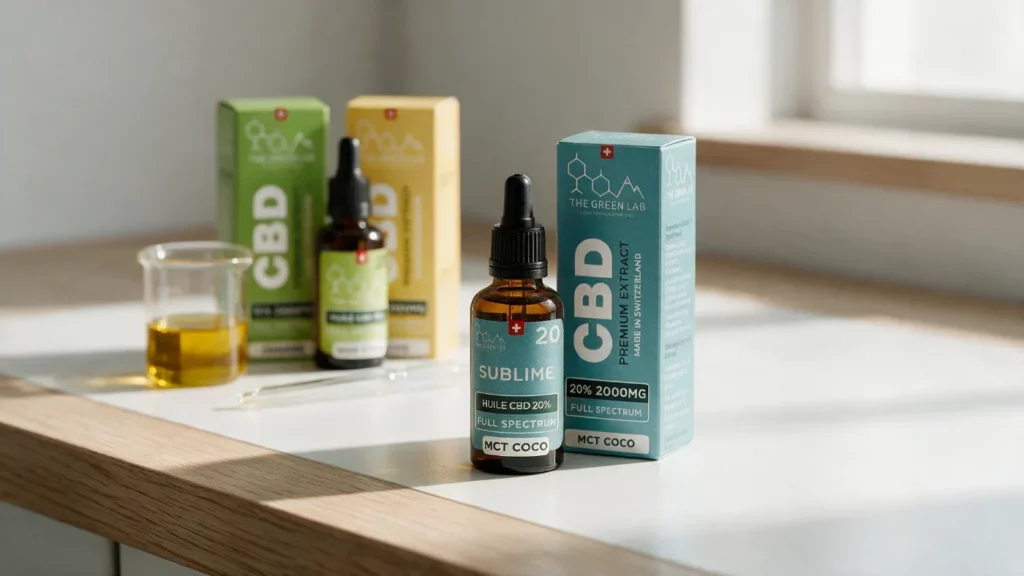
Coconut MCT is made up of medium-chain triglycerides, mainly caprylic and capric acids. These are saturated fatty acids: their carbon chains carry no double bonds. It is the most neutral carrier in the range, colourless, with no character of its own to overlay that of the extract, and its fluidity gives an even flow from the dropper. It is the carrier for our Sublime range, available from 10 to 40%.
Hemp oil belongs to a completely different family. Its dominant fatty acids are linoleic acid and alpha-linolenic acid, two long polyunsaturated chains, and polyunsaturated fatty acids make up between 70 and 90% of its composition, with an omega-6 to omega-3 ratio that normally lies between 2:1 and 3:1. It brings consistency of raw material, since the carrier and the extract come from the same plant, and it carries a deep green colour and a pronounced plant profile that remain noticeable in the finished product.
One point deserves clarification here, because it fuels a very widespread confusion in online retail. Hemp oil is pressed from the seeds, not the flower, and on its own it contains no cannabinoids. A bottle sold as hemp oil is therefore not a CBD oil, however the label is worded. In our formulas it serves only as a carrier: all of the cannabidiol comes from the extract diluted in it.
Olive oil sits in an intermediate position. Its dominant fatty acid, oleic acid, is monounsaturated: a single double bond per chain, against two or three for the fatty acids in hemp. It holds up well over time and accepts the addition of a flavouring without its stability being affected. Our lemon version is built on this base.
Oxidation behaviour follows directly from these structures, and that is what makes the ranking in the table predictable rather than arbitrary. Each double bond along a fatty acid chain is a site where oxygen can attack: the more unsaturated an oil is, the more points of attack it offers. MCT, being saturated, offers none. Olive oil, with one double bond per chain, resists well. Hemp oil, with two to three double bonds per chain and a share of polyunsaturated fatty acids that can reach 90%, is the most exposed of the three and needs to be kept away from light and heat. This parameter changes nothing about the cannabidiol content at the time of bottling: it affects how the product changes afterwards.
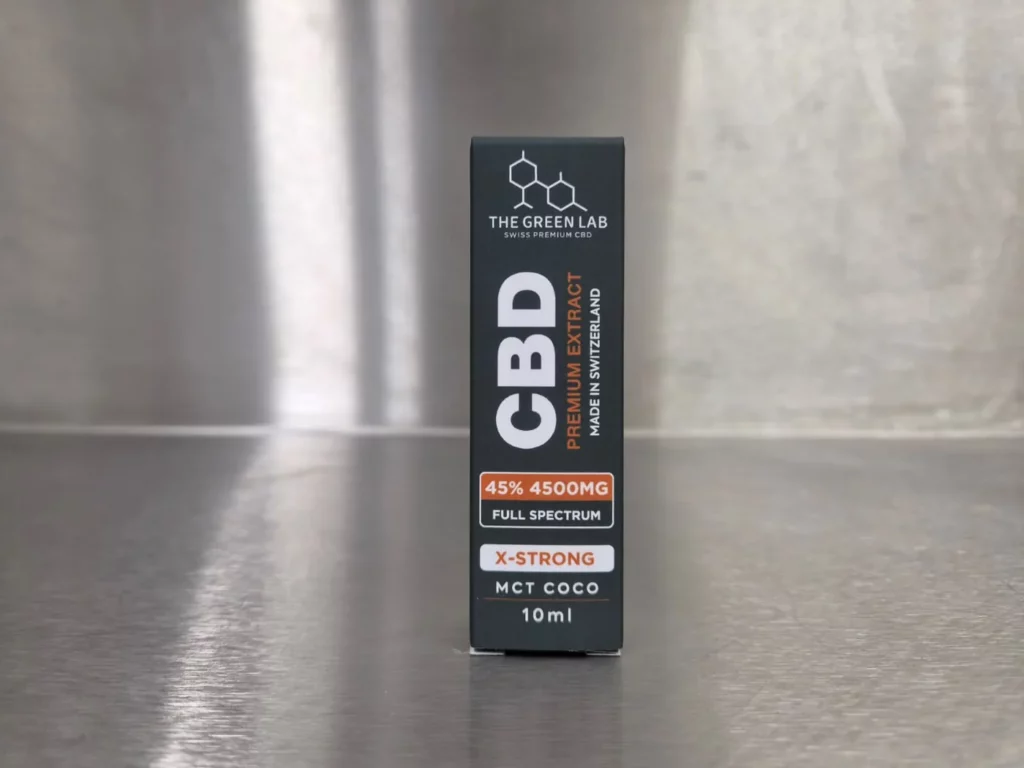
This solvent function has a consequence that we can measure directly across our range: each carrier oil sets a ceiling on the strength that can be formulated. Coconut MCT dissolves more cannabidiol than olive oil, and this is why the 40% in our Broad Spectrum range is made on MCT rather than on lemon olive, which cannot reach that level. It is not a commercial choice but a physical limit: beyond what the solvent accepts, the material does not stay in solution. The same logic explains why our X-Strong 45%, the highest strength in the range, is also formulated on MCT.
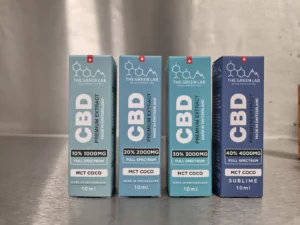
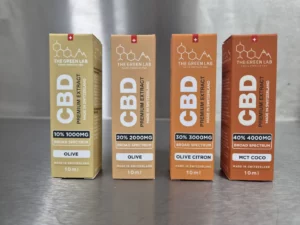
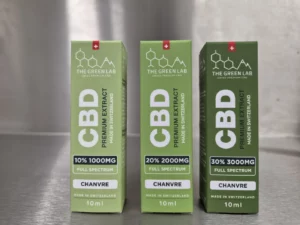
The carrier does more than hold the cannabidiol in solution; it also determines what happens to the terpenes. A study published in 2020 in the journal Molecules compared MCT oil and pharmacopoeia-grade olive oil as carriers for cannabis extracts. On the preservation of the cannabinoids themselves, the two carriers were on a par over sixty days. The difference lies in the terpenes: stable throughout the storage period in MCT, they declined markedly in olive oil after fifteen to thirty days. For an extract whose terpene profile is part of its identity, the choice of carrier oil therefore has a real bearing on what actually remains in the bottle after a few weeks.
What really sets two oils apart
The three criteria described on this page do not carry the same weight depending on what you are looking for.
Concentration is the easiest criterion to compare, because it converts into milligrams. It is also the least informative, since it says nothing about what accompanies the cannabidiol in the bottle.
The carrier oil is chosen on appearance and on shelf behaviour. It has no effect on the cannabidiol content at the time of bottling. It affects the product’s viscosity, its colour, its sensitivity to oxidation according to its degree of unsaturation, and the share of terpenes still present after a few weeks.
The spectrum is the criterion most often highlighted and the most poorly defined. Full Spectrum and Broad Spectrum refer to families of processes, not precise compositions, and no regulatory text defines them. Two extracts carrying the same claim can show very different ratios between cannabinoids. We devote an entire article to it.
One way out of this vagueness is to say which concentrate goes into which bottle. Here is what we use.
| Range | Carrier oil | Spectrum | Concentrate used | Strengths |
|---|---|---|---|---|
| Sublime | Coconut MCT | Full Spectrum | Distillate | 10, 20, 30, 40% |
| Hemp | Hemp seed oil | Full Spectrum | Distillate | 10, 20, 30% |
| Broad Spectrum | Olive, then lemon olive | Broad Spectrum | Distillate | 10, 20, 30% |
| Broad Spectrum | Coconut MCT | Broad Spectrum | Distillate | 40% |
| X-Strong | Coconut MCT | Full Spectrum | Crude extract, winterised and decarboxylated, not distilled | 45% |
The Gold X-Strong 45% holds a special place in this list. Its extract is winterised, which removes waxes and some of the lipids, then decarboxylated, which converts the cannabinoids from their acidic form to their neutral form. It is not, however, distilled. Its dark colour and powerful organoleptic profile are not manufacturing defects; they are the hallmarks of an extract that has not undergone this final separation.
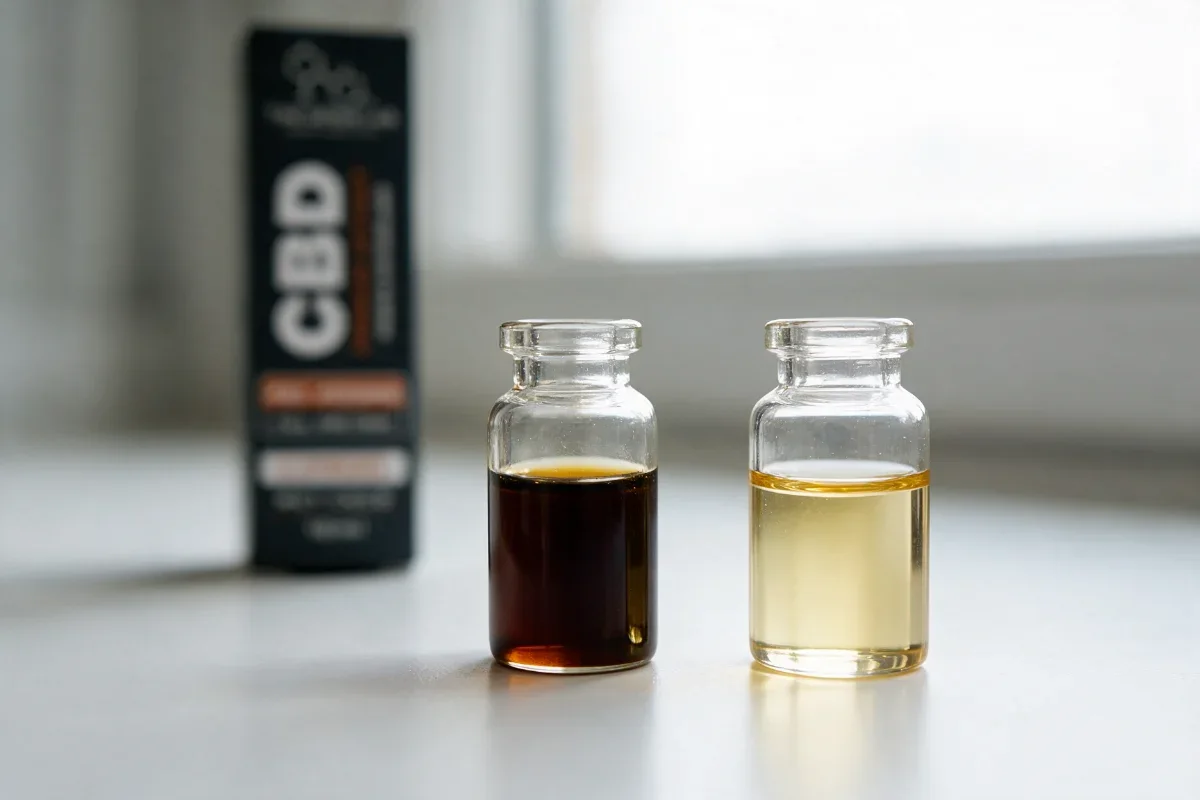
This last point is where most of the difference lies. An oil is not characterised by an isolated percentage but by the balance between the molecules it contains: the share of cannabidiol, that of minor cannabinoids, what remains of the terpenes after purification, and the proportion still in acidic form. These are the ratios that the process shapes at every stage, and they are what a batch certificate of analysis lets you verify. A percentage is read on a label. A composition is read on a report.
The topics in detail
Each of the points covered on this page is the subject of a separate article, for those who want to go further.
Full Spectrum, Broad Spectrum, isolate. No official text defines these three terms. The article explains what they cover in practice, how an isolate is obtained by crystallisation, and why the process tells you more than the claim on the label. Read the full article →
How much CBD is in a drop? The volume of a drop of oil depends on viscosity and the dropper, and no published measurement pins it down. The article shows why the drop is not a unit and how to calibrate your own dropper. Read the full article →
Same percentage, different extracts. The percentage measures only one molecule. Acidic and neutral forms, the 0.877 factor, losses on heating, volatile terpenes: what really makes up the profile of an extract, and how to read it on a certificate. Read the full article →
From crude extract to finished oil. Winterisation, decarboxylation, short path distillation, spectrum adjustment, dilution: what each manufacturing step removes, converts or adjusts, from crude extract to bottle. Read the full article →
Reading a concentration. Percentage, milligrams, bottle size: what each figure on a label says, why the same percentage can refer to two different quantities, and why our range stops at 45%. Read the full article →
Coconut MCT, hemp or olive. Fatty acid structure, viscosity, oxidative stability, terpene preservation: the role of the carrier oil and the reason for the ceiling it sets on each concentration. Read the full article →
Further reading: what Swiss law says about CBD, the 1% THC threshold and why a CBD oil is not a food supplement.
Also in our shop: our Hemp CBD oil.
Our laboratory
Our oils are formulated in our laboratory in Gland, in the canton of Vaud. Their cannabinoid levels are tested regularly by an external laboratory. Discover the laboratory →
Frequently asked questions
How many milligrams of CBD does a drop contain?
In a 10 ml bottle delivering around 250 drops, a 20% oil contains roughly 8 mg of cannabidiol per drop, and a 45% oil around 18 mg. These values are calculated from the bottle volume; the actual size of a drop varies with the viscosity of the oil and the dropper used.
What is the difference between a crude extract and a distilled extract?
Crude extract has not been distilled. It retains the waxes, heavy oils and pigments from the plant, which gives it a dark colour, high viscosity and a pronounced organoleptic profile. Distilled extract goes through a purification step that removes these compounds and concentrates the cannabinoids, resulting in a clear, fluid material with a more neutral profile.
Does distillation remove terpenes?
Yes. Hemp terpenes are volatile molecules, considerably lighter than cannabinoids, and distillation separates them from the target fraction. A distillate gains in purity and organoleptic neutrality, but it loses the aromatic profile of the original plant.
Why is Gold X-Strong 45% oil darker than the others?
Because it is based on a crude extract that has been winterised and decarboxylated, but not distilled. The pigments and heavy compounds that distillation would have removed are still present, which produces a darker, thicker material. The other oils in the range are formulated from distillates, which are considerably lighter in colour.
Why do two oils labelled 20% not look alike?
The percentage describes only the cannabidiol content. The proportions of minor cannabinoids, the presence or absence of acidic forms and the type of carrier oil vary from one product to another depending on the process and the raw material. The batch certificate of analysis is the document that makes these differences visible.
Which carrier oil should you choose?
Coconut MCT is colourless, the most fluid of the three and has no character of its own. Hemp oil, a deep green, comes from the same plant as the extract. Olive oil is the thickest and holds up well over time. None of these bases is superior to the others; they differ in appearance and stability.
Are CBD oils legal in Switzerland?
Products with a THC content below 1% may be sold in Switzerland, provided they comply with the regulations specific to their category. Stating a spectrum or a concentration is not enough to establish this compliance, which depends on analyses and labelling.
How long does an oil keep after opening?
The date is shown on the bottle. Shelf life depends mainly on storage conditions: away from light, at a stable room temperature and with the bottle closed after each use. Oils formulated on a base rich in unsaturated fatty acids, such as hemp oil, change more quickly than those formulated on coconut MCT.