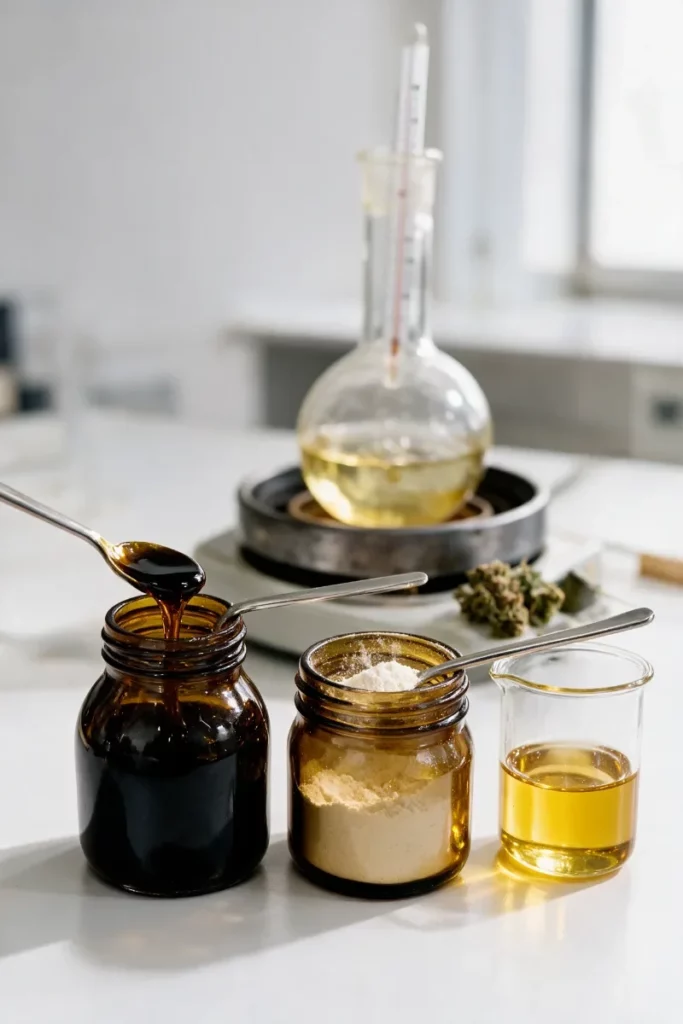
Two oils both show 20% CBD. Are they the same? Almost never. The percentage measures a single molecule; everything else, the other cannabinoids, their acidic or neutral form, the terpenes, depends on the plant and on how the extract was heated. Here is what really shapes the profile of an extract, and how to read it.
On this page
The percentage measures a single molecule
The figure printed on a bottle gives the amount of cannabidiol. It says nothing about the other molecules in the extract: CBG, CBC, acidic forms such as CBDA, and terpenes. Yet these are what set two extracts of the same strength apart. Two 20% oils can contain exactly the same amount of CBD and still very different proportions of everything else.
These proportions are not random. They depend on three things: the hemp variety, the timing of the harvest, and the process, especially the heat applied during production. The first two set what the plant produced; the third decides how much of it ends up in the bottle.
One parent molecule, three families
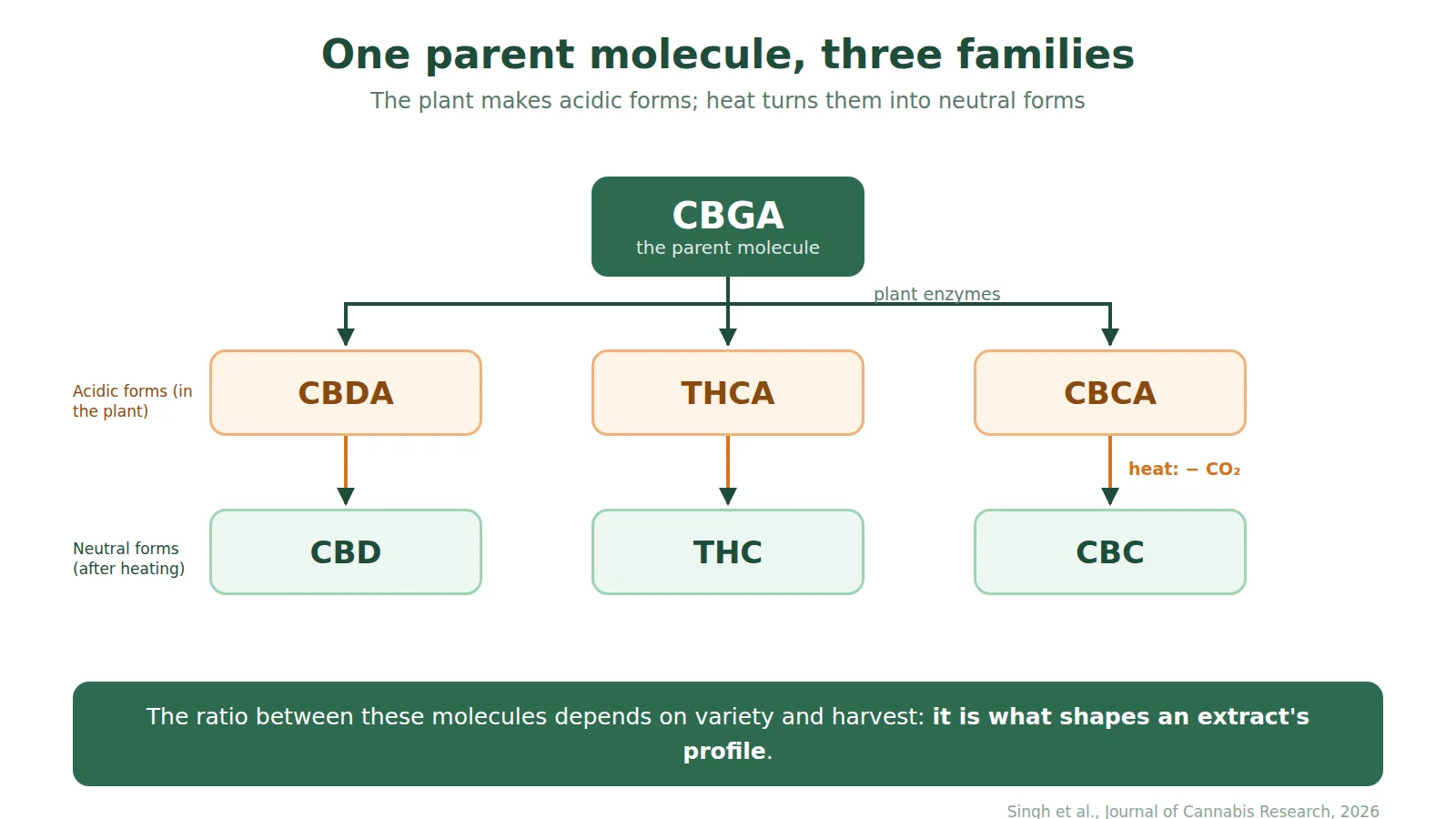
In the plant, cannabinoids all start from the same point. CBGA, often called the parent molecule, is converted by three different enzymes into CBDA, THCA or CBCA. The balance between these enzymes, specific to each variety, steers the plant towards a CBD-rich or THC-rich profile. CBD hemp comes from varieties geared towards CBDA.
Key point: the plant makes almost only acidic forms. CBD, THC and CBC, known as neutral forms, appear mainly when the material is heated. A small share of CBGA goes through none of the three enzymes: it stays in the plant and becomes CBG.
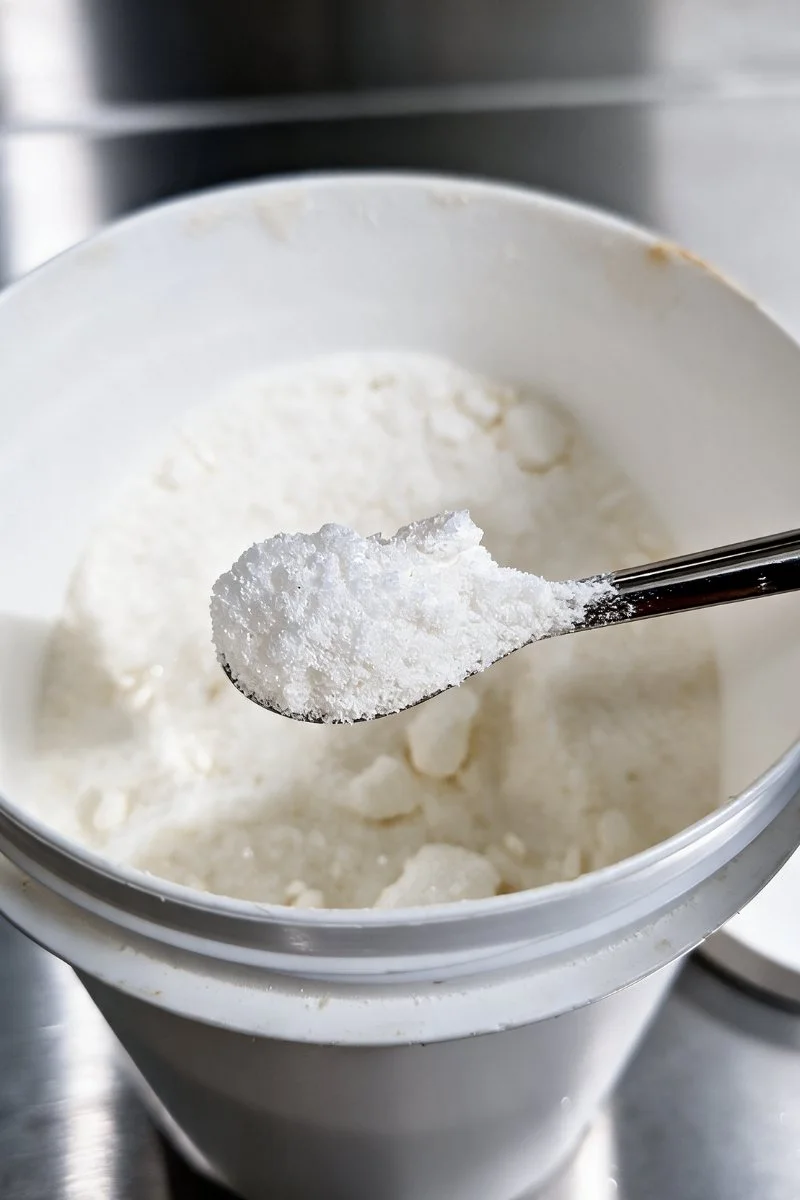
Acidic form, neutral form: what heat does
The shift from acidic to neutral form is called decarboxylation. Under heat, the molecule loses a carboxyl group, released as CO2. CBDA becomes CBD. The reaction also happens very slowly at room temperature during storage, but it is the heat applied during production that drives it.
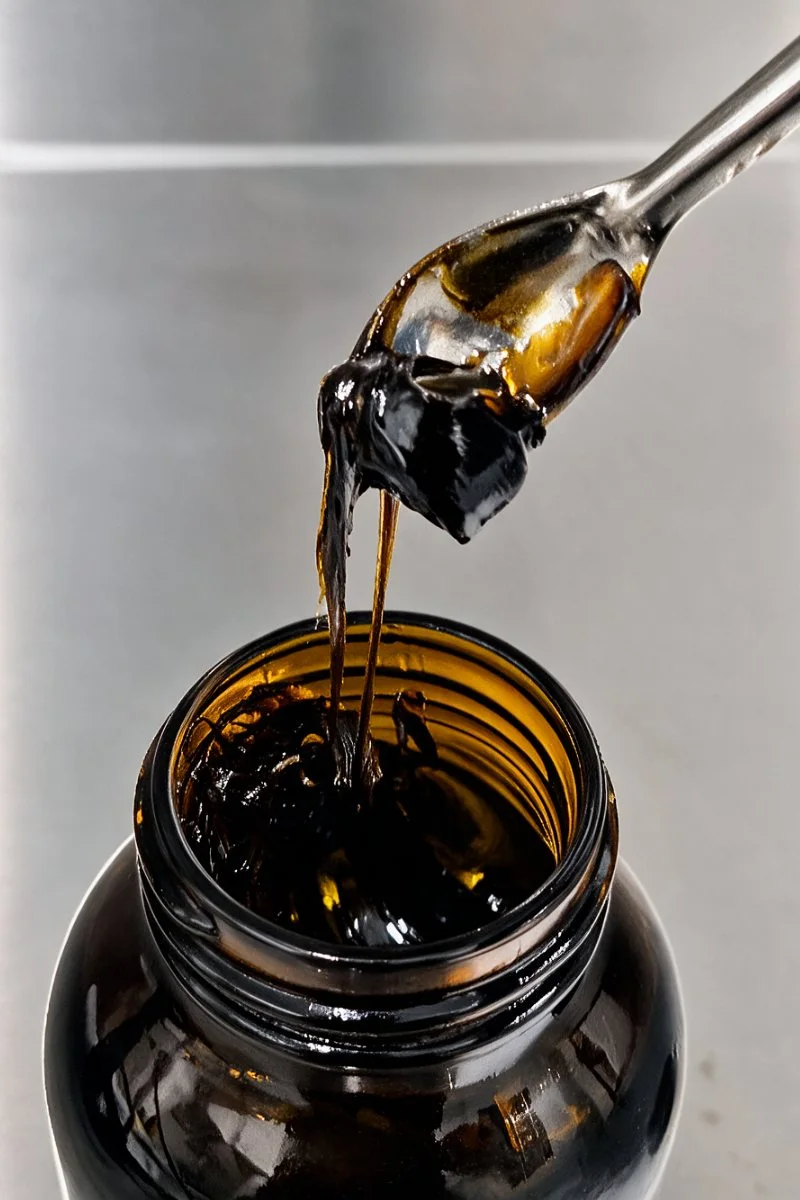
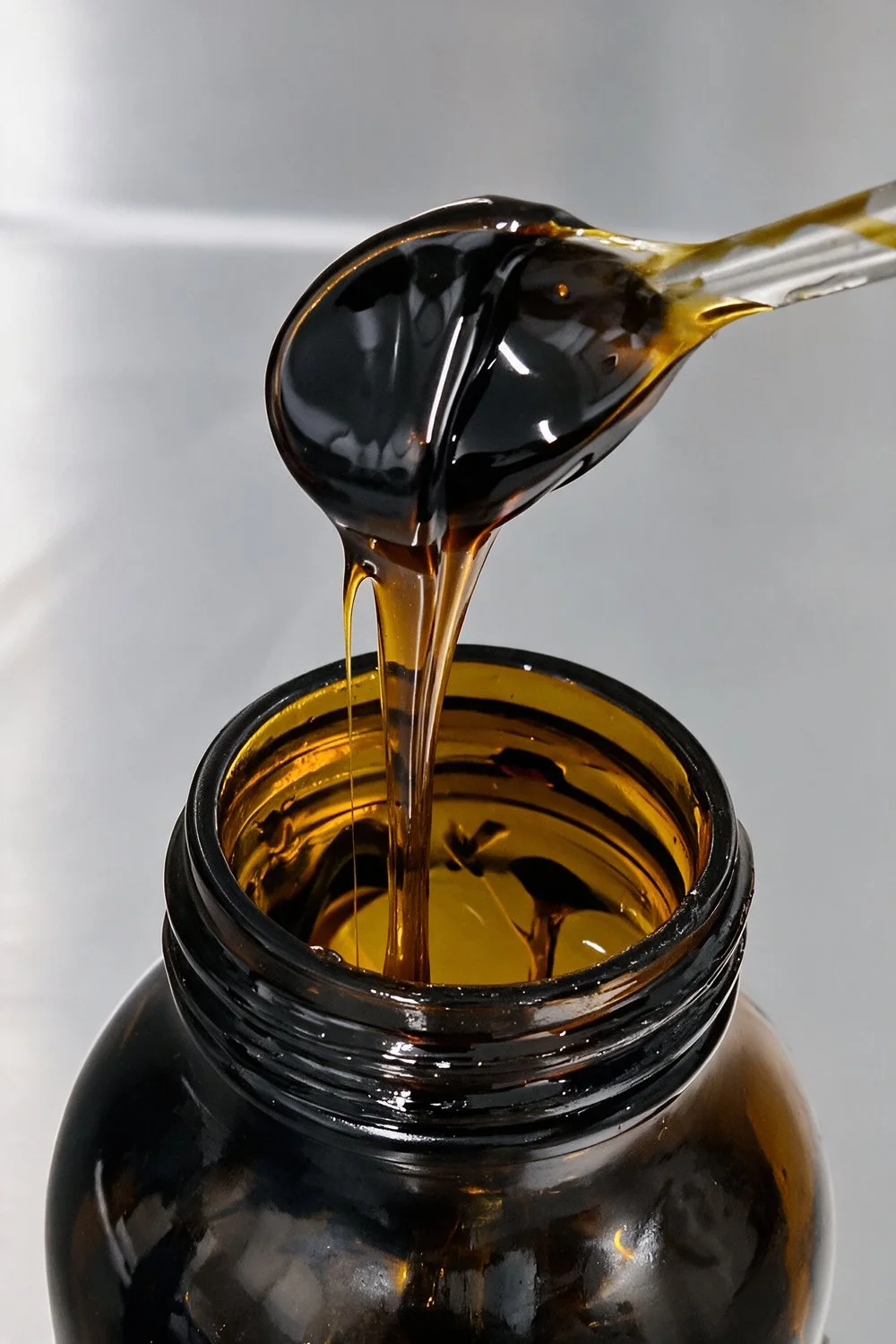
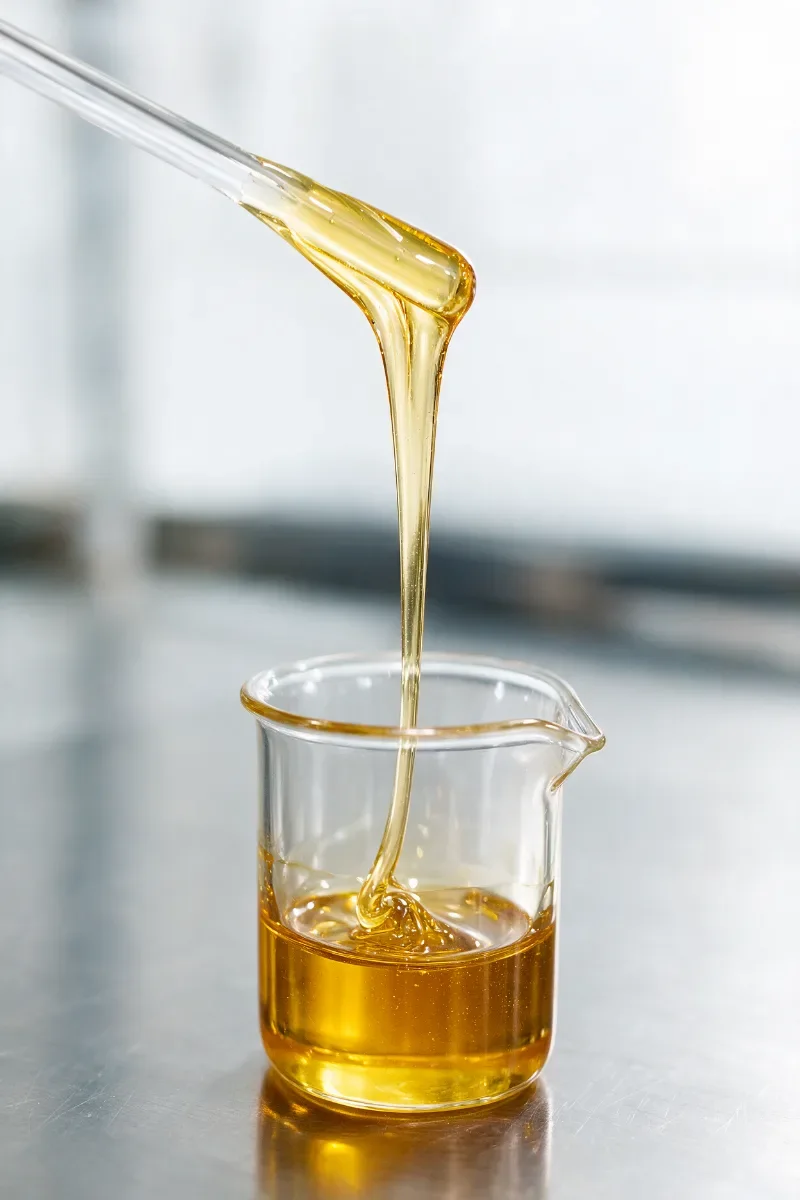
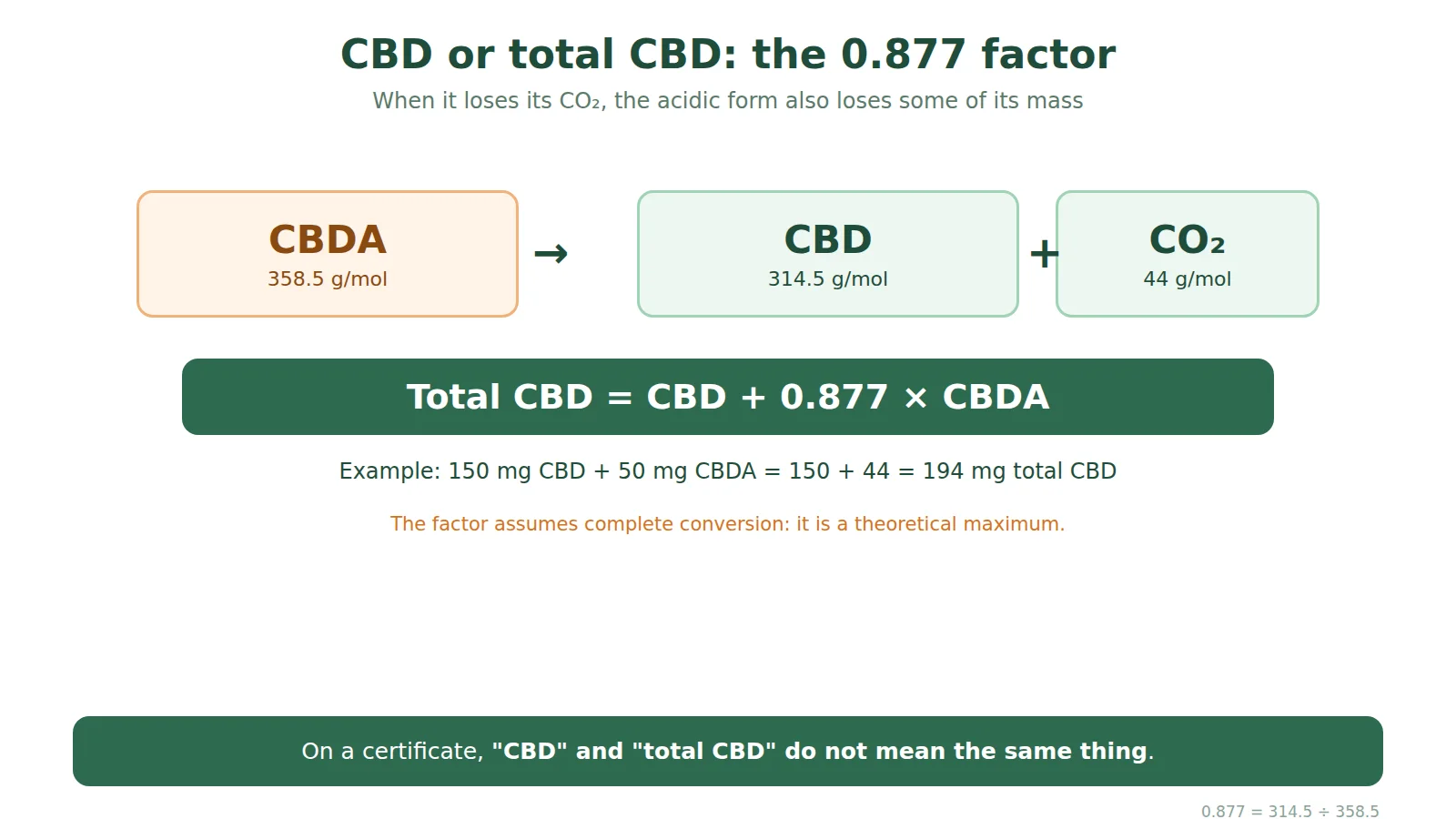
By losing its CO2, the molecule also loses part of its mass. CBDA weighs 358.5 g/mol, CBD 314.5 g/mol: one gram of CBDA can therefore yield at most 0.877 gram of CBD. That is where the 0.877 factor found on certificates of analysis, in the “total CBD” line, comes from. The same calculation applies to THC, which is why the Swiss threshold is based on total THC content, adding THC and converted THCA.
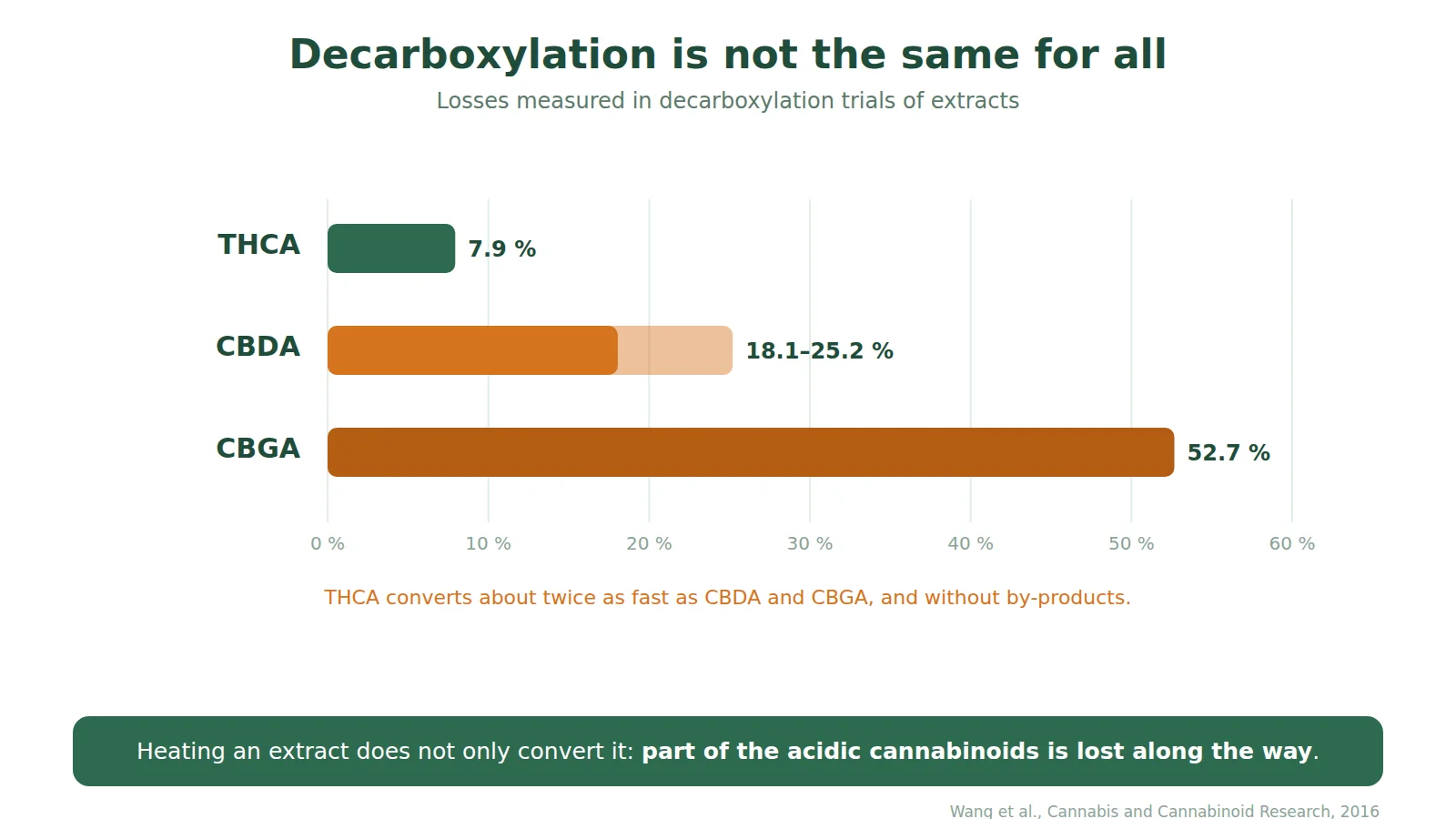
That maximum is not always reached. A 2016 study followed the decarboxylation of extracts between 80 and 145 °C. THCA converted about twice as fast as CBDA and CBGA, and without by-products. For CBDA and CBGA, however, part of the material was lost along the way, which the authors could not explain: 18 to 25% for the CBDA extracts, almost 53% for the CBGA ones. Heating an extract therefore does more than convert it; it also changes its proportions.
Terpenes, the most fragile part
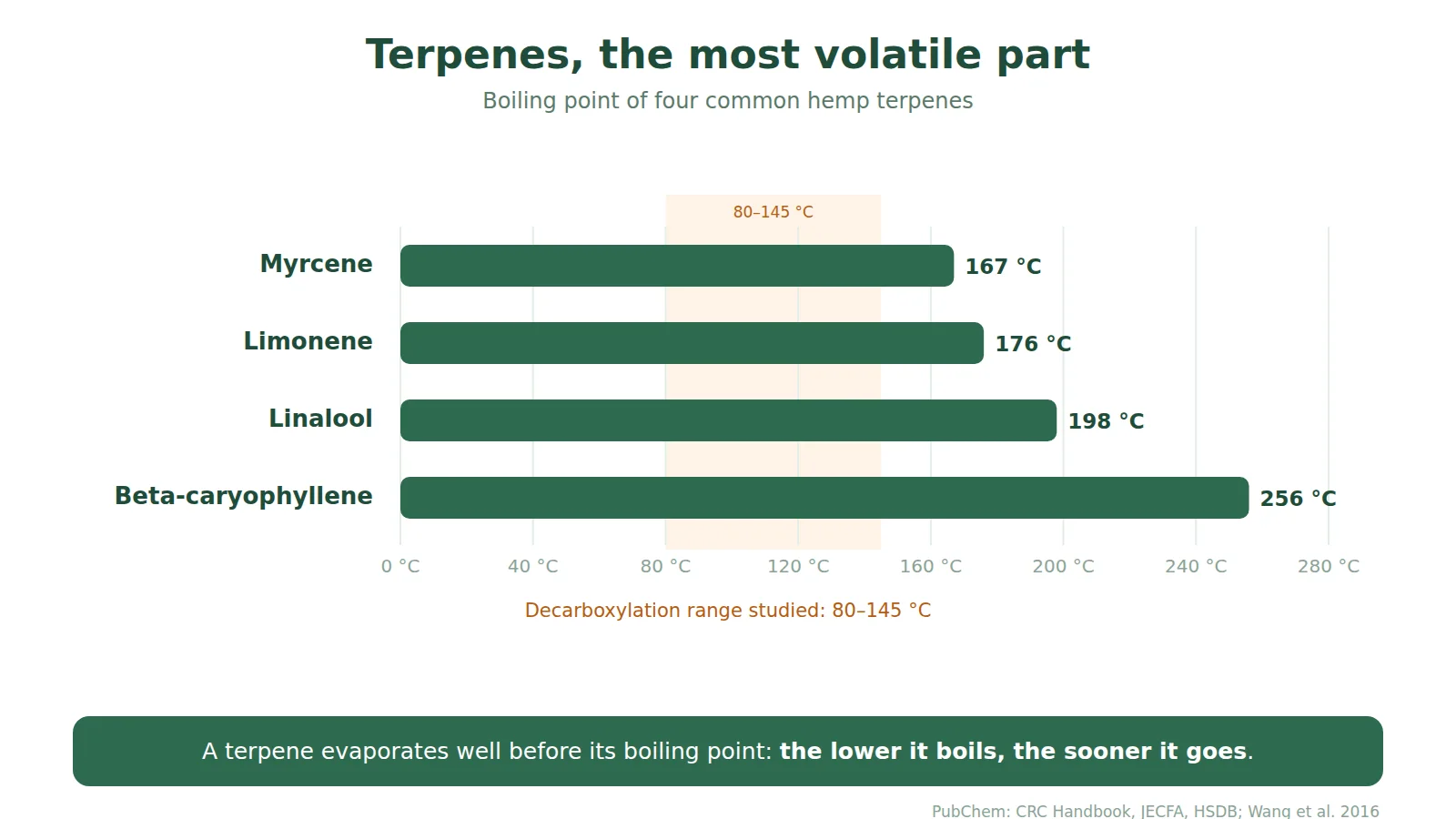
Terpenes are the aromatic molecules of hemp. They are also the most volatile part of the extract. Myrcene boils at 167 °C, limonene at 176 °C, linalool at 198 °C, beta-caryophyllene around 256 °C. And a liquid does not wait for its boiling point to evaporate: the lower a terpene boils, the sooner it escapes, already at drying, decarboxylation or distillation temperatures.
The extraction process matters too. A 2024 study comparing three processes on the same variety obtained plenty of terpenes by hydrodistillation, very few by supercritical CO2 extraction, and the most acidic cannabinoids by ethanol extraction. Two extracts with the same CBD percentage can therefore have unrelated aromatic profiles. We cover this in more detail in our article Full Spectrum, Broad Spectrum, isolate.
Comparing two extracts: what to read
To see what sets two oils of the same strength apart, read the batch certificate of analysis, and several of its lines rather than one. First, the difference between “CBD” and “total CBD”: if the two figures differ, part of the stated cannabidiol is still in the form of CBDA. Then the minor cannabinoids, CBG and CBC, whose shares vary from one variety and one batch to another. Finally the terpenes, which many certificates do not list.
| Certificate line | What it shows |
|---|---|
| CBD | cannabidiol already in neutral form |
| CBDA | the acidic form, not yet converted |
| Total CBD | CBD + 0.877 × CBDA: the maximum if everything were converted |
| CBG, CBC | minor cannabinoids, which change from batch to batch |
| Total THC | THC + 0.877 × THCA: the value that counts for the Swiss 1% threshold |
| Terpenes | often missing from the certificate; their presence depends on the process |
Watch point
“Total CBD” is not a measured amount of CBD: it is a calculation that assumes full conversion of CBDA. When a product highlights this figure, also check the “CBD” line on its own.
To go from the percentage to an amount per millilitre, then measure what a bottle actually delivers, our article on how much CBD is in a drop takes over. The carrier oil matters as well, across our ranges, from Sublime on MCT coconut oil to our olive oils.
Further reading: our guide to choosing a CBD oil and the 1% THC threshold.
Also in our shop: our Hemp CBD oil and all our CBD oils.
Our laboratory
In our laboratory in Gland, we work on our extracts at every step, from crude extract to finished bottle. It is the measured composition of each extract, not just its CBD percentage, that guides our formulations. Discover the laboratory →