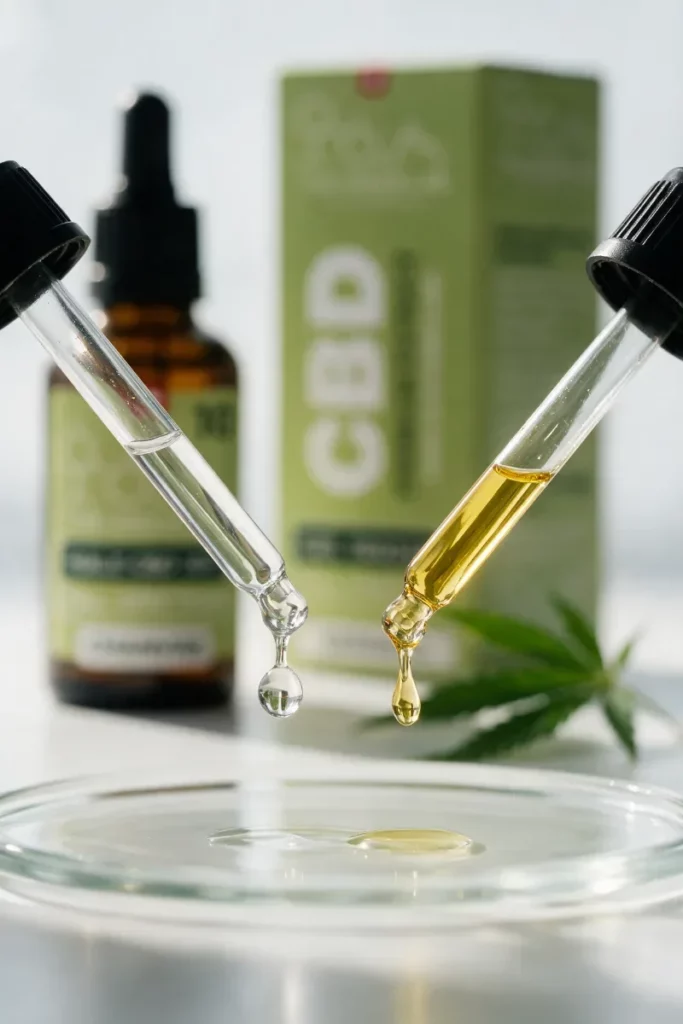
How many milligrams of CBD are in a drop? The question sounds simple, and it has no fixed answer. A drop is not a unit of measurement: its size depends on the tip, the liquid, the angle of the bottle and even the hand holding it. Here is what physics says, what the pharmacopoeias say, and the one reliable figure your bottle carries.
On this page
The reference drop only exists for water
A standard drop does exist. The European Pharmacopoeia devotes a chapter to it, 2.1.1 “Droppers”. Its definition is precise: 20 drops of water at 20 °C, released at one drop per second with the bottle held upright, must weigh 1,000 mg, give or take 50 mg. A compliant dropper therefore delivers drops of water of about 50 mg.
What matters is what the chapter leaves out. The only liquid it mentions is water. It says nothing about oils, their viscosity or their surface tension. The American reference points the same way: drop size varies with the dropper, but also with the viscosity, surface tension and density of the liquid, and a pharmacist must calibrate the dropper with the liquid actually used. The pharmacy of Geneva University Hospitals sums it up in one sentence: 1 mL does not always equal 20 drops.
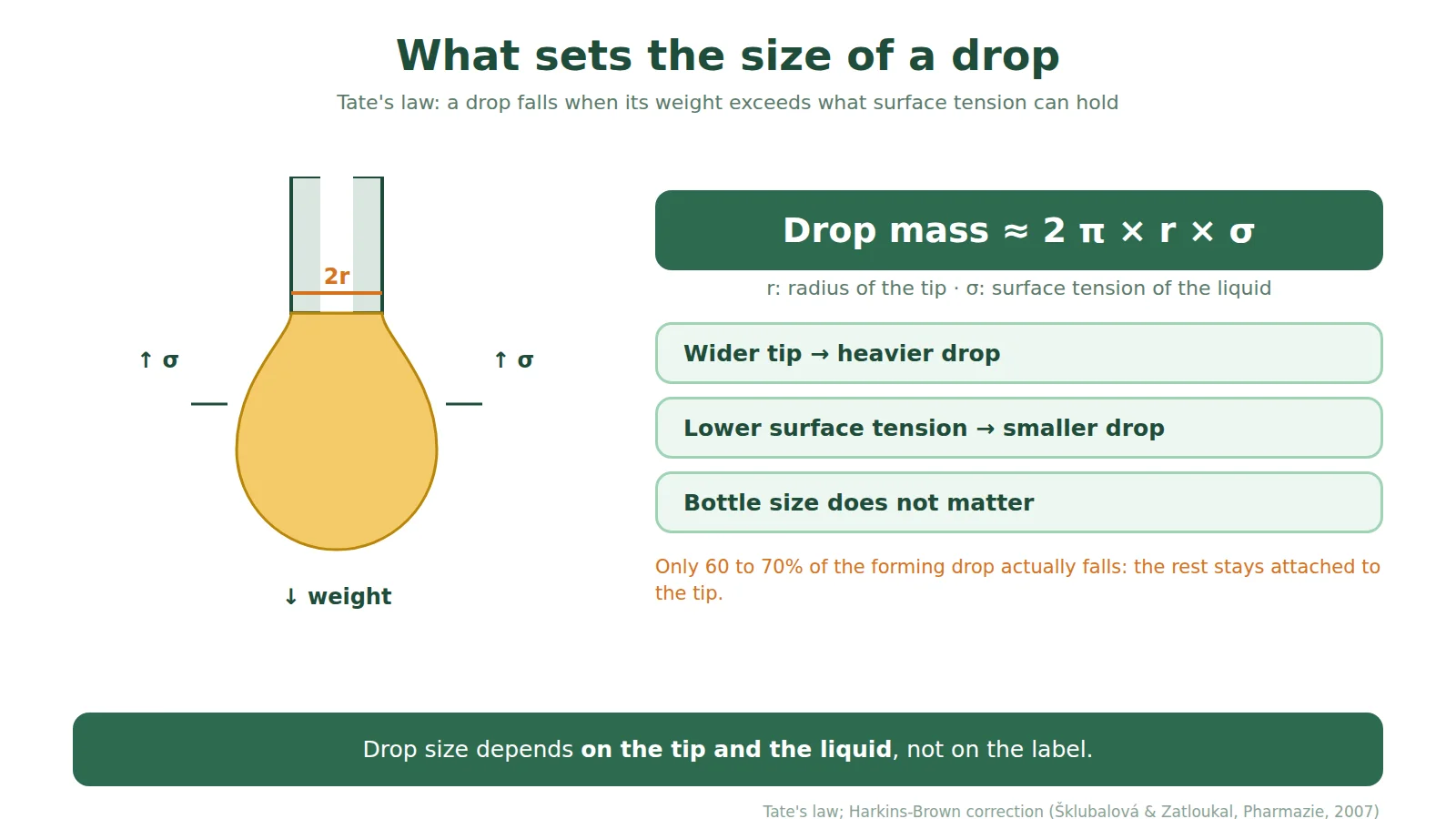
What sets the size of a drop
The physics of drops has been known since the 19th century. According to Tate’s law, a drop falls when its weight exceeds the force that surface tension exerts around the tip. To a first approximation, its mass is proportional to two things: the radius of the tip and the surface tension of the liquid. The size of the bottle plays no part.
Reality is a little subtler. The so-called Harkins-Brown correction shows that only 60 to 70% of the drop formed at the tip actually falls; the rest stays on the glass. A 2007 study of seven commercial plastic tips, 2.4 to 2.7 mm in diameter, measured drops of 32.6 to 46.8 mg, their mass rising steadily with the tip diameter.
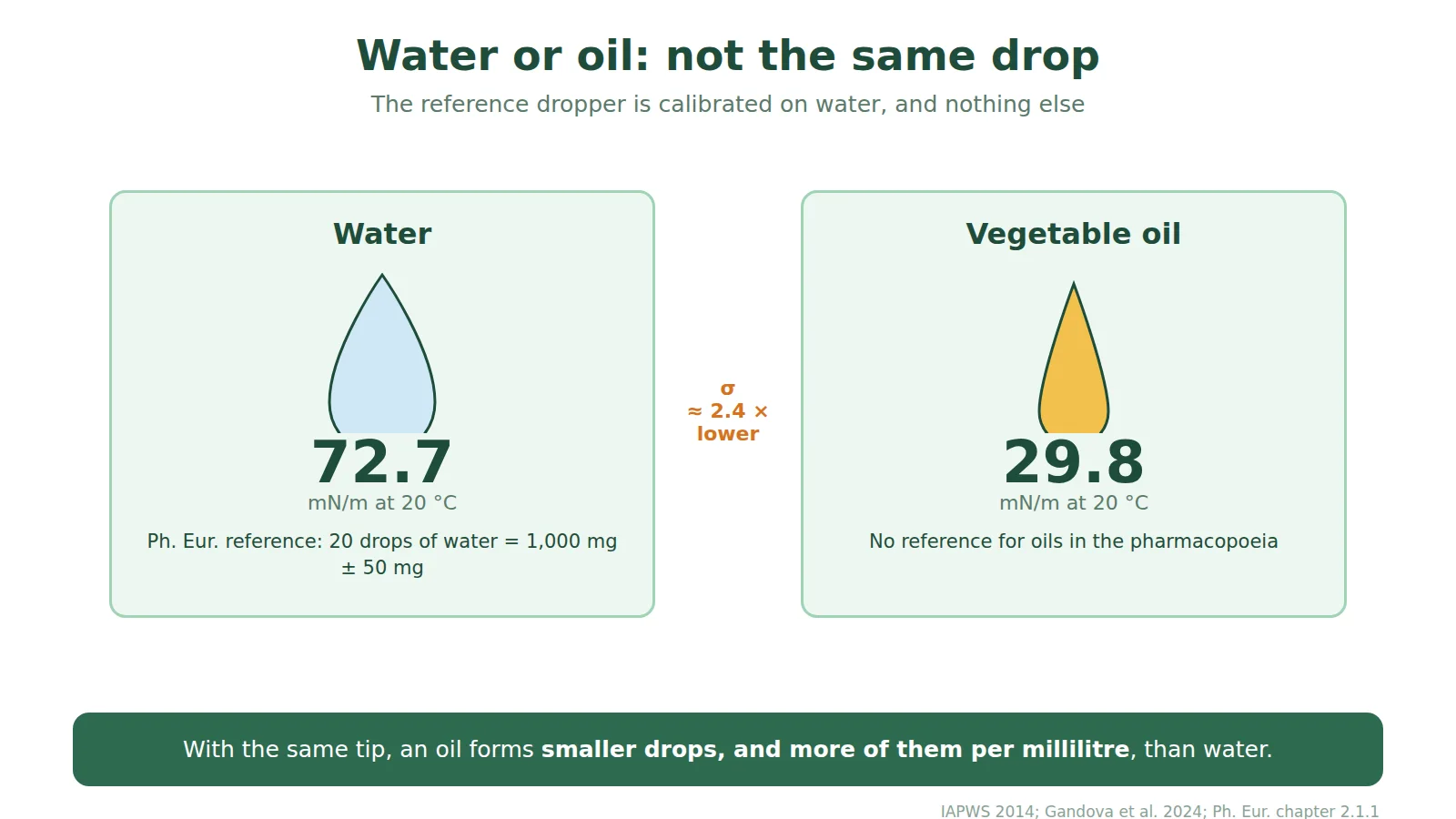
Water or oil: not the same drop
Since drop mass follows surface tension, the liquid changes everything. At 20 °C, the surface tension of water is 72.7 mN/m. That of a vegetable oil, measured in 2024, is 29.8 mN/m, about 2.4 times lower. Oil is also far more viscous: MCT oil, for example, measures 25 to 33 centipoise at 20 °C.
The consequence follows directly from Tate’s law: with the same tip, an oil forms smaller drops than water, and it takes more of them to fill a millilitre. The rule of 20 drops per millilitre, set on water, does not apply to an oil. This is a physical deduction, not a measurement: how much smaller, no one has published for a CBD oil.
The same drop, up to twice the size
Even with a single liquid, the drop varies. A 2005 study measured the volume of drops delivered by eye-drop bottles depending on the tip and how the bottle was held. Results ranged from 38.9 to 74.4 microlitres, almost double, for what looks like the same gesture.
| Conditions | Volume of one drop |
|---|---|
| Plastic tip, bottle upright | 41.3 to 48.1 µL |
| Plastic tip, bottle tilted at 45° | 38.9 to 44.8 µL |
| Wet rubber tip | 53.3 to 74.4 µL |
| Drop-to-drop variation, controlled conditions | 3.3 to 5.2% |
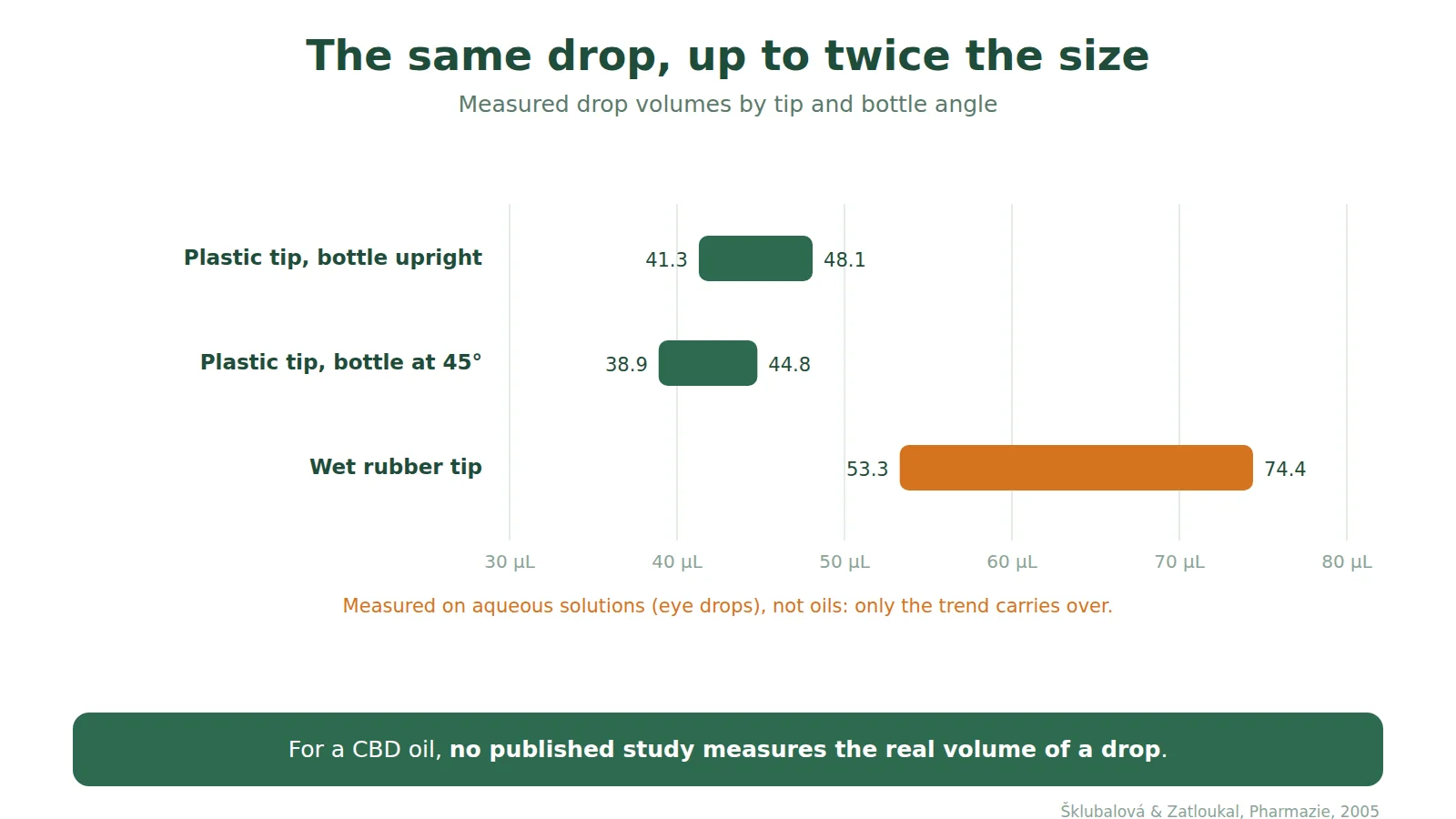
These figures concern aqueous solutions, not oils. Their values do not carry over as such; the trend does. Angle, tip diameter and tip material are enough to change the drop noticeably.
For a CBD oil, no published measurement
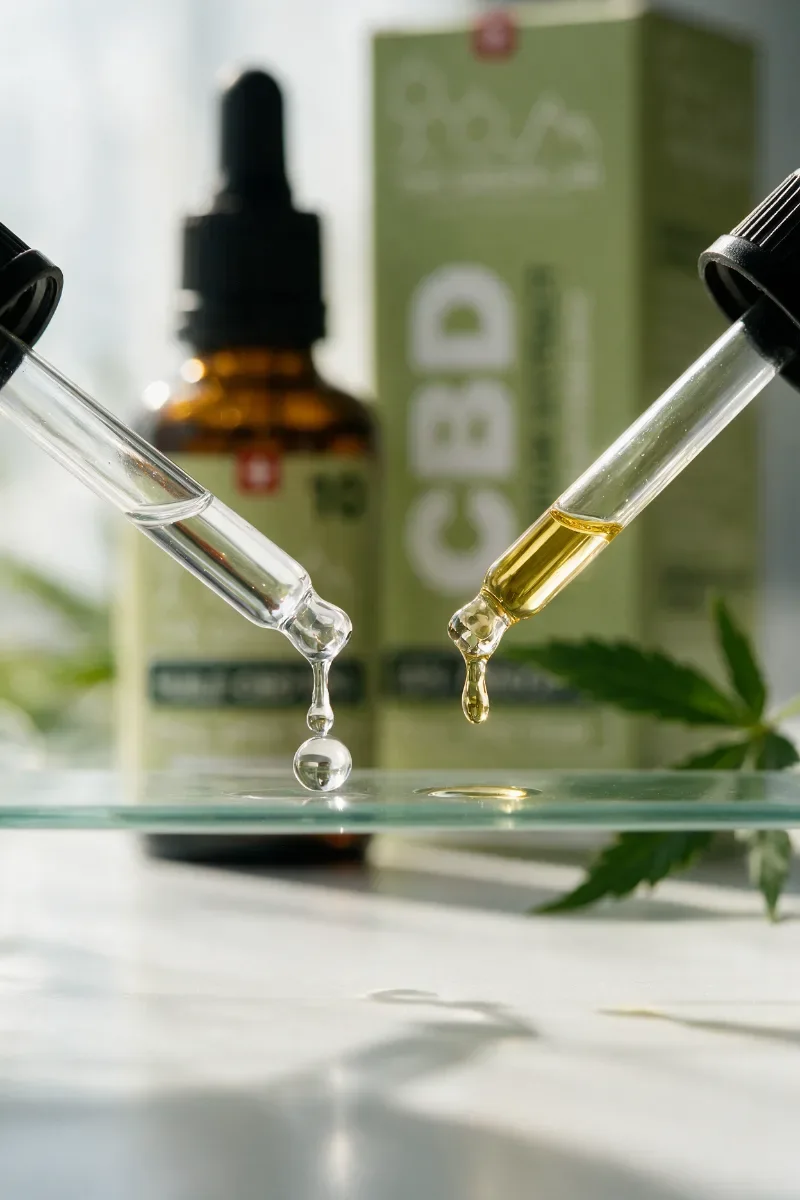
This is the most surprising finding of our research. All the available metrology of drops concerns aqueous liquids: eye drops, oral solutions. We found no published study measuring the real volume or mass of drops delivered by a bottle of vegetable oil, let alone CBD oil.
In other words, the “milligrams per drop” figures found almost everywhere are estimates based on the assumption of 20 drops per millilitre, that is, on water. For an oil, that assumption has no measured basis.
The one reliable figure: milligrams per millilitre
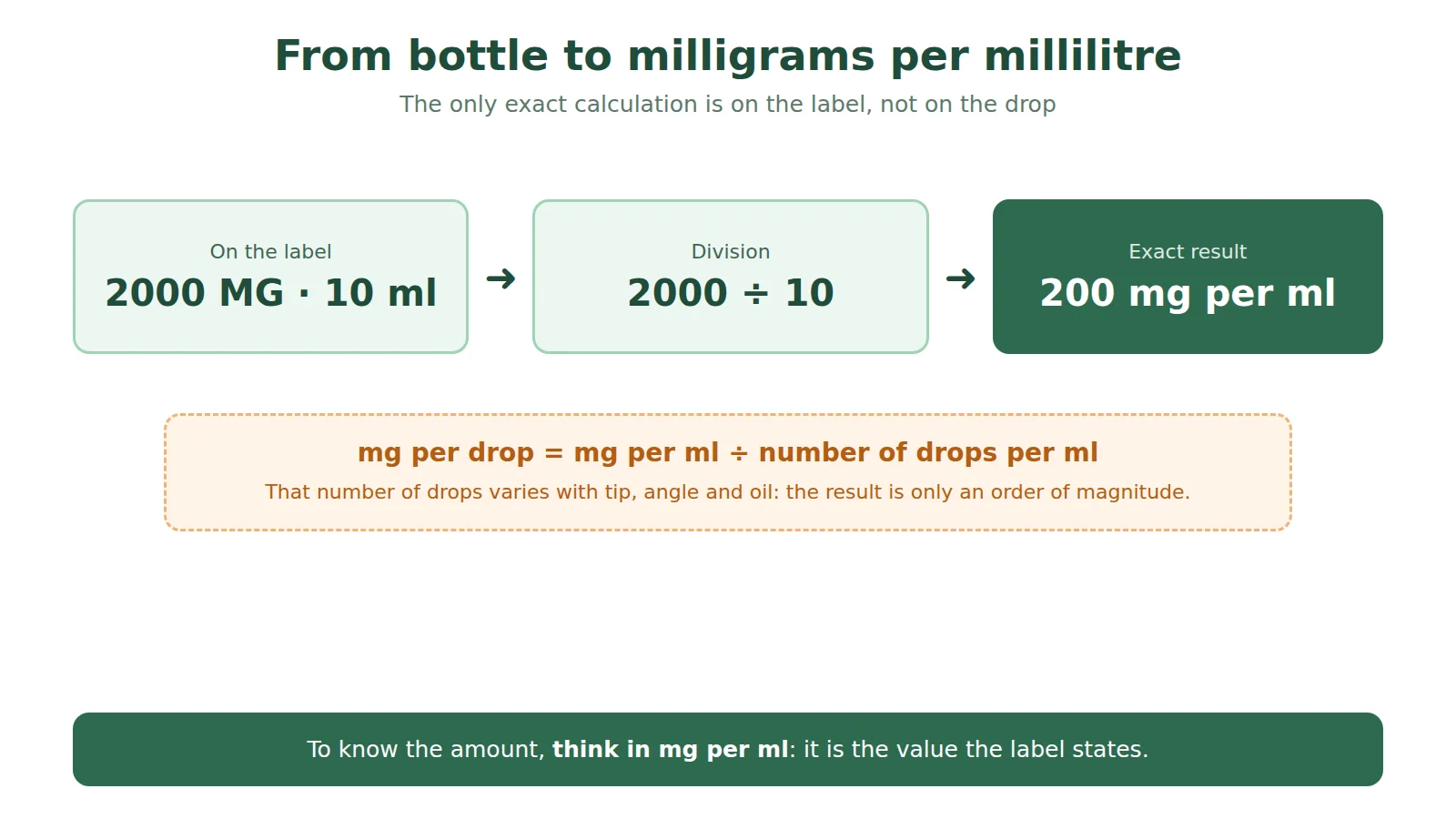
What the label lets you calculate without approximation is milligrams of CBD per millilitre. Simply divide the total amount printed by the bottle volume: a 10 ml bottle marked 2000 MG contains 200 mg per ml. Our labels express the percentage as mass per volume, which makes this calculation direct.
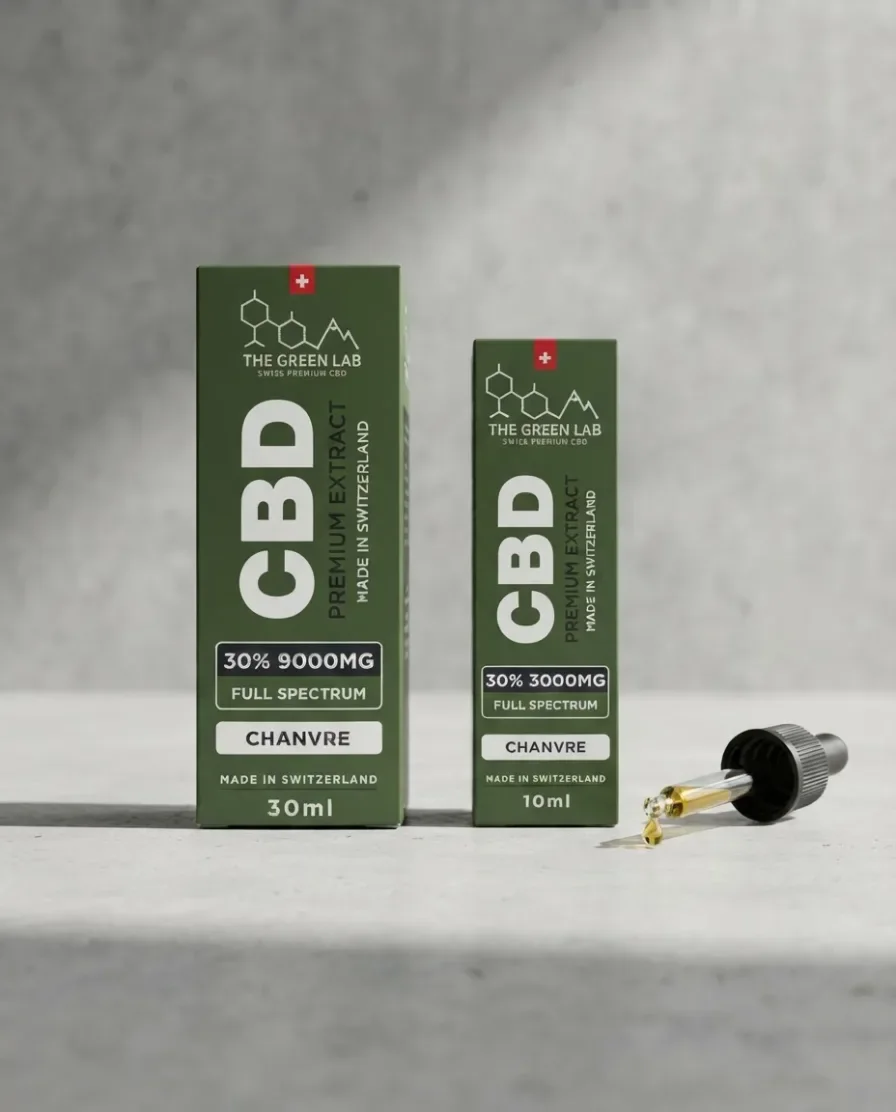
Bottle size does not change this figure. Our 30% Hemp oil comes in 10 ml, marked 3000 MG, and in 30 ml, marked 9000 MG: 300 mg per ml in both cases. And as Tate’s law shows, the drop depends not on the size of the bottle but on its tip.
Going from millilitres to drops requires a figure that only measurement provides: the number of drops that fill one millilitre with a given bottle and gesture. You get it by counting the drops needed to reach the 1 ml mark of a small graduated cylinder, always holding the bottle the same way. This is how pharmacists calibrate a dropper, and it is the only method that accounts for the actual oil. The same applies to all our oils, from the Sublime range on MCT coconut oil to our olive oils. And for what the oil contains beyond cannabidiol, our article Full Spectrum, Broad Spectrum, isolate explains it.
Watch point
A “milligrams per drop” figure given without a method almost always rests on the assumption of 20 drops per millilitre, which holds for water. For an oil, treat it as an order of magnitude, never as a measurement.
Further reading: our guide to choosing a CBD oil, how to read a concentration and the role of the carrier oil.
Also in our shop: our Olive CBD oil (Broad Spectrum).
Our laboratory
In our laboratory in Gland, the content of our oils is expressed per volume of oil, never per drop. It is the only unit that depends neither on the dropper nor on how the bottle is held. Discover the laboratory →
Frequently asked questions
How many drops are in 1 ml of CBD oil?
There is no fixed number. The rule of 20 drops per millilitre comes from the European Pharmacopoeia dropper, calibrated on water. An oil has a surface tension about 2.4 times lower: with the same tip, its drops are smaller and more numerous. The only way to know is to count the drops needed to fill 1 ml with your own bottle.
How many milligrams of CBD are in a drop?
It depends on the oil’s concentration and the real volume of the drop. The concentration is on the label: a 10 ml bottle marked 2000 MG contains 200 mg per ml. The drop volume varies with the tip, the angle and the oil, and no published study measures it for a CBD oil. Any per-drop figure is therefore an order of magnitude.
Why is an oil drop smaller than a water drop?
According to Tate’s law, the mass of a drop is proportional to the radius of the tip and the surface tension of the liquid. At 20 °C, water measures 72.7 mN/m and a vegetable oil 29.8 mN/m. With the same tip, the oil drop therefore falls sooner and smaller.
Does bottle size change the size of the drop?
No. Drop size depends on the tip and the liquid, not on the bottle volume. A 30 ml and a 10 ml bottle at the same concentration contain the same amount of CBD per millilitre: our 30% Hemp oil shows 300 mg per ml in both sizes. Only the tip, if it differs, can change the drop.
How do I find the CBD content of my bottle?
Divide the total amount of CBD printed on the label by the bottle volume. You get milligrams per millilitre, the only value that can be calculated without approximation. On our bottles, the percentage is expressed as mass per volume: 20% means 200 mg per ml, 30% means 300 mg per ml.