
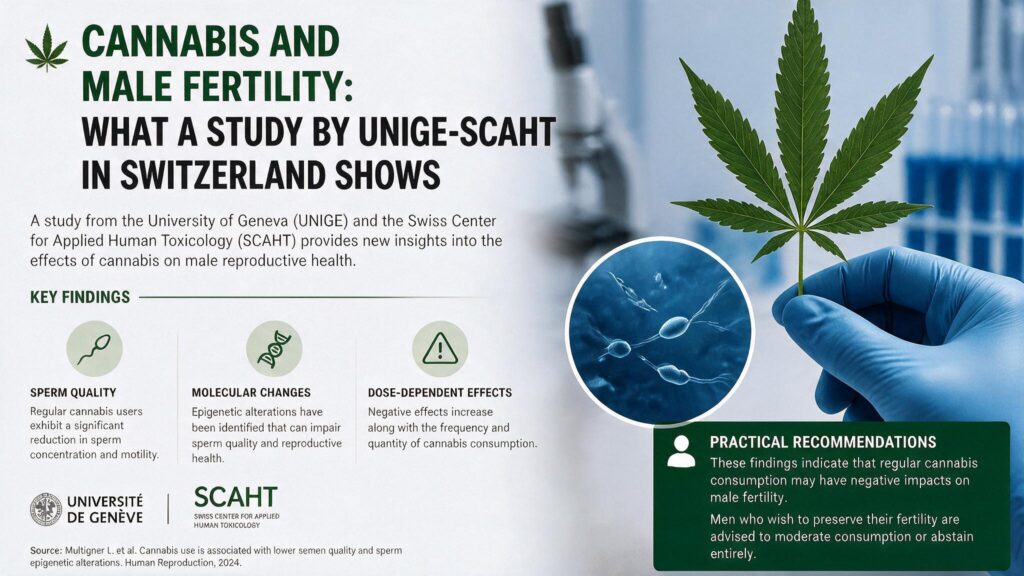
Scientific research on cannabis is moving forward at a rapid pace. And sometimes, its findings are surprising — even to experts. A study conducted jointly by the University of Geneva (UNIGE) and the Swiss Centre for Applied Human Toxicology (SCAHT) has just shed new light on the interactions between cannabis compounds, the male hormonal system, and fertility. This valuable data is fuelling a global scientific debate — and deserves to be read with care, nuance, and a critical mind. At TheGreenLab.ch, based in Gland in the canton of Vaud, we closely follow the evolution of research around cannabidiol and its molecular cousins. Not to make grand promises, but to offer you honest, well-documented, and accessible information. Here is what this Swiss study teaches us, what it does not yet tell us, and why it matters in the scientific landscape of cannabis in 2024.
What is this UNIGE-SCAHT study on cannabis and the hormonal system?
The SCAHT (Swiss Centre for Applied Human Toxicology), in collaboration with researchers from the University of Geneva, conducted an in-depth investigation into the biological effects of cannabinoids — and in particular their interaction with the male endocrine system, meaning the system responsible for hormonal regulation.
The goal was not to validate or invalidate a practice, but to observe: what happens, at a molecular level, when certain cannabis compounds come into contact with the cells involved in hormonal production and spermatogenesis?
A rapidly expanding research landscape
This study is part of a global movement of scientific reassessment of cannabis. Since the gradual legalisation of CBD in many countries, including Switzerland, academic laboratories have been multiplying their investigations to better understand how the various compounds in the plant interact with our biology.
The cannabinoids studied include not only THC (the psychoactive compound, legally regulated), but also CBD (cannabidiol), CBG (cannabigerol), CBC (cannabichromene), as well as the terpenes and flavonoids that make up the plant’s complete chemical profile.
Why is male fertility at the heart of the study?
The male reproductive system is particularly sensitive to hormonal fluctuations. Testosterone production, sperm quality, and the sperm maturation process all depend on a precise hormonal balance. The researchers were asking: are the cannabinoid receptors present in male reproductive tissue influenced by exposure to cannabinoids? And if so, in what way?
What does science actually say about cannabinoids and hormones?
The human body has an endocannabinoid system (ECS) — a network of biological receptors found in almost every organ, including the testes, the pituitary gland, and the hypothalamus. These three structures play a central role in male hormonal regulation.
CB1 and CB2 receptors in reproductive tissue
The CB1 and CB2 receptors, which are the two main anchoring points of the endocannabinoid system, have been identified in Leydig cells (which produce testosterone), in sperm cells themselves, and in Sertoli cells (involved in sperm maturation).
What the UNIGE-SCAHT study highlights is that the interaction of certain cannabinoids with these receptors can modulate biological signals upstream of hormonal production — without a direct causal link having yet been precisely established for each compound.
THC and CBD: different interaction profiles
This is one of the most important points in current research: not all cannabinoids behave in the same way. THC, by binding directly to CB1 receptors, may exert a more direct influence on the hypothalamic-pituitary-gonadal axis — the main pathway for testosterone regulation.
CBD, on the other hand, does not act as a direct agonist of these receptors. Its mechanism of action is more indirect, more complex. Current data suggests a distinct interaction profile, which opens up fascinating questions for future research — without yet allowing for definitive conclusions.
- THC: direct interaction with CB1, documented potential impact on hormonal regulation
- CBD: indirect mechanism, different interaction profile, ongoing research
- CBG, CBC, terpenes, flavonoids: still emerging data, growing scientific interest
How does this research fit into the landscape of legal CBD in Switzerland?
In Switzerland, CBD has been legal since 2016, provided the THC content is below 1%. The market has developed rapidly, with a diverse range of products: CBD oils, CBD flowers, CBD hash, CBD vapes, and CBD balms.
This rapid commercial development has outpaced exhaustive scientific research. This is precisely where institutions such as UNIGE and SCAHT play a fundamental role: objectively documenting what is not yet known, free from industrial or ideological bias.
A market that needs science
Swiss CBD consumers are increasingly informed and discerning. They no longer simply want to buy a product — they want to understand what they are consuming. This is a healthy development. And it places a editorial responsibility on market players like TheGreenLab.ch: to share available scientific information honestly, without over-interpretation or minimisation.
Why this study also concerns CBD consumers
Even though legal CBD products in Switzerland contain a very low level of THC (below 1%), the question of the biological effects of cannabinoids more broadly remains entirely legitimate. CBD interacts with the endocannabinoid system — that is its very nature. Understanding how this system is connected to other biological systems, such as the hormonal system, is a normal and necessary scientific approach.
This does not mean that legal CBD products represent an established risk to male fertility — current data does not support such a conclusion. It means that research is ongoing, that the questions are legitimate, and that transparency is essential.
What are the limitations and prospects for this research?
Every scientific study deserves to be read within its methodological context. A few points of caution are necessary before interpreting the results of the UNIGE-SCAHT study.
Exposure conditions often far removed from reality
Many studies on cannabis and human biology are conducted in vitro (on cells in a laboratory) or on animal models. The doses and exposure conditions used in the laboratory do not always correspond to the actual exposure levels of consumers. A result observed in a cell culture does not automatically translate