In a double-blind pilot trial at the University of Florida, 29 healthy young adults took 67 mg of CBD per day or a placebo for 15 days, with an intense leg workout after about ten days. Forty-eight hours after the exercise, participants in the CBD group rated their pain at rest at 47.8 out of 100 on average, compared with 61.6 in the placebo group, and had lost less strength. No adverse effects were reported. The trial, small and designed first to test tolerability and feasibility, does not allow any conclusion about efficacy. Here is what it measured. Our method and the list of all summaries in the series are in our guide to understanding a scientific study on CBD.
| The study at a glance | |
|---|---|
| Original title | Efficacy and safety of cannabidiol (CBD) on reducing pain and functional impairment associated with exercise-induced muscle injury: a randomized placebo-controlled feasibility trial |
| Journal | Journal of Cannabis Research, vol. 8, article 64 |
| Date | 31 March 2026 |
| Authors | J. W. Stauffer, J. A. Crow, M. D. Bishop, R. L. Cook et al. (University of Florida and Augusta University, United States) |
| Type | Randomised, double-blind, placebo-controlled pilot trial in 29 healthy young adults |
| Funding | Consortium for Medical Marijuana Clinical Outcomes Research. No conflicts of interest declared |
| Level of evidence | ●●○○ 2 out of 4: a randomised controlled trial, but small and designed first to test safety and feasibility |
| Full text | Open access on PubMed Central |
On this page
- Why test CBD after intense exercise
- Exercise calibrated to damage the muscle
- What the trial measured 48 hours after exercise
- Time to recovery: about 12 hours apart
- Tolerability: no adverse effects reported
- What the trial shows and does not show
- Competitive sport: the anti-doping question
- And in Switzerland?
- In summary
- Frequently asked questions
Why test CBD after intense exercise
In the United States, many athletes, including professionals, use CBD (cannabidiol) products for muscle soreness or pain. According to a survey cited by the authors, pain relief is the leading medical reason for using CBD, given by 62% of respondents.
For the University of Florida researchers, this use has got ahead of the evidence. Their pilot trial had three aims: to check the tolerability of a CBD-rich extract, to test the feasibility of the protocol, and then to collect preliminary data on efficacy. It was authorised by the US Food and Drug Administration (FDA) and registered on ClinicalTrials.gov.
Exercise calibrated to damage the muscle
Of 37 people randomly assigned, 29 completed the trial: 15 in the CBD group and 14 in the placebo group. They were healthy young adults, 20 women and 9 men, aged 20 on average, who did not regularly use cannabis, tobacco or anti-inflammatory drugs, and did not train their legs more than twice a week.
The CBD group received a commercial hemp extract described as “full spectrum”: rich in CBD, it also contains the plant’s minor cannabinoids and terpenes, with less than 0.3% THC. Participants placed it under the tongue (sublingual route), morning and evening, for 15 days, giving 67 mg of CBD per day. The placebo was a neutral liquid that could not be told apart from the active product. Neither the participants nor the researchers knew who was receiving what: this is what double-blind means.
After about ten days of use, each participant performed five sets of 25 maximal-effort leg extensions on a machine that controls and measures force (an isokinetic dynamometer). Braking work, known as eccentric work, causes small injuries in the muscle at the front of the thigh (the quadriceps): inflammation, soreness and loss of strength for a few days.
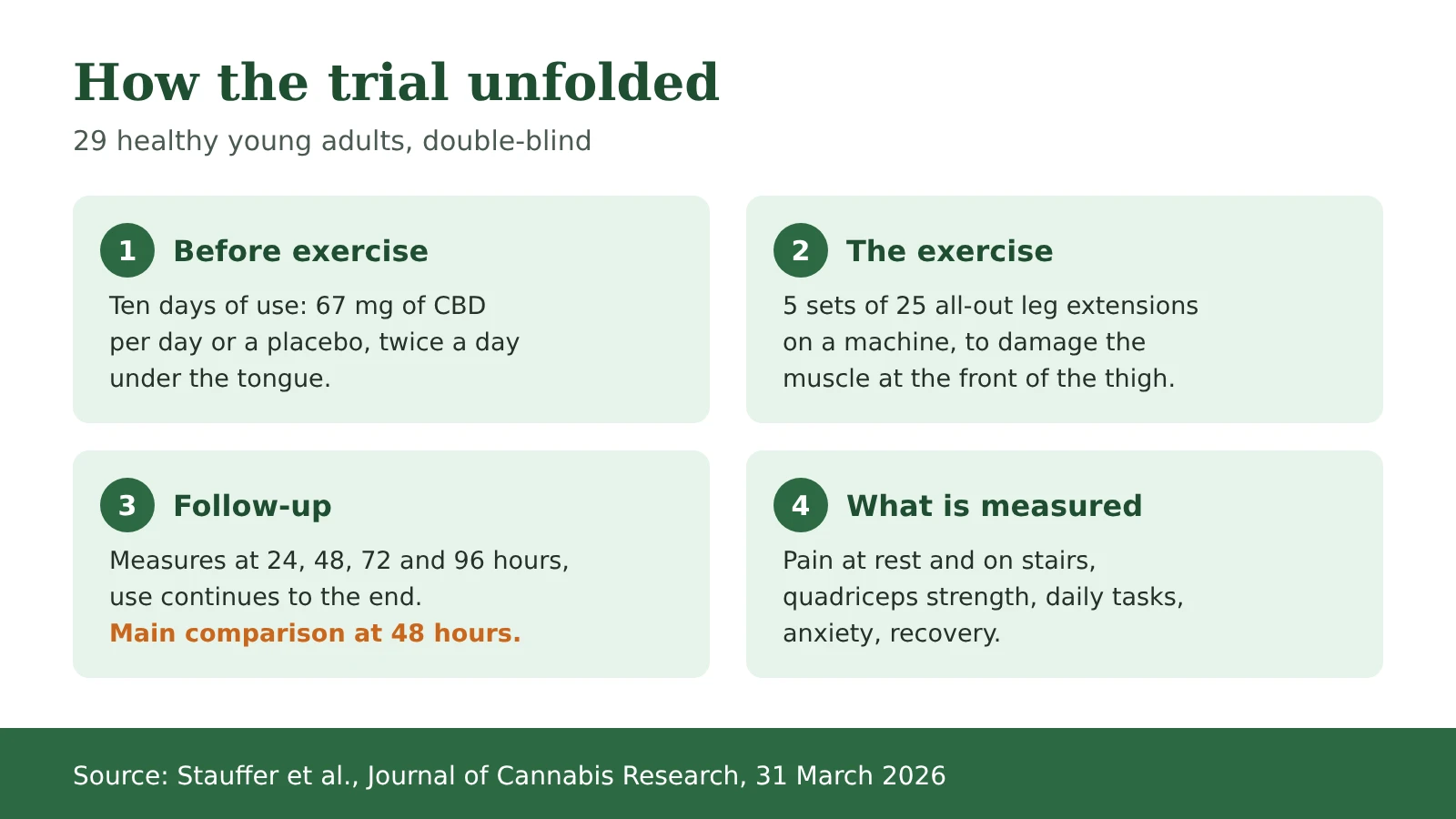
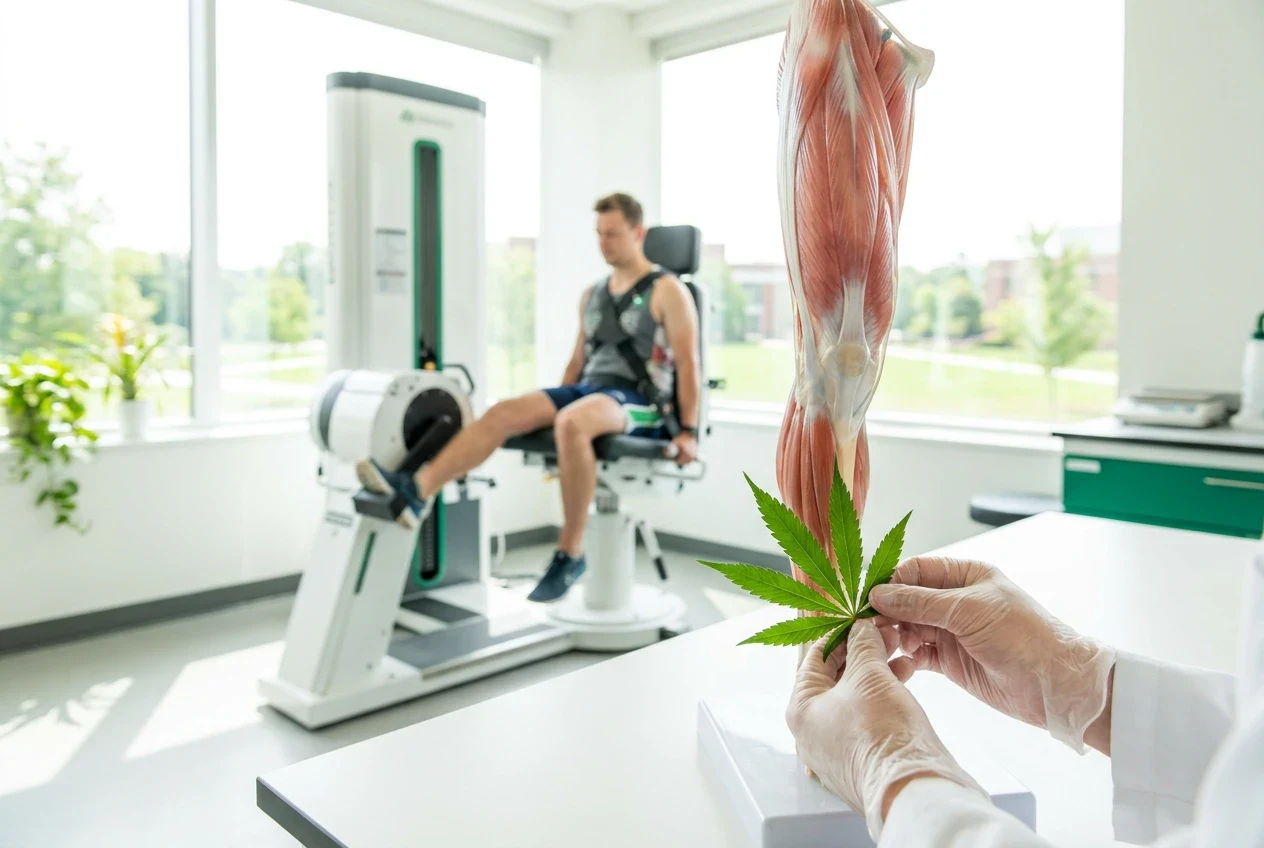
At 24, 48, 72 and 96 hours after the exercise, the researchers measured peak pain at rest (scored from 0 to 100), pain when walking up and down ten steps, quadriceps strength, the ability to carry out twenty everyday tasks and pain-related anxiety. Recovery was reached when pain returned to within 5% of its starting level.
What the trial measured 48 hours after exercise
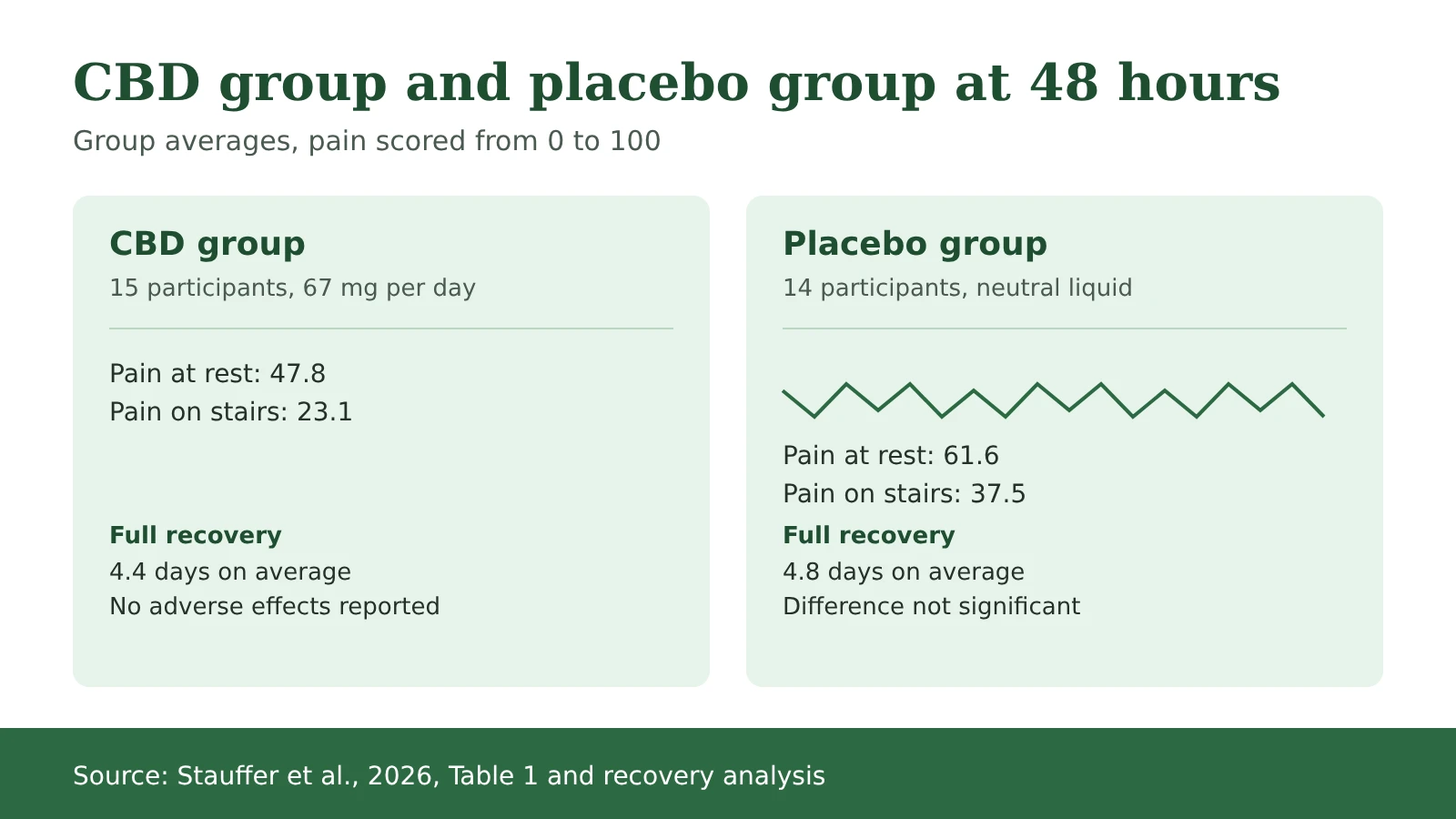
Symptoms peaked between 24 and 48 hours, so the researchers compared the groups at 48 hours. On all four main measures, the averages in the CBD group were more favourable than in the placebo group. Pain at rest reached 47.8 out of 100 in the CBD group, compared with 61.6 on placebo; on the stairs, 23.1 compared with 37.5. Quadriceps strength loss was 24.4 compared with 36.7.
| Measure at 48 hours | CBD group (15) | Placebo group (14) | Size of the difference according to the authors |
|---|---|---|---|
| Peak pain at rest (0 to 100) | 47.8 | 61.6 | Medium difference, in favour of the CBD group |
| Pain on stairs (0 to 100) | 23.1 | 37.5 | Medium difference, in favour of the CBD group |
| Quadriceps strength loss | 24.4 | 36.7 | Small to medium difference, in favour of the CBD group |
| Everyday function score (% of maximum) | 67.7 | 60.1 | Medium difference, in favour of the CBD group |
| Average time to recovery (estimate) | 4.4 days | 4.8 days | About 12 hours apart, not significant |
The authors describe differences of medium size for pain, and small to medium size for strength and everyday function. A technical note: the legend of their table describes the function score the opposite way round from the methods. According to the methods and the authors’ text, a high score means fewer difficulties: participants in the CBD group were therefore on average less limited in their everyday tasks.
Time to recovery: about 12 hours apart
According to the trial’s estimates, at 72 hours 38% of participants in the CBD group had recovered, compared with 25% on placebo; at 96 hours, 60% compared with 45%. Full recovery took 4.4 days on average in the CBD group and 4.8 days in the placebo group, a difference of about 12 hours. This difference is not statistically significant.
The authors consider that half a day could matter for competitive athletes, who need to return to training quickly. Pain-related anxiety remained stable in both groups.
Tolerability: no adverse effects reported
Over 15 days of daily use, participants, questioned at each visit with a detailed checklist, reported no side effects, either in the CBD group or in the placebo group. This was the trial’s primary aim. The authors conclude that the safety profile was favourable in these healthy young adults taking no daily medication.
At the end of the trial, 12 of the 15 participants in the CBD group, or 80%, thought they had received the placebo. According to the authors, they expected to get “high”, which CBD does not cause. The blinding therefore held, which limits the risk that expecting an effect influenced the CBD group’s results.
What the trial shows and does not show
The trial shows that this protocol is feasible and that the extract tested was well tolerated for 15 days by healthy young adults. It does not demonstrate efficacy: its first aim was tolerability and feasibility. With 29 participants, its statistical power ranged from 20 to 37% depending on the measure: it had little chance of telling a real effect apart from chance. The confidence intervals of the two groups overlap widely, and the article reports no significance test for the comparisons at 48 hours.
No blood tests measured inflammation, and the authors consider the dose of 67 mg per day rather low compared with other trials. The comparable trials they cite disagree: in 2020, a single dose of CBD reduced muscle soreness; in 100 patients after shoulder surgery, 75 or 150 mg per day for 14 days reduced post-operative pain; in 2021, 150 mg per day in capsules for three days made no difference.
Point to watch
These results concern one specific extract, taken under the tongue by healthy young adults. They do not automatically apply to other forms, other doses or other people. The authors describe CBD as “promising” and call for larger studies, with several doses, to confirm these trends.
Competitive sport: the anti-doping question
The article does not deal with doping, but the question arises for athletes who are tested. Since 2018, CBD has no longer been on the World Anti-Doping Agency (WADA) list of prohibited substances. Other cannabinoids, including THC, remain on it. A “full spectrum” extract like the one in the trial also contains minor cannabinoids and traces of THC: so it is not only CBD that is at stake. To learn more about these molecules, see our guide to hemp cannabinoids.
And in Switzerland?
The trial was carried out in the United States, where a hemp product is legal if it contains less than 0.3% THC by dry weight. In Switzerland, the limit is different: hemp and products containing 1% or more total THC are narcotics, and their non-medical use is prohibited (see what the 1% threshold measures).
CBD products sold freely fall under other laws, set out in our guide to Swiss legislation: they are not medicines. The preparation and dose tested here (one specific American extract, 67 mg of CBD per day, within a supervised research protocol) cannot be transposed to these products. Epidyolex, a CBD-based medicine, is authorised by Swissmedic for certain forms of epilepsy. Since 1 August 2022, doctors can prescribe cannabis-based medicines without an exceptional authorisation from the Federal Office of Public Health (FOPH); Swissmedic oversees their production and trade, and basic health insurance reimburses them only in exceptional cases.
In summary
In 29 healthy young adults, 67 mg of CBD per day taken under the tongue for 15 days was well tolerated, with no adverse effects reported. Forty-eight hours after exercise designed to damage the muscle, participants in the CBD group had on average less pain and had lost less strength than those in the placebo group. Their full recovery took 4.4 days on average compared with 4.8, a difference that is not significant. This is a pilot trial, too small to draw conclusions: the authors call for larger studies to confirm these trends or not.
What the science says
Independent summary of a scientific publication. It does not describe The Green Lab products and is not health advice.
Frequently asked questions
What did this trial show about muscle soreness after sport?
Forty-eight hours after intense exercise, the CBD group rated their pain lower on average than the placebo group, both at rest (47.8 out of 100 compared with 61.6) and on the stairs (23.1 compared with 37.5). With 29 participants and low statistical power, the trial does not allow a conclusion, and other trials on the subject give mixed results.
What dose of CBD was used in this trial?
Participants received 67 mg of CBD per day, in two doses under the tongue, morning and evening, for 15 days: about ten days before the exercise, then during the follow-up. It was a full-spectrum hemp extract. The authors consider this dose rather low compared with other trials.
Were any adverse effects observed?
No side effects were reported, either in the CBD group or in the placebo group, even though participants were questioned at each visit. The authors describe a favourable safety profile. This finding covers 15 days in healthy young adults taking no daily medication: it says nothing about longer use or other populations.
Is CBD banned under anti-doping rules?
No. Since 2018, CBD has no longer been on the World Anti-Doping Agency’s list of prohibited substances. However, other cannabinoids, including THC, remain on it. A full-spectrum extract, like the one in this trial, also contains other cannabinoids and traces of THC. The study itself does not address this question.
What comes next for this research?
The authors call for larger trials, with several doses. Theirs, designed first to test tolerability and feasibility, had 15 and 14 participants per group: its statistical power, from 20 to 37% depending on the measure, was too low to confirm on its own the differences observed between the two groups.