In this meta-analysis of 43 surveys, 12.8% of people surveyed in Europe reported having used CBD at least once, compared with 28.9% in North America. The team from the University of Oviedo, Spain, pooled data collected from nearly 390,000 people; the proportion of women in the samples did not change these figures. The level of evidence is intermediate: the pooled surveys differ widely from one another, and the study describes use, not its effects. Here is what it measured, Switzerland included. Our method and the list of all summaries in the series are in our guide to understanding a scientific study on CBD.
| The study at a glance | |
|---|---|
| Original title | The prevalence of cannabidiol (CBD) use in North America and Europe: A meta-analysis |
| Journal | Addiction, vol. 121, no. 7, pp. 1653-1670 |
| Date | 22 February 2026 (online), July 2026 issue |
| Authors | Sara Weidberg, Clara Iza-Fernández, Layla Alemán-Moussa, Andrea Krotter et al. (University of Oviedo and International University of La Rioja, Spain) |
| Type | Systematic review and meta-analysis of 43 cross-sectional surveys (388,447 people), protocol registered in advance |
| Funding | Spanish National Plan on Drugs and grants from the Principality of Asturias, with no role in the study. No conflicts of interest declared |
| Level of evidence | ●●○○ 2 out of 4: a rigorous meta-analysis, but of surveys that differ widely from one another; it describes use, not effects |
| Full text | Open access on PubMed Central |
On this page
A meta-analysis of 43 surveys
According to its authors, this meta-analysis is the first to estimate the share of people who use CBD in Europe and North America. The CBD market has grown considerably in recent years, and surveys had already measured use in a given country or group, but without an overall synthesis.
A meta-analysis pools several studies to produce a common estimate. The researchers included 43 studies published up to March 2025: 30 from North America (353,088 people) and 13 from Europe (35,359 people). Participants were 31 years old on average and 57.5% were women. The protocol was registered in advance, two researchers selected the studies independently, and 30 of the 43 surveys were rated at low risk of bias. Most tests for publication bias, that is the tendency to publish only certain results, did not detect any.
All these studies are surveys: people are asked whether they have used a product sold for its CBD content. The researchers calculated prevalence, that is the share of people concerned, over five periods: at least once in a lifetime, in the past year, in the past month, in the past week, and daily.
Europe and North America: the estimates
Across the five periods studied, the estimates are higher in North America. The two continents were so different that the researchers calculated separate estimates.
| Period | Europe | North America |
|---|---|---|
| At least once in a lifetime | 12.8% (6 to 25%) | 28.9% (20 to 39%) |
| In the past 12 months | 17.6% (11 to 28%) | 19.5% (11 to 32%) |
| In the past 30 days | 7.2% (2 to 21%) | 12.0% (7 to 20%) |
| In the past 7 days | 4.3% (1 to 13%) | 10.5% (1 to 47%) |
| Daily | 2.1% (1 to 8%) | 6.4% (3 to 13%) |
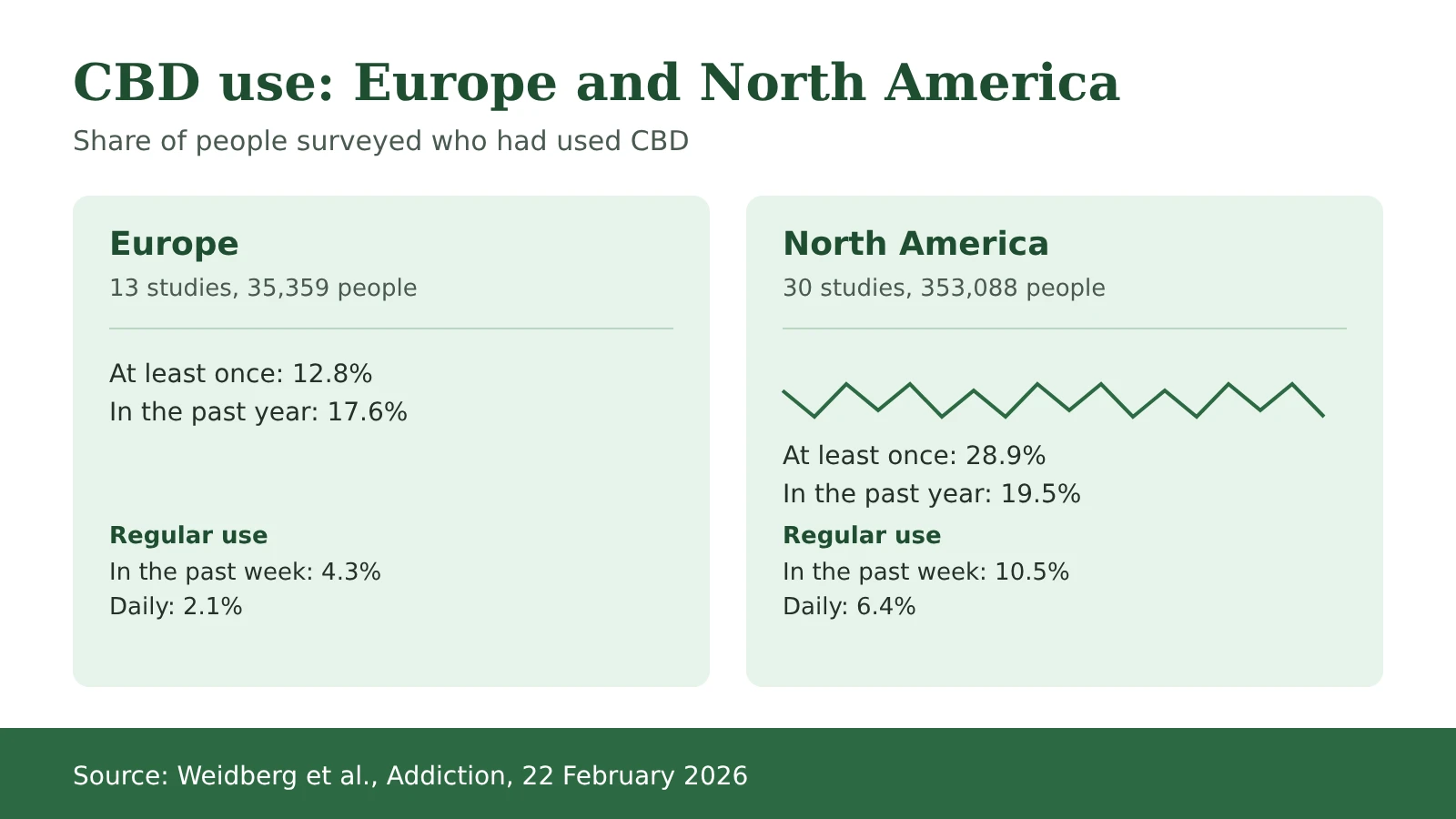
In North America, 28.9% of people surveyed had used CBD at least once, compared with 12.8% in Europe. The widest gap concerns daily use: 6.4% of people surveyed in North America, compared with 2.1% in Europe, three times as many. In Europe, 7.2% of people surveyed had used it in the past month.
A point to note when reading: in Europe, past-year use (17.6%) exceeds use “at least once” (12.8%), which is impossible within a single population. This is because each estimate is based on a different group of studies: 10 studies for lifetime use, 8 for the past year.
Who uses CBD, and how?
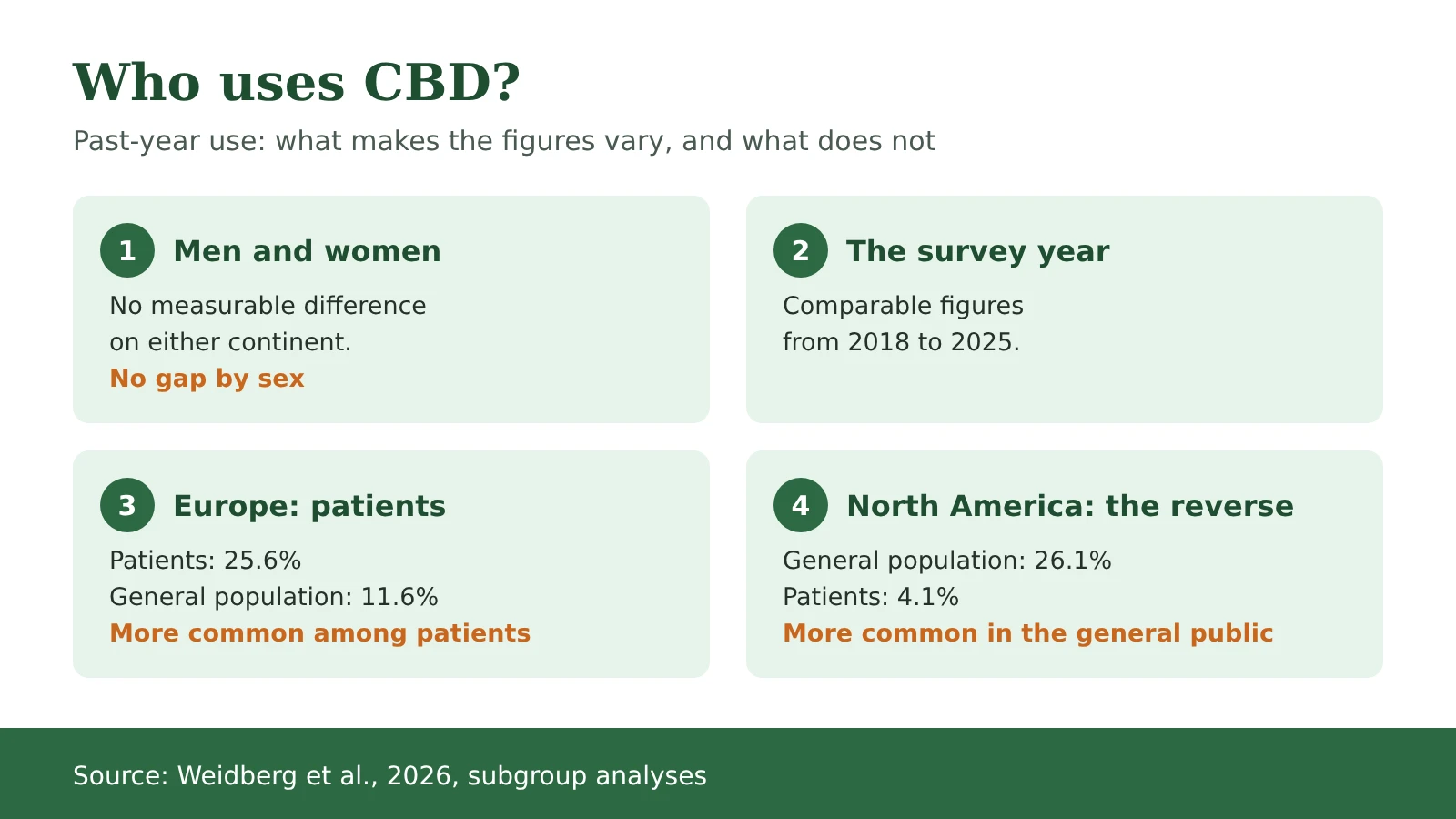
On both continents, the proportion of women in the samples did not change the usage figures. Nor did the survey year, between 2018 and 2025. The authors note that this differs from cannabis, which is used more by men, and point to marketing that also targets women.
The type of population, however, does make the figures vary. In Europe, 25.6% of patients being treated for an illness had used CBD in the past year, compared with 11.6% of the general population. These patients had, in particular, joint problems, cancers or chronic pain. In North America, the reverse is true: 26.1% in the general population compared with 4.1% among patients. The authors’ hypothesis: more restricted access to cannabis, including medical cannabis, may lead some European patients to turn to CBD.
The authors would like these patients to talk to a healthcare professional more often, because CBD can alter how the liver eliminates certain medicines: this is something to discuss with your doctor.
Over a lifetime, the sublingual route (drops under the tongue) is the most frequently cited, by 61.4% of users, ahead of vaping (52.8%) and smoking (43%). Over the past year and month, inhalation comes first, based on a smaller number of studies. The authors see this as a sign of recreational marketing of CBD.
Why such a gap between the continents?
The authors put forward three possible explanations. Marketing first: advertisements mainly highlight health (pain, anxiety, sleep, stress), and in their view perceived benefits often exceed proven efficacy. Supply next: North America offers more products, notably edibles (gummies, chocolate), which cannot be legally marketed in Europe, they write.
Third explanation: THC. Legal limits apply to the plant, not to the finished product. A US analysis cited by the authors found THC in 21 of 80 products labelled “THC-free”. In Europe, a similar study found it in 12 of 14 products, and 93% remained below the 0.2% limit. The authors see this as a risk of unintentional exposure to THC, mainly in the United States.
What the meta-analysis shows and does not show
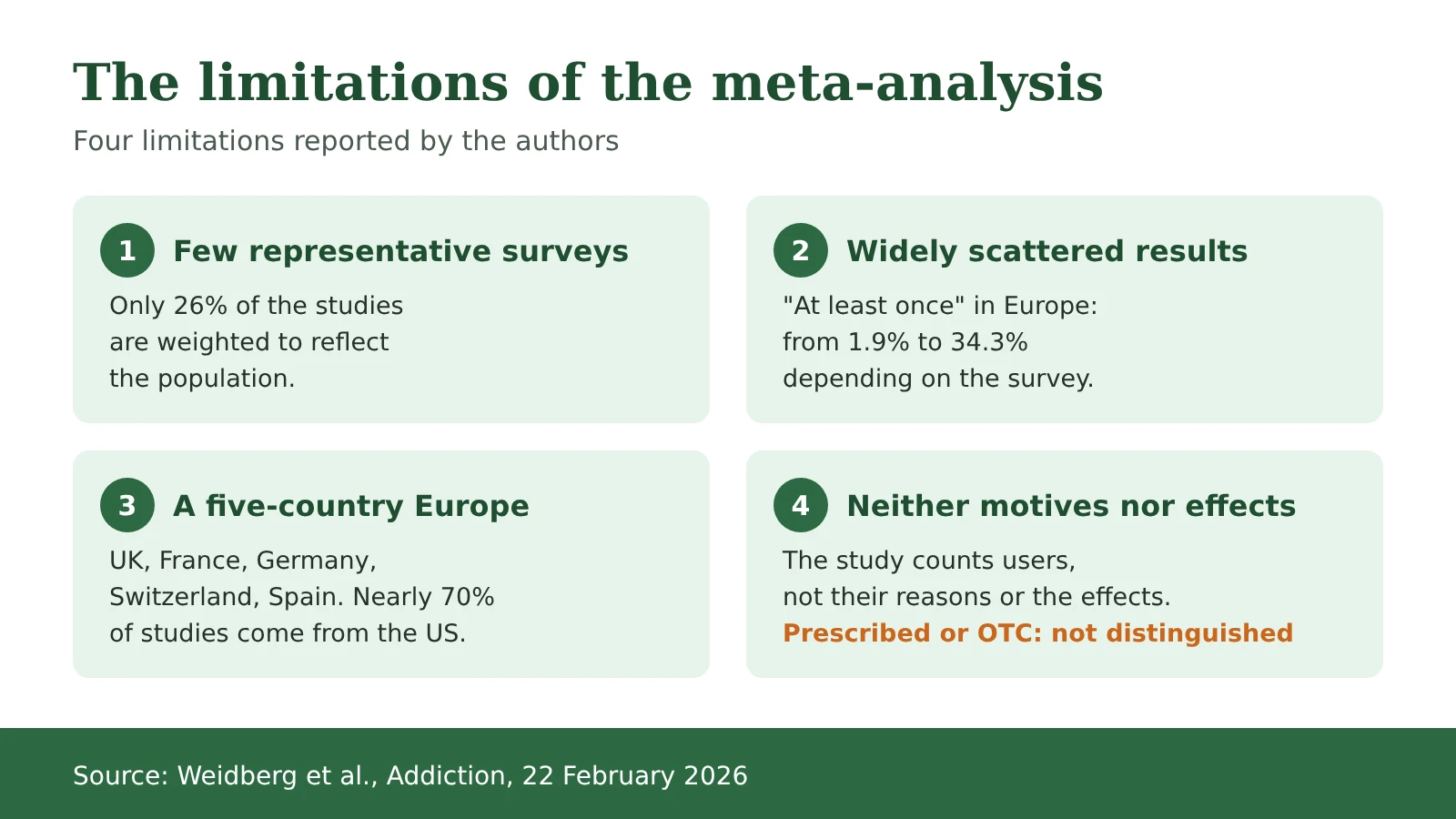
The meta-analysis gives an order of magnitude for CBD use on two continents, based on surveys that differ widely from one another. The authors themselves ask readers to interpret these estimates with caution. Only 26% of the studies were weighted to represent the population, and nearly a third (14 of 43) had a moderate or high risk of bias. Results also vary enormously from one survey to another: use “at least once” ranges from 1.9% to 34.3% in Europe, and from 7.1% to 73.1% in North America.
The study’s “Europe” comes down to five countries, and nearly 70% of the studies come from the United States. Prescribed CBD is not distinguished from over-the-counter CBD: only 7 of 43 studies provided this information. Age, each country’s laws and THC use are not taken into account. Finally, the study counts users: it measures neither their motives nor the effects they experience, and the authors call on the large national surveys to collect these data.
Point to watch
An average is not a portrait. The pooled surveys range from adolescents aged 13-14 to patients with chronic illnesses. These figures give an order of magnitude, not the share of users in any given country.
What the authors propose
The researchers make several proposals to the authorities: accurate labels, clear THC limits in finished products and harmonised rules between countries, as many products are bought online. They also want advertising to be regulated, especially advertising that may reach minors, and a clearer distinction, in public information, between cannabis-based medicines with proven efficacy and CBD products whose efficacy has not been established.
And in Switzerland?
Two of the 13 European studies were conducted in Switzerland. The first surveyed 5,233 young men (28 years old on average) in 2019-2020: 32.4% had used CBD at least once and 18.5% in the past year, and 0.6% daily. Inhalation was by far the most frequently cited route. The second covered 469 patients being treated for a substance use disorder, in 2019: 34.3% had used CBD at least once, 25.2% in the past year. These two surveys concern specific groups and do not represent the Swiss population as a whole.
CBD products sold freely contain less than 1% total THC (see what the 1% threshold measures); they fall under other laws, presented in our guide to Swiss legislation, and are not medicines. Above 1%, hemp is a narcotic and its non-medical use is prohibited. For flowers and vapes, see also what the tobacco products law changes.
Since 1 August 2022, doctors can prescribe cannabis-based medicines without an exceptional authorisation from the FOPH; Swissmedic oversees their production and trade, and basic health insurance reimburses them only in exceptional cases. Epidyolex, which is CBD-based, is authorised by Swissmedic for certain forms of epilepsy. When driving, the blood THC limit is 1.5 µg/L (see travelling and driving with CBD).
In summary
In this meta-analysis of 43 surveys, 12.8% of people surveyed in Europe and 28.9% in North America had used CBD at least once, and daily use was three times as frequent across the Atlantic. Sex and survey year did not change these figures; in Europe, 25.6% of patients being treated for an illness had used it in the past year. These averages give an order of magnitude; the study measures the extent of use, not its effects.
What the science says
Independent summary of a scientific publication. It does not describe The Green Lab products and is not health advice.
Frequently asked questions
How many people use CBD in Europe?
According to this meta-analysis of 13 European studies, 12.8% of people surveyed had used it at least once, 7.2% in the past month and 2.1% daily. These are orders of magnitude, surrounded by a wide margin of uncertainty and drawn from only five countries: the United Kingdom, France, Germany, Switzerland and Spain.
Do women use more CBD than men?
No, according to this study. In both Europe and North America, the proportion of women in the samples did not change the usage figures. The authors note that this differs from cannabis, which is used more by men, and suggest it may reflect marketing that also targets women.
Why is use higher in North America?
The authors put forward three explanations: marketing with a strong health focus, a wider range of products, notably edibles which, according to them, cannot be legally marketed in Europe, and products that sometimes contain more THC than the label states. These are hypotheses that the study did not test.
What is known about CBD use in Switzerland?
Two Swiss studies are included in the meta-analysis. Among 5,233 young men surveyed in 2019-2020, 32.4% had used CBD at least once and 18.5% in the past year, and 0.6% daily. Among 469 patients being treated for a substance use disorder, 25.2% had used it in the past year. Neither represents the whole population.
Does this study show that CBD is effective?
No, that is not its purpose. It measured the share of people who say they have used CBD, without collecting their reasons or the effects they experienced. The authors believe that the benefits many users expect go beyond what the evidence establishes. The only recognised CBD medicine, Epidyolex, targets rare forms of childhood epilepsy.