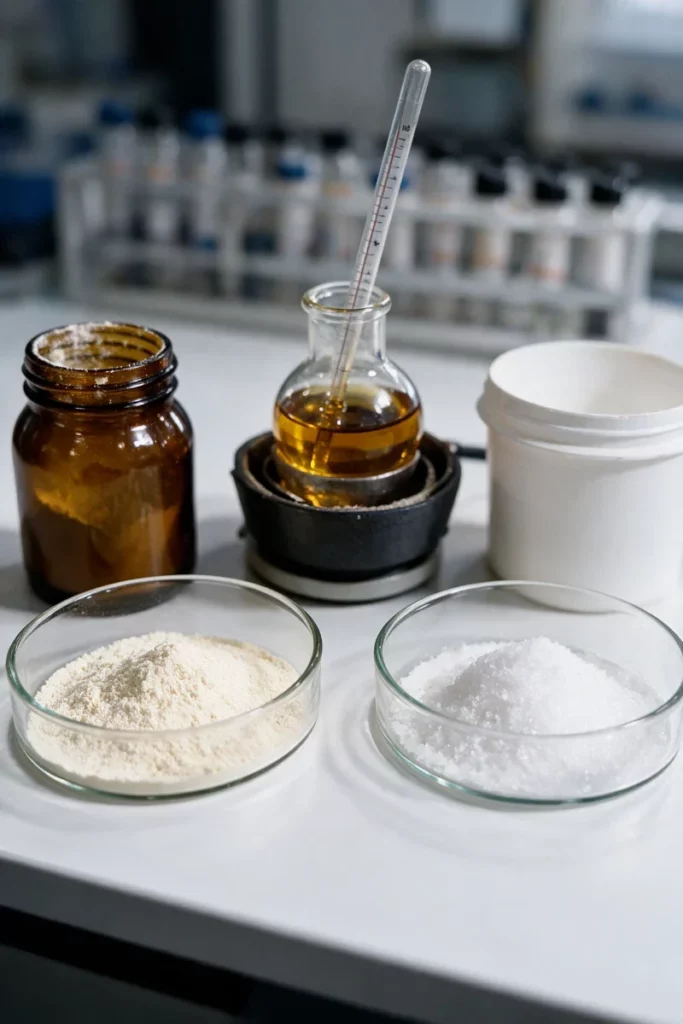
In the plant, cannabinoids first exist in acidic form: CBDA, THCA, CBGA, CBCA. When heated, these acids become CBD, THC, CBG or CBC. Understanding this step makes it easier to read an analysis, to compare a raw extract with an oil, and to know what a total CBD figure covers.
On this page
What the A stands for
The final “A” in CBDA, THCA or CBGA comes from the word acid. These molecules carry a carboxyl group, written COOH, attached to their aromatic ring. Some chemists call them precannabinoids, and the very definition of the word cannabinoid, proposed in the late 1960s, includes these acids. Our guide to hemp cannabinoids places each of them within the plant.
A second A can cause confusion. In THCA-A, the final letter distinguishes one isomer from another, THCA-B, in which the acid group sits at a different position on the molecule.
| Acidic form | Formula | Neutral form | Formula |
|---|---|---|---|
| CBDA, cannabidiolic acid | C22H30O4 | CBD | C21H30O2 |
| THCA, tetrahydrocannabinolic acid | C22H30O4 | THC | C21H30O2 |
| CBGA, cannabigerolic acid | C22H32O4 | CBG | C21H32O2 |
| CBCA, cannabichromenic acid | C22H30O4 | CBC | C21H30O2 |
Decarboxylation
When heated, the carboxyl group breaks away and leaves as carbon dioxide. The molecule thus loses one carbon atom and two oxygen atoms: CBDA becomes CBD, THCA becomes THC, CBGA becomes CBG and CBCA becomes CBC. A 2016 review points out that all the neutral forms in the plant come from this reaction, which largely takes place without enzymes.
The reaction also occurs, more slowly, at room temperature during prolonged storage, with heat remaining the main driver. To produce an oil, it is triggered deliberately by heating the extract. Our article on the profile of an extract details the losses that come with it.
The acids do not all convert at the same rate. In a 2016 study conducted between 80 and 145 °C, THCA decarboxylated twice as fast as CBDA and CBGA. For these last two, the reaction came with losses: part of the CBDA, and more than half of the CBGA, disappeared without reappearing in neutral form.
Measuring acidic forms: GC or HPLC
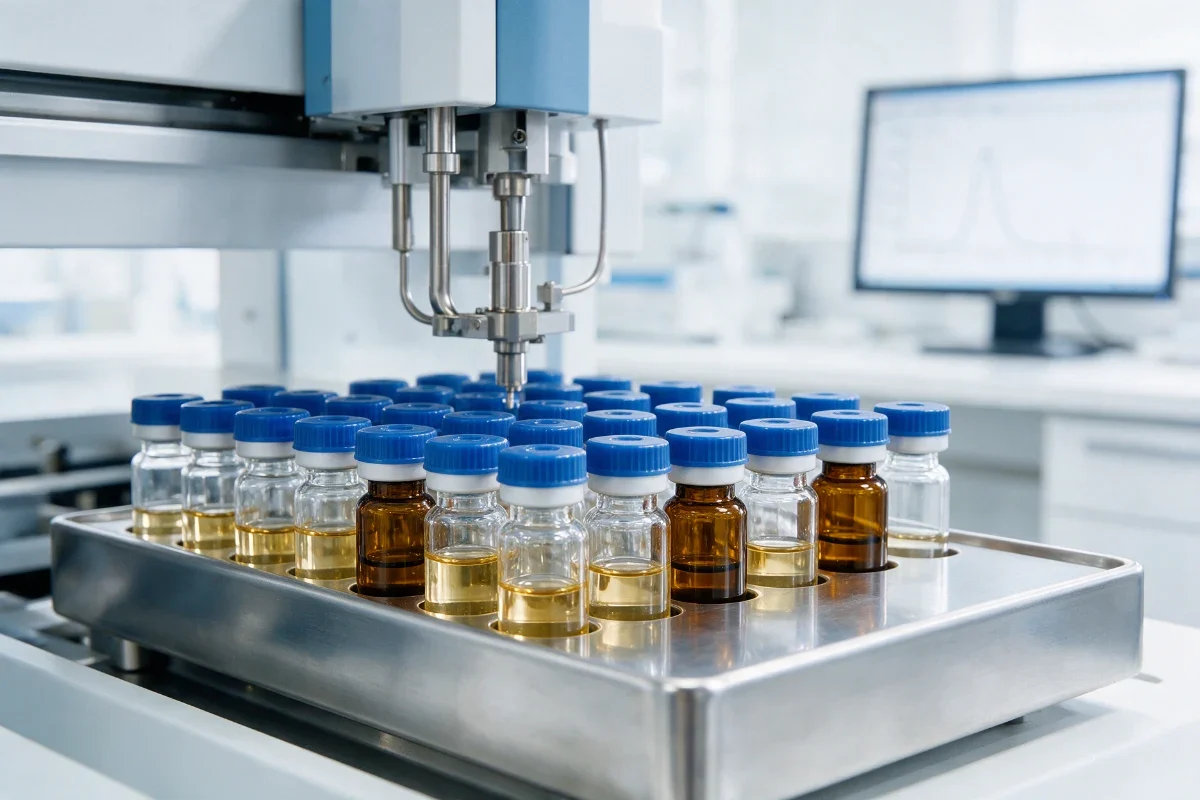
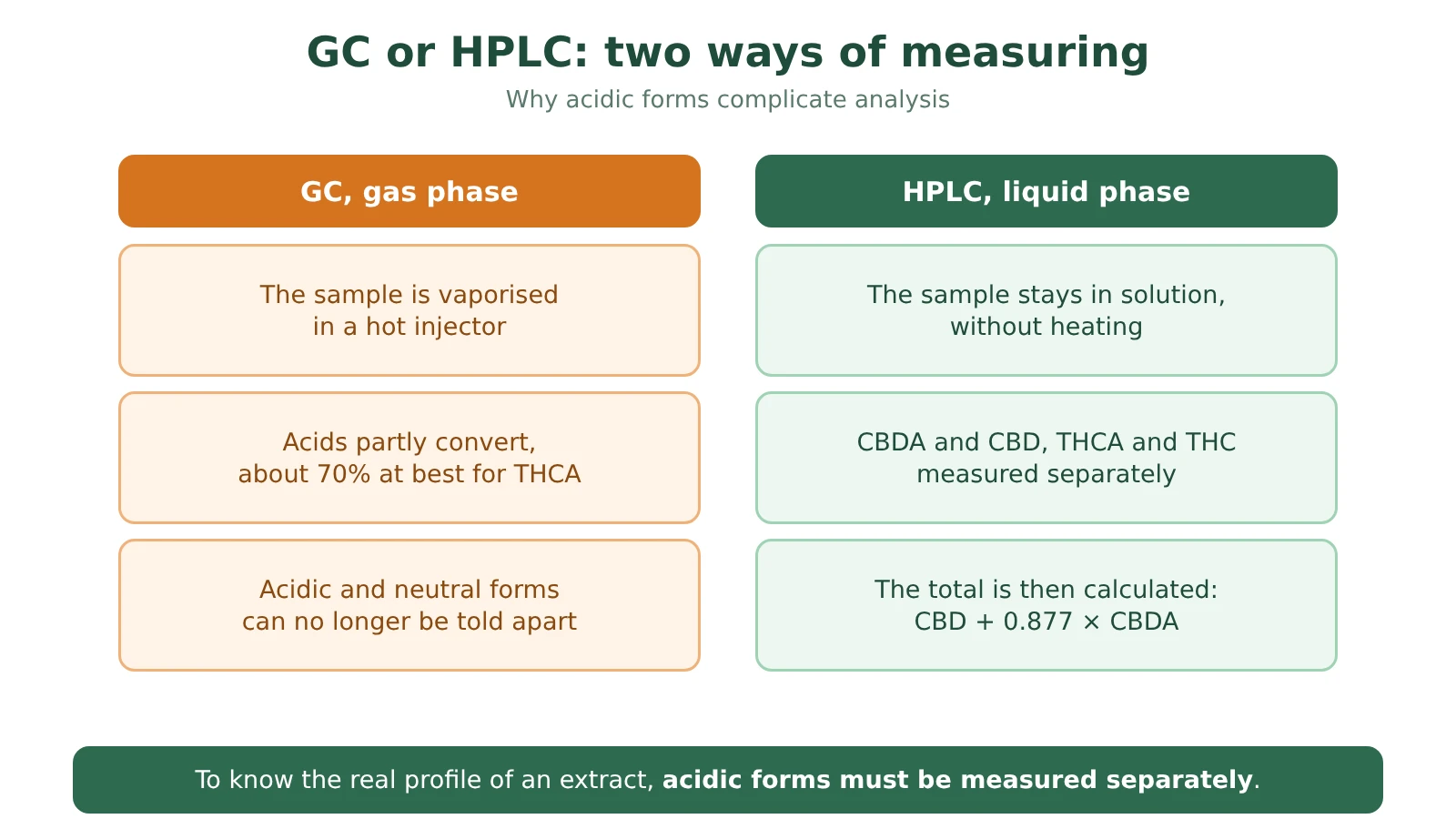
Testing laboratories mainly use two techniques. Gas chromatography, or GC, vaporises the sample in a heated injector. There, the acids partly decarboxylate, so the instrument does not distinguish them from their neutral forms. A 2005 study showed that this conversion levels off at around 70% for THCA, even with optimised settings.
High-performance liquid chromatography, or HPLC, works without heating the sample. It measures acidic and neutral forms separately, with no additional chemical preparation, which reveals the actual profile of an extract.
Total CBD and total THC
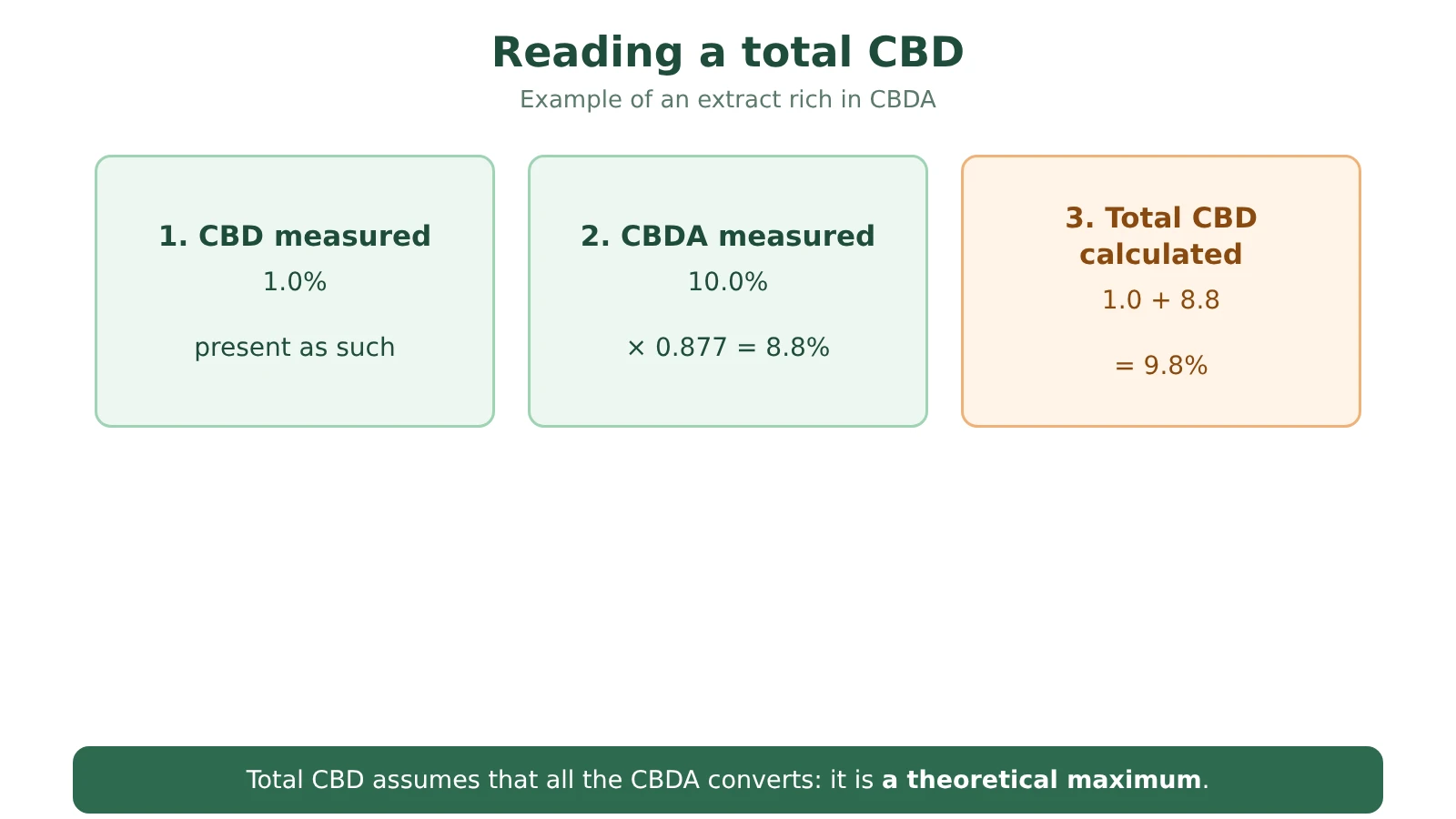
On an analysis report, total CBD adds the measured CBD to the CBDA multiplied by 0.877. This factor corresponds to the ratio of the masses of the two molecules: it expresses the amount of CBD the CBDA would yield if it converted fully. Total CBD is therefore a calculated value, which assumes complete conversion.
The same calculation applies to THC. In Switzerland, the 1% limit refers to the total THC content, which includes the THCA present in the plant or extract. Our article on the 1% THC limit explains why this notion of a total matters.
Two terms come up often in reports. The limit of detection is the smallest amount the method can detect with reasonable certainty; the limit of quantification, or LOQ, is the smallest amount it can measure with sufficient precision. A result below the LOQ means that the compound is either absent or present in too small an amount to be quantified.
Raw extract, finished oil: comparing like with like
An unheated raw extract may contain mostly CBDA, whereas an oil prepared from a distillate contains mostly CBD. Displaying a percentage without specifying whether it refers to CBD, CBDA or total CBD amounts to comparing figures that do not measure the same thing.
Any remaining acidic forms continue to change after manufacture. A 2020 study that followed flowers and extracts for a year, stored in the dark, observed the most marked changes at 25 °C, with decarboxylation remaining the main transformation pathway for the acids.
Point to watch
Before comparing two products, check what the percentage refers to: CBD, CBDA or total CBD. On our oils, it refers to CBD, as mass per volume.
Our Full Spectrum oils, such as the X-Strong 45% or the Sublime range, are prepared from decarboxylated extracts, and our full range is presented on the CBD oils page. Our profiles of CBD and CBG look at each of these molecules in detail, and our article on minor cannabinoids shows what becomes of THC when it oxidises.
Our laboratory
Decarboxylation is one of the steps we carry out in our laboratory in Gland, after winterisation at −80 °C and before vacuum short-path distillation. The cannabinoid levels of our oils are then checked regularly by an external laboratory. Discover the laboratory →
Frequently asked questions
What does the A in CBDA stand for?
It comes from the word acid. CBDA, cannabidiolic acid, carries one more carboxyl group than CBD. It is the form the plant produces; it becomes CBD by losing this group as CO₂ when exposed to heat.
At what temperature does CBDA become CBD?
The conversion speeds up with heat; a reference study followed it between 80 and 145 °C. It also occurs, very slowly, at room temperature. The rate depends on the compound: THCA converts faster than CBDA and CBGA.
What is total CBD?
A calculated value that adds the measured CBD to the CBDA multiplied by 0.877. It indicates the amount of CBD that would be obtained if all the CBDA converted. It does not directly measure the CBD present.
Why do a GC analysis and an HPLC analysis give different results?
GC heats the sample: the acidic forms partly convert inside the instrument and can no longer be distinguished from the neutral forms. HPLC works without heating and measures CBDA and CBD, THCA and THC separately.
What does a result below the LOQ mean?
That the compound is below the method’s limit of quantification, which cannot give a sufficiently precise value for it. It may be absent, or present in a very small amount.