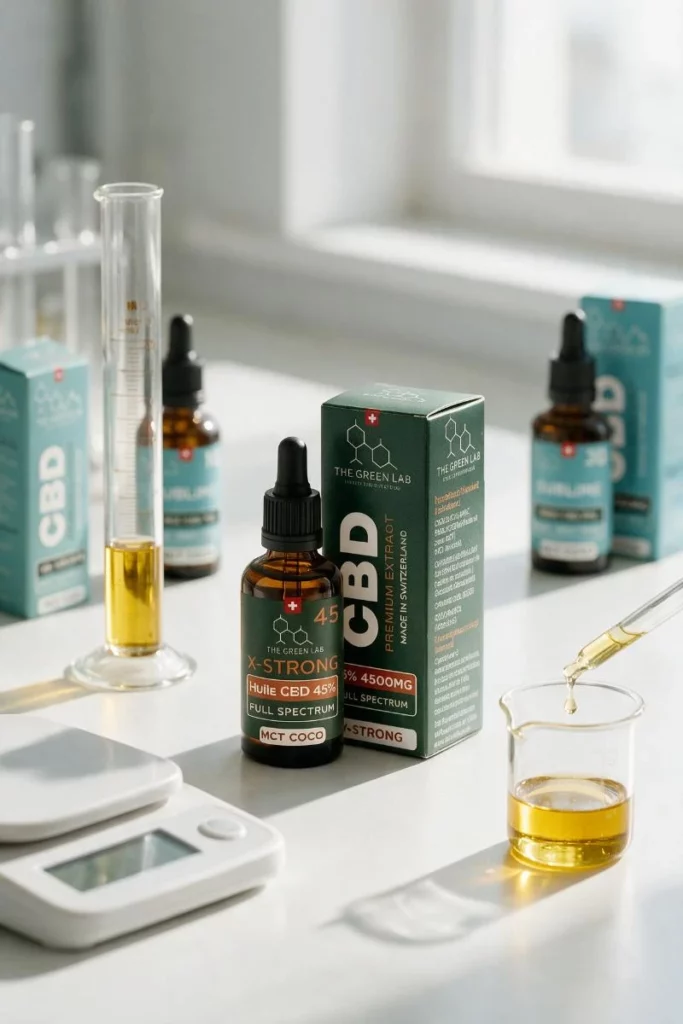
On a CBD oil, the percentage tells you how much CBD each millilitre of oil contains. It says nothing about the total amount in the bottle: that comes from the volume. And depending on the reference system used, the same “20%” does not mean quite the same thing. Here is how to read a label without getting it wrong.
On this page
What the percentage tells you
At The Green Lab, the percentage is read as mass of CBD per volume of finished oil. A 20% means 20 grams of CBD per 100 millilitres of product, i.e. 200 milligrams per millilitre. The MG figure printed next to it is simply this strength applied to the volume of the bottle.
The calculation fits on one line: percentage × 10 × millilitres = milligrams of CBD. For a 10 ml bottle at 20%: 20 × 10 × 10 = 2,000 mg. That is exactly what the label states. The same rule applies to all our formats, without exception.
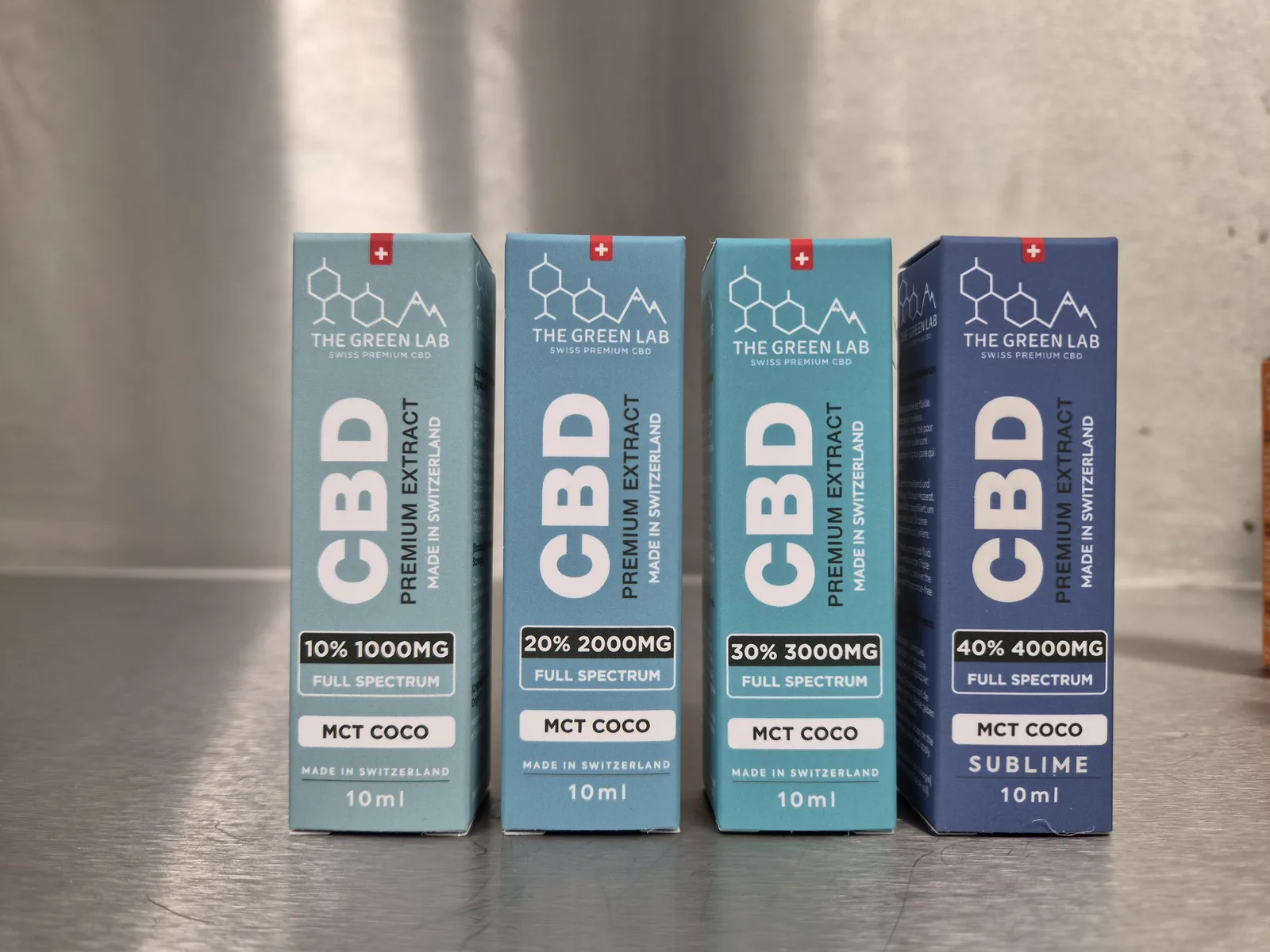
| Strength | Per millilitre | 10 ml bottle | 30 ml bottle | In the range |
|---|---|---|---|---|
| 10% | 100 mg | 1,000 mg | 3,000 mg | Sublime, Hemp, Broad Spectrum |
| 20% | 200 mg | 2,000 mg | 6,000 mg | Sublime, Hemp, Broad Spectrum |
| 30% | 300 mg | 3,000 mg | 9,000 mg | Sublime, Hemp, Broad Spectrum |
| 40% | 400 mg | 4,000 mg | 12,000 mg | Sublime, Broad Spectrum |
| 45% | 450 mg | 4,500 mg | 13,500 mg | X-Strong |
Same percentage, different bottles
The percentage describes the oil, not the bottle. Two bottles at the same strength therefore hold exactly the same oil, but not the same amount of CBD if their volumes differ. Our Hemp oil at 30% illustrates this: 3,000 mg in the 10 ml, 9,000 mg in the 30 ml.
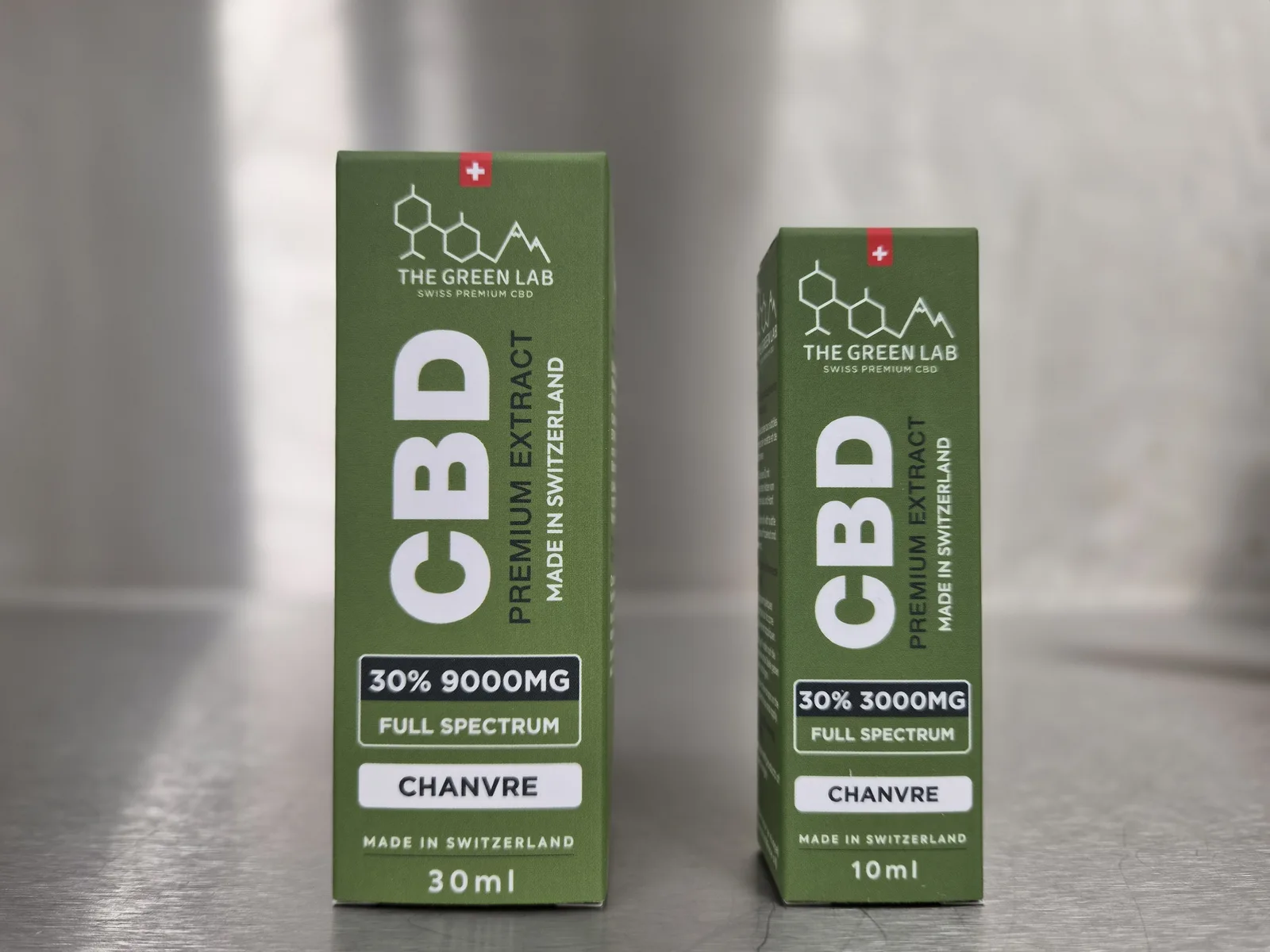
To compare two products, you therefore need to keep both pieces of information in mind. The strength is used to compare how rich two oils are, the MG quantity to compare the contents of two bottles. As for the amount of CBD in a drop, that is a separate question, which depends on the dropper and on the oil itself: we cover it in a dedicated article on milligrams per drop.
m/m or m/V: a “%” with no single definition
A percentage can refer to a mass or to a volume. In mass in mass (m/m), 20% means 20 g of CBD per 100 g of finished product. In mass in volume (m/V), 20 g per 100 ml. For water, where one millilitre weighs about one gram, the difference would be negligible. For an oil, it is not.
The two major pharmacopoeias take opposite positions. The General Notices of the European Pharmacopoeia recognise only two meanings of the term “per cent”: m/m and V/V. The m/V reading does not appear there. The General Notices of the United States Pharmacopeia (USP), by contrast, state that an unqualified “percent”, for a solid dissolved in a liquid, is read as mass in volume. A CBD oil is precisely a solid dissolved in a liquid.
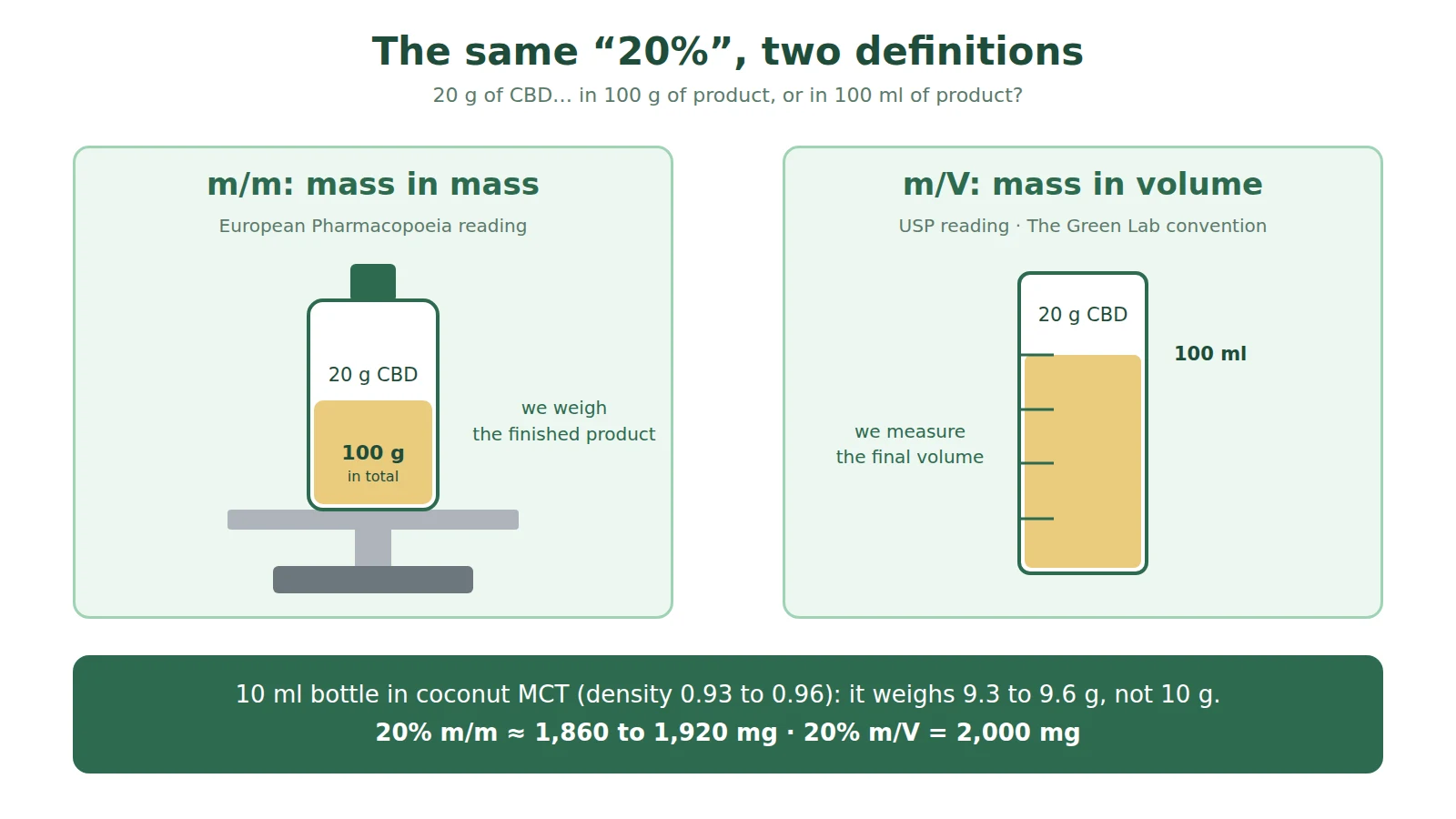
The gap comes from density. The USP monograph for medium-chain triglycerides (MCT) gives a relative density of 0.93 to 0.96 at 20 °C. A 10 ml bottle of MCT therefore weighs 9.3 to 9.6 g, not 10 g. Read as m/m, a 20% then represents 1,860 to 1,920 mg of CBD; read as m/V, 2,000 mg. Olive oil, whose relative density is 0.910 to 0.916 according to the Codex standard, behaves in the same way.
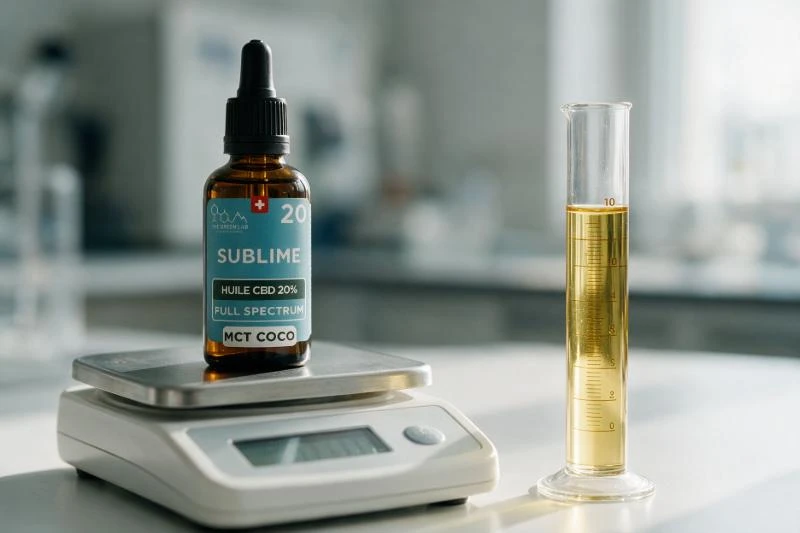
The law does not decide between the two readings. European chemicals law, which Switzerland adopts, expresses its thresholds as a percentage by mass. European food law, on the other hand, measures liquids by volume. And the reference document published by Swissmedic, the FOPH and the FSVO on products containing CBD (version 8.0, May 2025) does not prescribe any way of expressing the content. In the absence of a rule, each manufacturer chooses its own convention. Ours is m/V, because an oil is sold by the millilitre and the MG figure must match exactly what the bottle contains.
Why the range stops at 45%
You cannot dissolve as much CBD as you like in any oil. Each carrier oil has a dissolving capacity that sets a ceiling on the strength that can be formulated. This is a technical constraint, not a commercial choice.
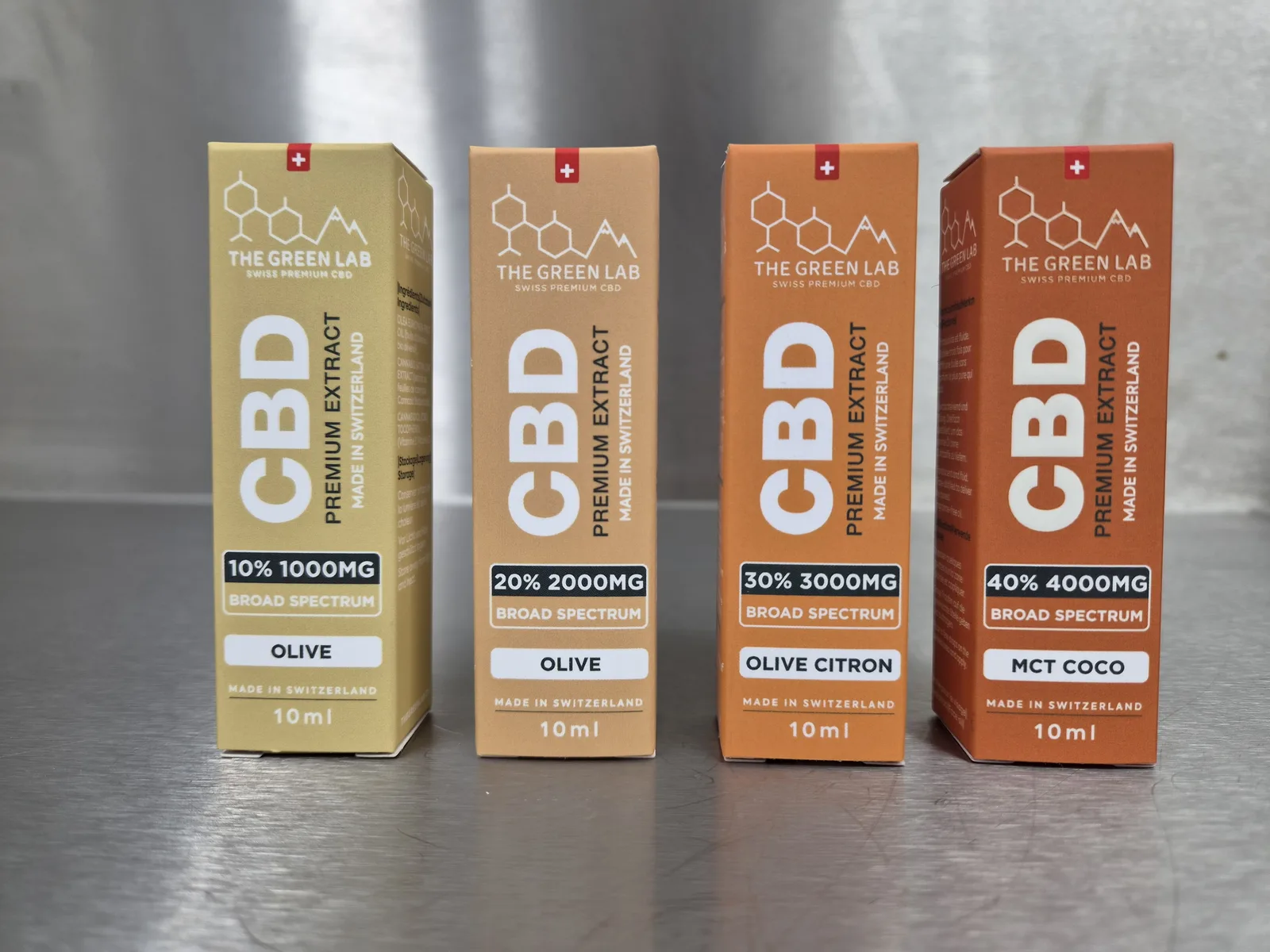
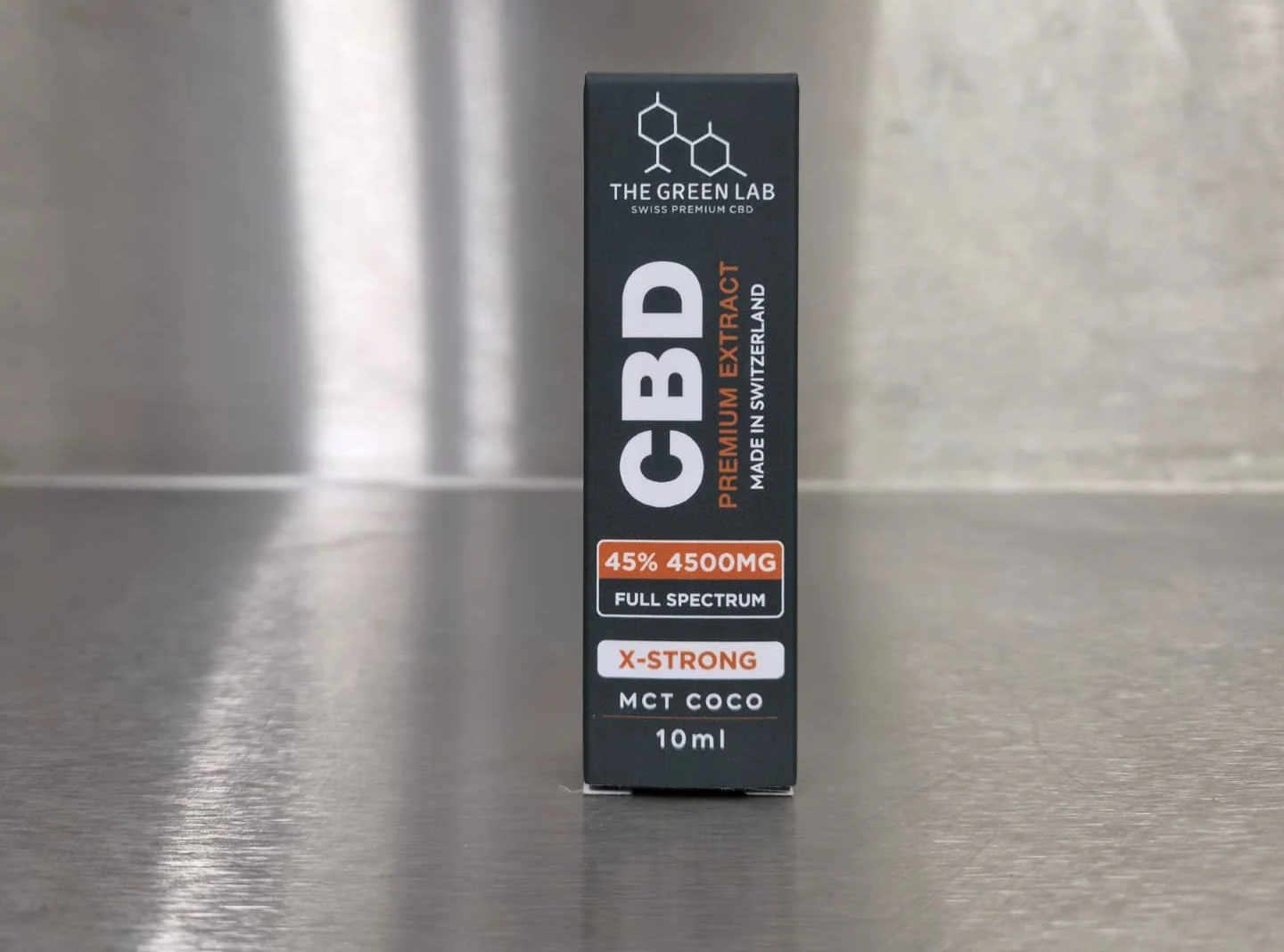
Our Broad Spectrum range shows this on its boxes. The 10% and 20% are formulated on olive oil, the 30% on lemon olive oil. To reach 40%, the oil had to change: lemon olive oil does not allow this strength, coconut MCT does. Our highest strength, the X-Strong at 45%, is also formulated on coconut MCT: 4,500 mg in a 10 ml bottle. The role of each carrier oil is detailed in our article Coconut MCT, hemp or olive.
What a label is worth
A readable label is still a manufacturer’s declaration. Several independent studies have compared the stated content of commercially available CBD oils with their measured content, allowing a tolerance of 10% either way. Their results relate to foreign markets and to products sold under other statuses, but they give a good picture of label reliability in general.
| Study | Products | Within tolerance | Below 90% | Above 110% |
|---|---|---|---|---|
| Johnson et al., 2022 | 80 oils, United States | 54% | 15% | 31% |
| Triemstra et al., 2024 | 202 products, United States | 26% | 28% | 46% |
| Binova et al., 2026 | 186 oils, Europe | 49% did not contain the declared content | ||
The least intuitive finding: the most frequent error is not a shortfall of CBD. In the 2024 study, nearly one product in two contained more than the label stated. An upward deviation is still a deviation: the product does not match what is declared.
Before comparing two oils, three checks are enough. Is the volume stated? Does the total quantity in mg appear next to the percentage? And does the calculation percentage × 10 × millilitres give that figure? If so, the manufacturer works in m/V as we do. If not, you need to ask them which convention they use.
Watch point
A percentage alone does not allow you to compare two products. Without the volume, you do not know the amount of CBD in the bottle; without the convention (m/m or m/V), you do not know exactly what the figure measures. A label that gives the strength, the volume and the total in mg is one you can check.
Further reading: how a CBD oil is made.
Also in our shop: our Hemp CBD oil and all our CBD oils.
Our laboratory
All our oils are formulated in our laboratory in Gland, as mass of CBD per volume of finished oil. This is what allows the MG figure on the label to match the contents of the bottle exactly, whatever the format. Discover the laboratory →
To place concentration among the other selection criteria, including spectrum and carrier oil, see our guide Swiss CBD oil: choosing your concentration and spectrum.
Frequently asked questions
What does 20% mean on a CBD oil?
At The Green Lab, 20% means 20 grams of CBD per 100 millilitres of finished oil, i.e. 200 mg per millilitre. A 10 ml bottle at 20% therefore contains 2,000 mg of CBD, the figure printed next to the percentage. Other manufacturers may work in mass in mass: in that case, check their convention.
How do you convert a percentage into milligrams?
Multiply the percentage by 10, then by the volume in millilitres. A 30% in 10 ml gives 30 × 10 × 10 = 3,000 mg; the same 30% in 30 ml gives 9,000 mg. This calculation applies to a strength expressed as mass per volume, the convention used on all our labels.
Is a 30% oil more concentrated in 30 ml than in 10 ml?
No. The strength is the same, so the oil is the same: 300 mg of CBD per millilitre in both cases. The 30 ml bottle simply contains three times more oil, and therefore three times more CBD in total: 9,000 mg against 3,000 mg for the 10 ml.
Why does the range not go above 45%?
Because each carrier oil can only dissolve a limited amount of CBD. In our Broad Spectrum range, lemon olive oil does not allow 40% to be reached: that strength is formulated on coconut MCT. Our highest strength, the X-Strong, is 45% on coconut MCT.
Is there a Swiss rule on how concentration is displayed?
No. The reference document from Swissmedic, the FOPH and the FSVO on products containing CBD does not prescribe how to express the content. The European and American pharmacopoeias do not even give the % symbol the same meaning. Each manufacturer chooses its own convention; ours is mass per volume.