

According to four researchers at Yale University, more and more people over 50 use cannabis for sleep, and many report sleeping better. The authors bring together the first published results, such as sometimes falling asleep faster with THC or a slight rise in measured sleep efficiency in a pilot trial on CBD, and list the studies still missing in older adults. Their text is an expert opinion, with no new data, based mainly on work carried out in younger adults. Here is what they write, and how to read it. This summary belongs to our “What the science says” series; our method is explained in how to read a scientific study on CBD.
| The study at a glance | |
|---|---|
| Original title | Cannabis for sleep in older adults: use has outpaced the science |
| Journal | Journal of Cannabis Research, vol. 8, article 104 |
| Date | 9 October 2026 |
| Authors | Khaled Draghmeh, Prakash Gupta, Henry Yaggi and Deepak Cyril D’Souza (Yale School of Medicine and VA Connecticut Healthcare System, United States) |
| Type | Commentary letter: an expert summary, with no new data |
| Funding | Partly by Yale’s cannabis research centre. No conflicts of interest declared |
| Level of evidence | ●○○○ 1 out of 4: expert opinion summarising existing studies |
| Full text | Open access on PubMed Central |
On this page
- Rising use after 50
- Why the authors call for studies in older adults
- “I sleep better”: reported feeling and measured sleep
- THC: effects described in the laboratory, tolerance with habitual use
- CBD and CBN: what the first trials measured
- What the letter shows and does not show
- What about Switzerland?
- In summary
- Frequently asked questions
Rising use after 50
In the United States, the 2024 National Survey on Drug Use and Health estimates that 15% of people over 50 used cannabis in the past year, and 10.5% of those over 65. Older adults are one of the groups where use is rising fastest, and the gap between men and women is narrowing. The authors take 50 as the threshold, as the US National Institute on Drug Abuse does.
Sleep is among the main reasons given. Insomnia affects up to half of older adults, and it is linked to falls, cognitive decline, cardiovascular disease and depression. Many see cannabis as a more natural alternative to sleeping pills. The authors also note that the products sold in the United States are not approved by the FDA, that their claims are rarely backed up and that their composition varies widely from one product to another.
Why the authors call for studies in older adults
The authors put forward a thesis, summed up in the title of one of their sections: older adults are not simply younger users who have grown older. They give four reasons, each corresponding to a line of research.
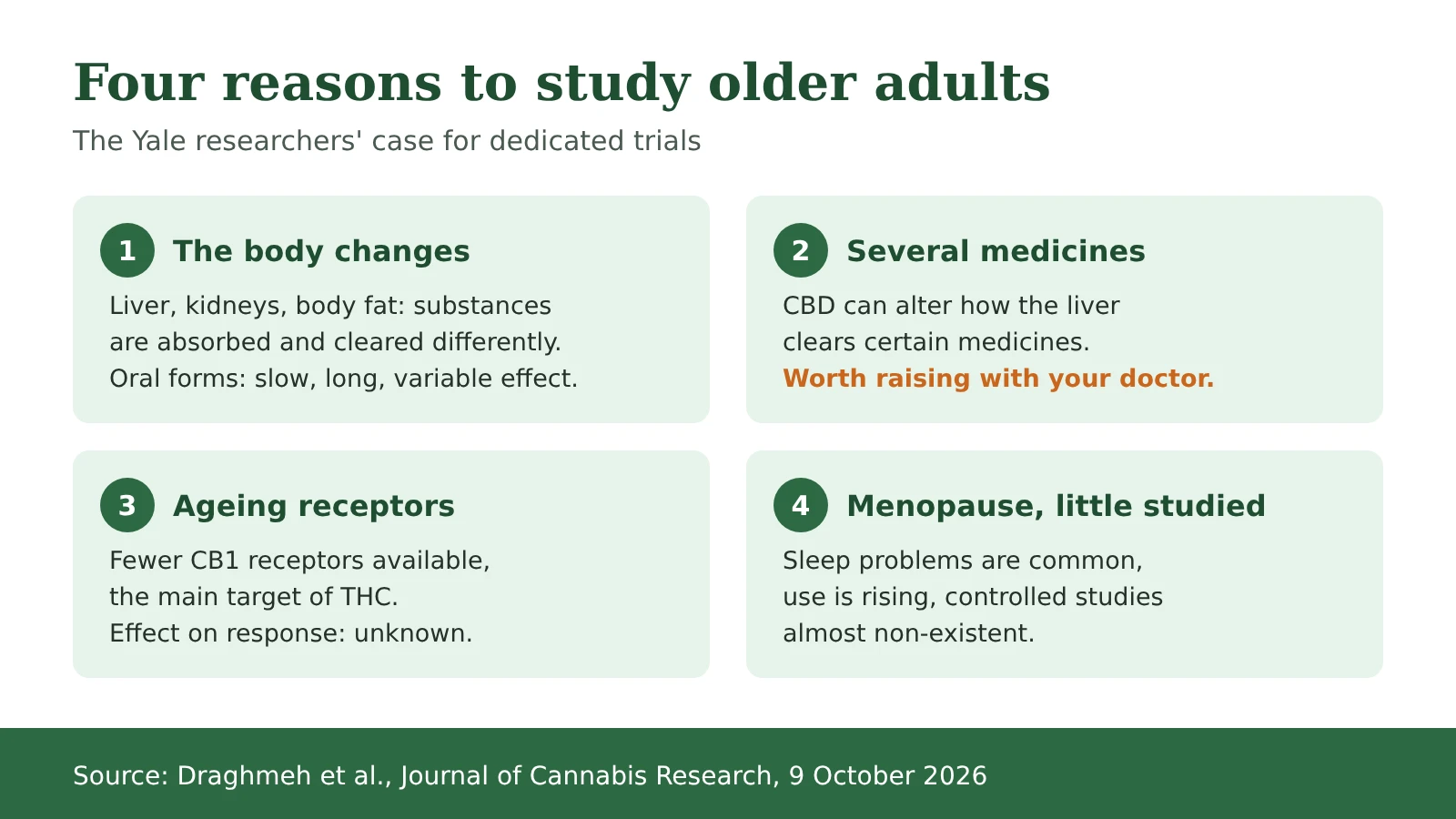
First, the body changes. Body fat, the liver and the kidneys no longer work in the same way, which alters how a substance is absorbed and then cleared. For THC, CBD or CBN, these differences are still almost entirely unexplored. Older adults also mostly use oral forms, whose effect comes on slowly, lasts a long time and varies widely from person to person.
Second, they often take several medicines, and CBD can alter the way the liver clears some of them, interactions that are still poorly described and worth raising with your doctor.
Third reason: the endocannabinoid system itself ages. Animal studies and human brain imaging suggest that CB1 receptors, the main target of THC, become less available with age. It is not yet known whether this strengthens, weakens or changes the effects.
Finally, menopause. Sleep problems are common at this stage, and more and more women report using cannabis during this period. Controlled studies in these women are practically non-existent.
“I sleep better”: reported feeling and measured sleep
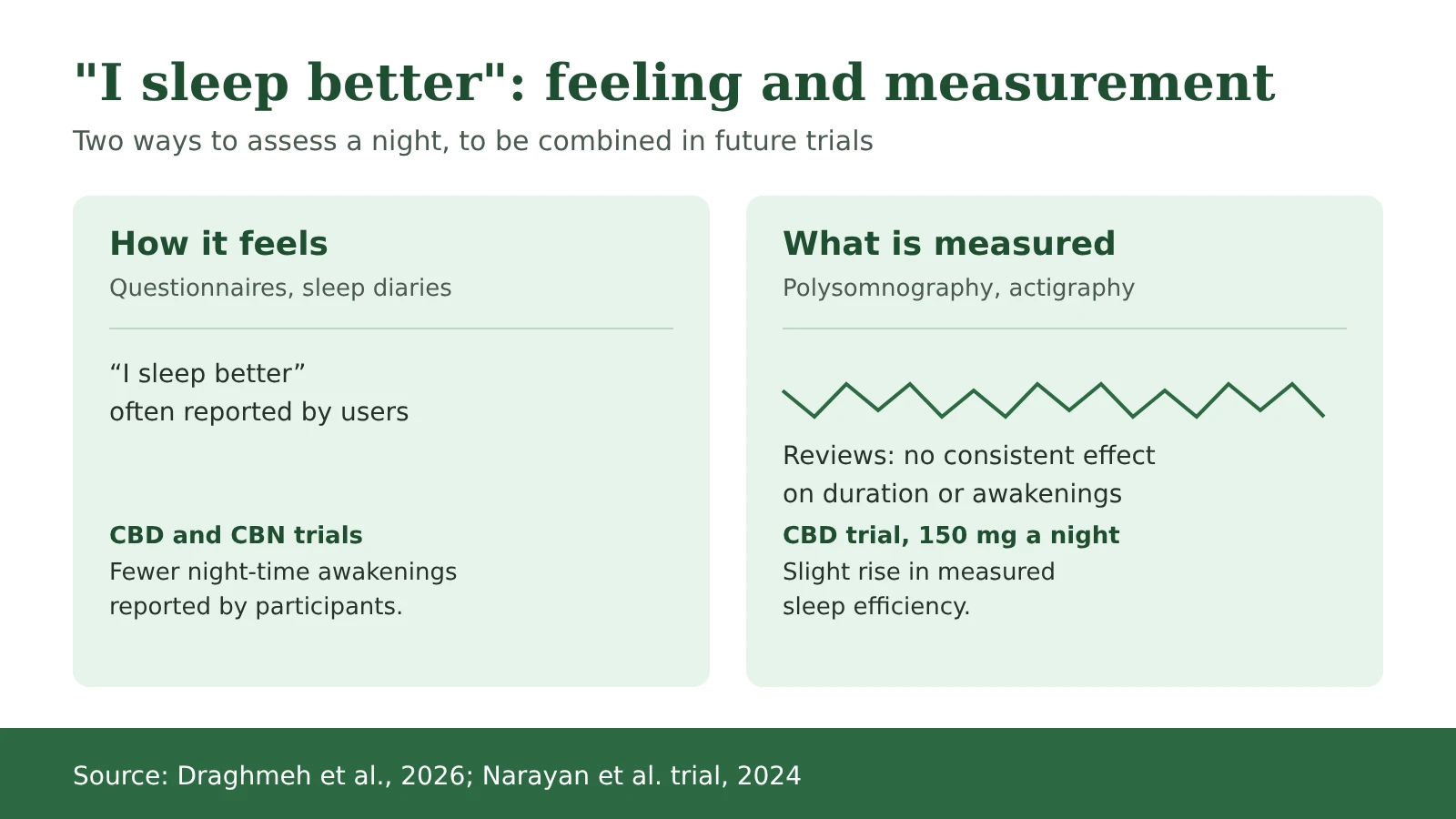
According to the authors, many people who use cannabis for sleep report that they sleep better. They ask future trials to record this feeling alongside objective measurements. Sleep can be measured in two ways: polysomnography, in a laboratory, records the activity of the brain, eyes and muscles through the night; actigraphy tracks movement with a small sensor worn on the wrist.
How sleep feels and how it measures do not always match, a gap known to insomnia specialists, with or without cannabis. Recent reviews based on objective measurements have found no consistent effect of cannabis or cannabinoids on sleep duration, time to fall asleep, awakenings, sleep efficiency or the different sleep stages. The authors therefore call for trials that combine both approaches.
THC: effects described in the laboratory, tolerance with habitual use
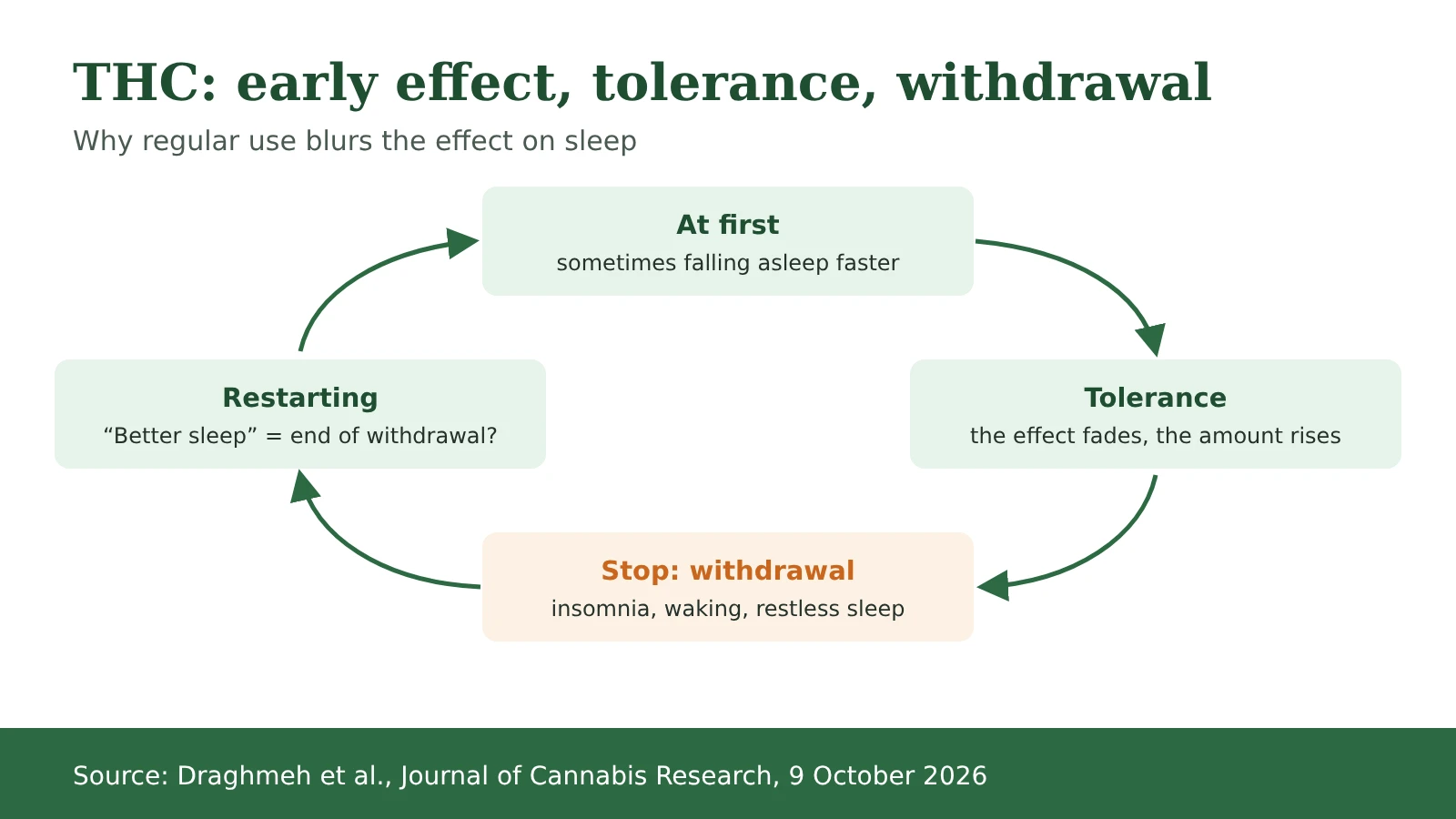
Studies on THC, mostly single doses in the laboratory, sometimes describe falling asleep faster, slightly longer sleep, more deep sleep and less REM sleep. These results vary from one study to the next.
With regular use, the body gets used to THC: this is tolerance, and the initial effect may fade, which leads some people to increase the amount. On stopping, withdrawal causes sleep problems: difficulty falling asleep, awakenings, less efficient sleep. According to the authors, some of the “better sleep” described by regular users may therefore reflect relief from this withdrawal rather than a lasting effect.
CBD and CBN: what the first trials measured
In a placebo-controlled pilot trial in people with insomnia, participants taking 150 mg of CBD each evening had a slight rise in sleep efficiency, as measured by the instruments. Most self-reported measures changed little. CBD and CBN are often presented as sleep aids, but trials remain few.
Other trials on CBD and CBN report improvements stated by participants, such as fewer night-time awakenings. Their results do not always agree, and adding CBD to CBN did not clearly do better than CBN alone. In the authors’ view, whether CBD, CBN or their combinations improve sleep quality remains an open question.
| Molecule | What has been studied | What the results show | Studies in older adults |
|---|---|---|---|
| THC | Mostly single doses in the laboratory, in younger adults | Sometimes faster sleep onset, more deep sleep; inconsistent effects, tolerance with regular use, sleep problems on withdrawal | Almost none |
| CBD | A few trials, including one at 150 mg each evening | Slight rise in measured efficiency; little change in how sleep feels | Almost none |
| CBN | A few trials, alone or combined with CBD | Self-reported improvements, such as fewer awakenings; inconsistent results | Almost none |
What the letter shows and does not show
The letter describes a trend: the use of cannabis for sleep is growing among older adults faster than the research. It does not demonstrate any effect in people over 50. It is an expert opinion, with no new data. The studies it summarises mostly involve younger adults, often with few participants. Many studies on THC are old and use preparations very different from today’s products. The “better sleep” people report has not been confirmed by objective measurements, and the trials on CBD and CBN tested high doses of pure molecules, bearing little relation to the amounts found in the plant.
The doses and preparations tested (150 mg of CBD each evening in the pilot trial, pure molecules at high doses) are in no way comparable with the CBD products sold freely in Switzerland, which are not medicines.
Point to watch
As the authors stress, the lack of studies shows neither a benefit nor a harm. It means that the question has not yet been studied properly in the people who use these products the most.
For researchers, the authors set four priorities: double-blind controlled trials in older adults, using products close to those actually sold; measurements that are both self-reported and objective; studies of what happens to cannabinoids in the body according to age, and of interactions; and finally, follow-up over several years on tolerance and dependence.
They ask doctors to routinely question older patients about their cannabis use, as many do not mention it unprompted, and to discuss the remaining uncertainties frankly: product composition, amounts, tolerance, withdrawal, interactions, memory, falls, heart and driving. As long as robust trials are lacking, they advise keeping established treatments for chronic insomnia as the first line.
What about Switzerland?
The article describes the situation in the United States, where THC-rich cannabis is legal in many states. In Switzerland, the framework is different. Hemp and products containing 1% total THC or more remain narcotics, and their non-medical use is prohibited (see what the 1% threshold measures).
Since 1 August 2022, doctors can prescribe cannabis-based medicines without an exceptional authorisation from the Federal Office of Public Health (FOPH), under their own responsibility. The production and sale of this medical cannabis are controlled by Swissmedic, and basic health insurance only reimburses it in exceptional cases. CBD products sold freely fall under other laws, set out in our guide to Swiss legislation: they are not medicines. For the chemistry of these molecules, see our feature on hemp cannabinoids.
In summary
According to the Yale letter, cannabis is part of the nights of many older adults, and many report that it helps them sleep better. The studies cited describe sometimes falling asleep faster with THC, an effect that wears off with habitual use, a slight rise in measured sleep efficiency in a pilot trial on CBD, and fewer reported awakenings in trials on CBD and CBN. These studies are few and were mostly carried out in younger adults. The authors call for trials designed for people over 50 before any conclusion can be drawn either way.
What the science says
Independent summary of a scientific publication. It does not describe The Green Lab products and is not health advice.
Frequently asked questions
Does CBD help with sleep after 50?
Studies in people over 50 are almost non-existent. In a placebo-controlled pilot trial, participants taking 150 mg of CBD each evening had a slight rise in measured sleep efficiency, with little change in how sleep felt. Other trials on CBD and CBN report fewer self-reported awakenings, with inconsistent results, mostly in younger adults.
Why study older adults specifically?
Because their bodies work differently, according to the authors. With age, the body absorbs and clears substances differently, medical treatments multiply and CB1 receptors become less available. The Yale researchers therefore call for trials designed for this population, rather than results carried over from younger adults.
What is polysomnography?
It is the reference test for sleep. Over one night, usually in a laboratory, sensors record the activity of the brain, eyes and muscles, as well as breathing. It measures falling asleep, awakenings and sleep stages objectively, and so complements questionnaires, which capture how sleep feels. The Yale researchers want future trials to use both.
Why does the effect of THC on sleep wear off?
In laboratory studies, THC sometimes helps people fall asleep faster at first. With regular use, the body gets used to it: this is tolerance, which reduces the initial effect. On stopping, withdrawal causes sleep problems. According to the authors, some of the improvement described by regular users may therefore reflect the end of this withdrawal rather than a lasting effect.
Can a doctor prescribe cannabis in Switzerland?
Yes. Since 1 August 2022, doctors can prescribe cannabis-based medicines without an exceptional authorisation from the FOPH, under their own responsibility. Non-medical use of cannabis containing 1% THC or more remains prohibited, and reimbursement by basic health insurance is exceptional.