Alongside CBD, CBG and CBC, hemp contains cannabinoids present in very small amounts. Three of them come up often: CBN, which forms as THC ages, and THCV and CBDV, short-chain cousins of THC and CBD. This article looks at where they come from and what their presence indicates.
On this page
CBN, the first cannabinoid to be isolated
Cannabinol, or CBN, is the first cannabinoid ever isolated. In 1895, the chemists Wood, Spivey and Easterfield obtained it as a crystalline acetate from a red oil distilled from charas, the resin of Indian hemp. Their results were published in 1896 and 1899. Our guide to hemp cannabinoids presents the main molecules; those covered in this article are rarer.
Its structure took longer to establish. In the early 1930s, Cahn worked out its skeleton without managing to fix the position of all its groups, and it was the total synthesis carried out by Roger Adams in 1940 that confirmed it. CBN has the formula C21H26O2 and a molar mass of 310.4 g/mol.
A product of THC ageing
No enzyme makes CBN: no biosynthetic pathway has been identified for it or for its acidic form, CBNA. It forms when THC oxidises in air. One of the molecule’s rings becomes aromatic and THC turns into CBN. Small amounts of CBNA have been found in some hemp samples, resulting from the same transformation of THCA under the influence of ultraviolet light, storage and heat.
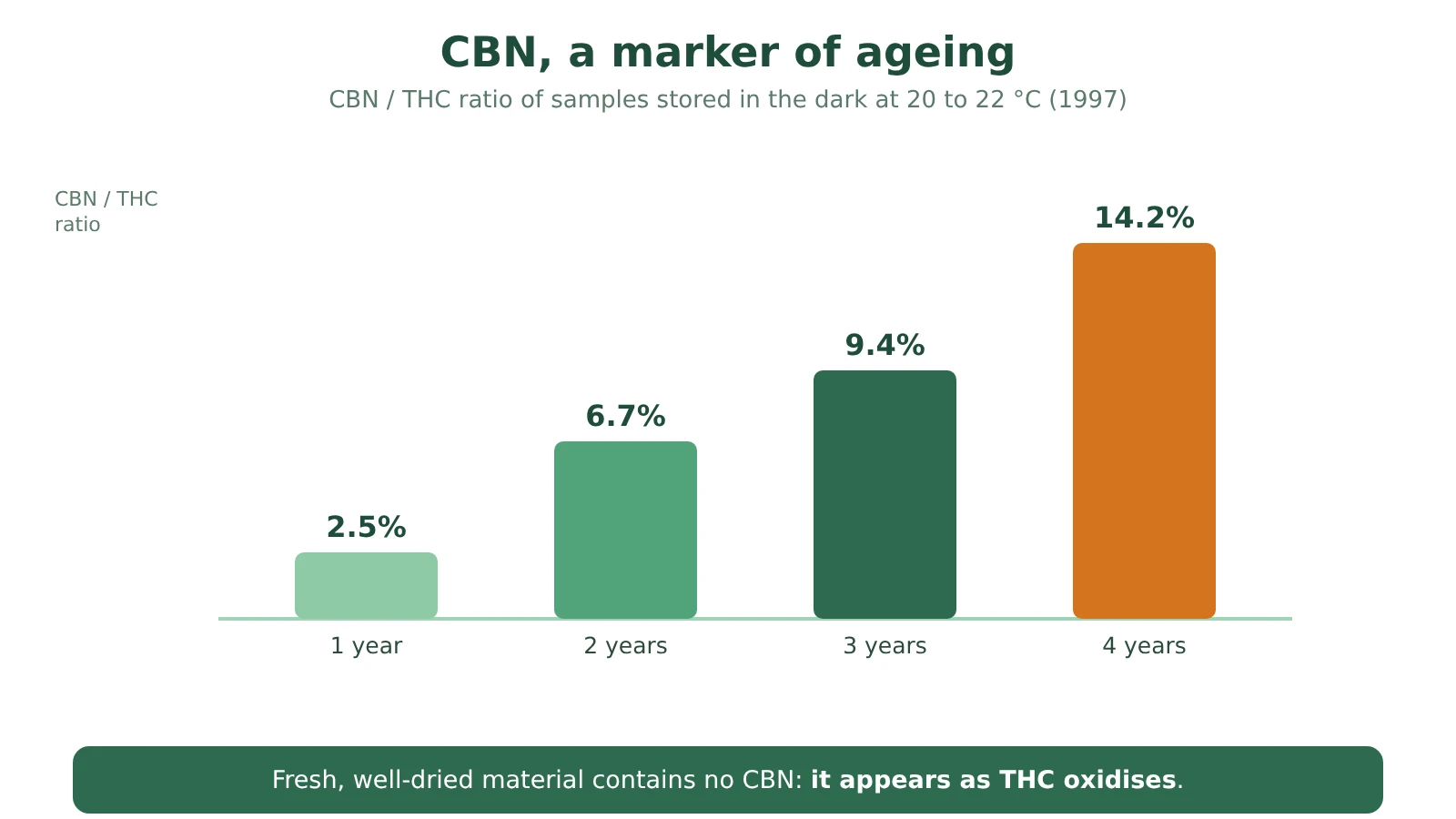
This transformation is regular enough to serve as a clock. In 1997, Ross and ElSohly followed samples of THC-rich cannabis stored for four years in the dark, between 20 and 22 °C. The ratio of CBN to THC rose from 2.5% after one year to 14.2% after four years, while THC lost 16.6% of its initial value in the first year and 41.4% after four years. The authors noted that fresh, carefully dried material contains no CBN.
Light and heat speed up the process. A 2019 study of samples stored for four years showed that temperature changed the rate of conversion, whereas light altered both its rate and the products formed. Our article on the stability of CBD and THC looks at the role of temperature. CBN itself is very stable: it has been found in plant material dating from around 750 BC.
CBN in CBD-rich hemp
Since CBN comes from THC, it is expected in small quantities in low-THC hemp. In a 2019 study of two hemp flower samples, its content was 0.01 g per 100 g.
A high CBN content mainly provides information about the age of a material and its storage conditions. CBN also features in standard testing panels: liquid chromatography methods published in 2019 and 2024 quantify it alongside around ten other cannabinoids, as explained in our article on acidic forms and reading lab results.
Point to watch
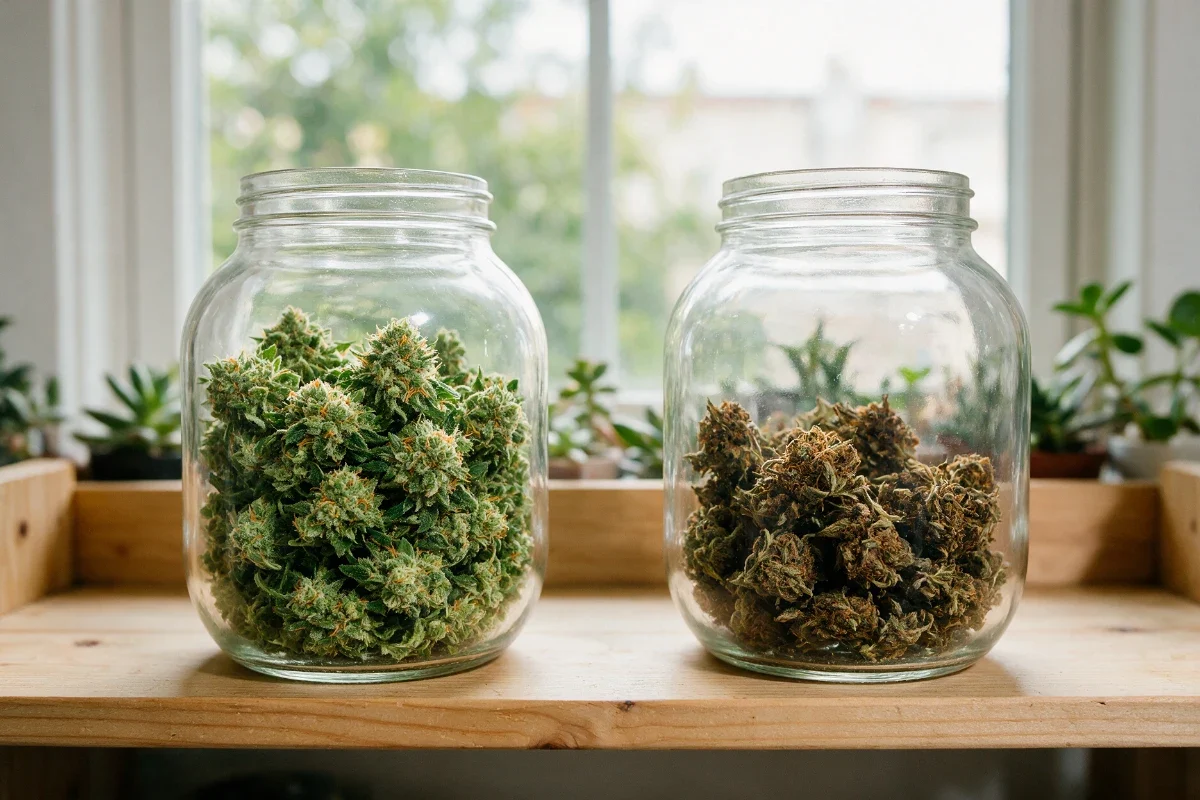
A high CBN content in a flower or an extract mainly signals old material, or material poorly protected from air and light. Flowers are best kept in a closed jar, away from light.
THCV and CBDV: the short-chain cannabinoids
THCV and CBDV belong to a parallel family, the varins. Their side chain has three carbon atoms instead of five: CBDV is to CBD what THCV is to THC. Both molecules share the same molecular formula, C19H26O2, with a molar mass of about 286.4 g/mol.
CBDV was identified in 1969 by Vollner, Bieniek and Korte. THCV was detected in 1970 in a cannabis tincture by Gill, Paton and Pertwee, then isolated and confirmed by synthesis by Gill in 1971; its name, tetrahydrocannabivarin, appeared the same year in a paper by Merkus. Despite its name, THCV is not an isomer of THC: its formula has two fewer carbon atoms and four fewer hydrogen atoms.
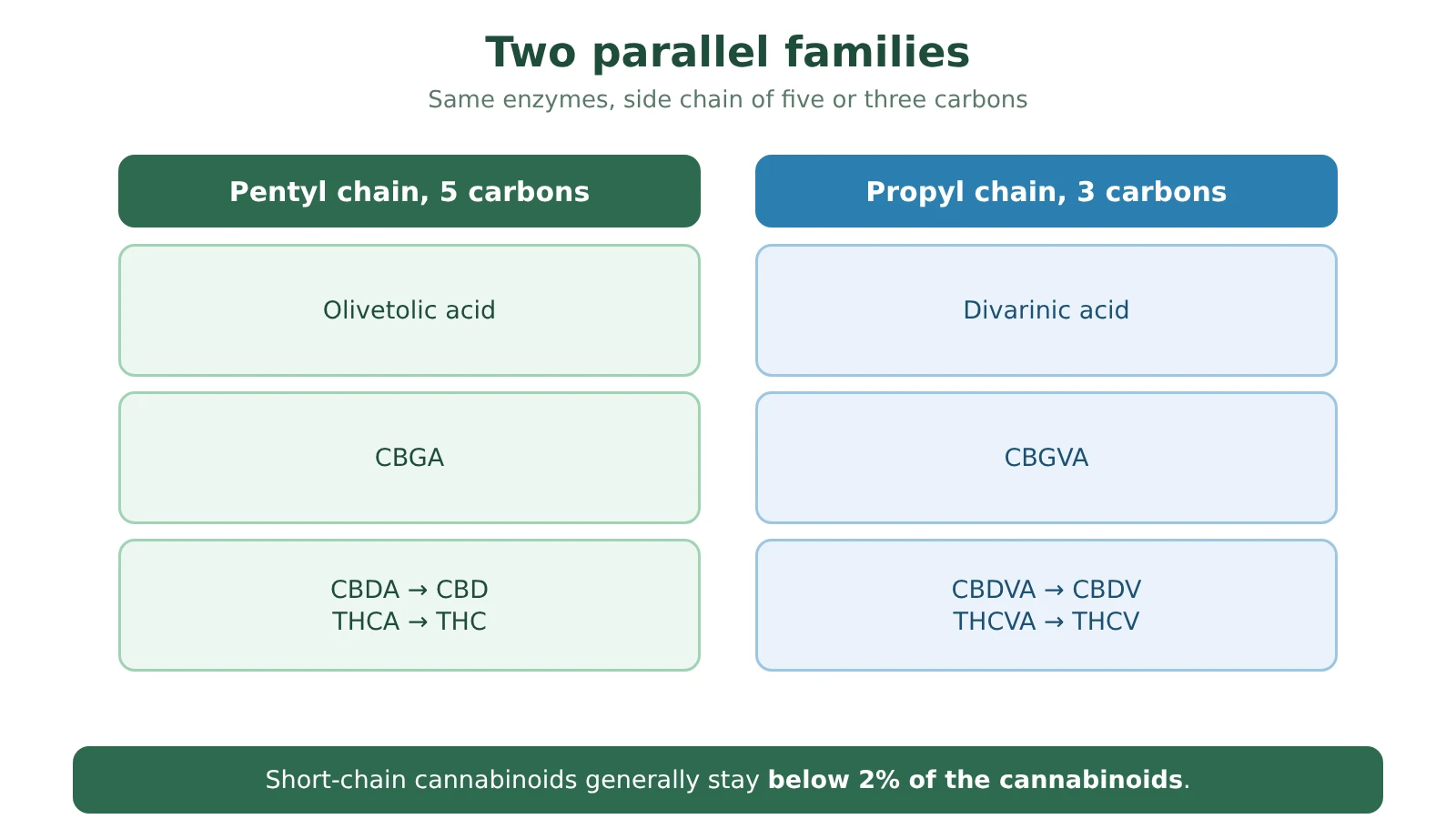
The plant makes them with the same enzymes as their counterparts. At the start, it forms divarinic acid, which has a short chain, instead of olivetolic acid. Combined with geranyl pyrophosphate, this gives CBGVA, the short-chain equivalent of CBGA, which the synthases convert into CBDVA or THCVA. The parallel goes a long way: in the 2003 study that established the role of the B locus, traces of CBDV appeared only in CBD plants, and traces of THCV only in THC plants.
Low levels, with exceptions
In most plants, the varins remain marginal. According to a 2014 reference work, short-chain cannabinoids generally make up less than 2% of the cannabinoid fraction. Some populations are exceptions: in them, THCVA can reach 70% of the cannabinoids. These plants often originate from China, as fibre and seed hemp, or from southern Africa.
In CBD-rich hemp, the varins are often absent or undetectable. A 2019 study found no THCV in the hemp flowers it analysed, and a 2018 study of commercial varieties detected CBDV in none of them.
The Swiss framework
In Switzerland, CBN and THCV fall under narcotics legislation. They belong to derivative group no. 303 (“cannabinoids”) in Annex 6 of the FDHA Narcotics Lists Ordinance (BetmVV-EDI), which covers a family of molecules defined by their chemical structure: their industrial and scientific use is exempt from control measures, their private use is not. Swissmedic specifies that this classification covers CBN as a pure substance, not CBN occurring naturally in hemp, as long as it is neither added nor enriched. CBDV, which shares the architecture of CBD, is not part of this group and, like CBD, follows the rules of the category under which the product is sold. For hemp and hemp products, the criterion remains a total THC content below 1%.
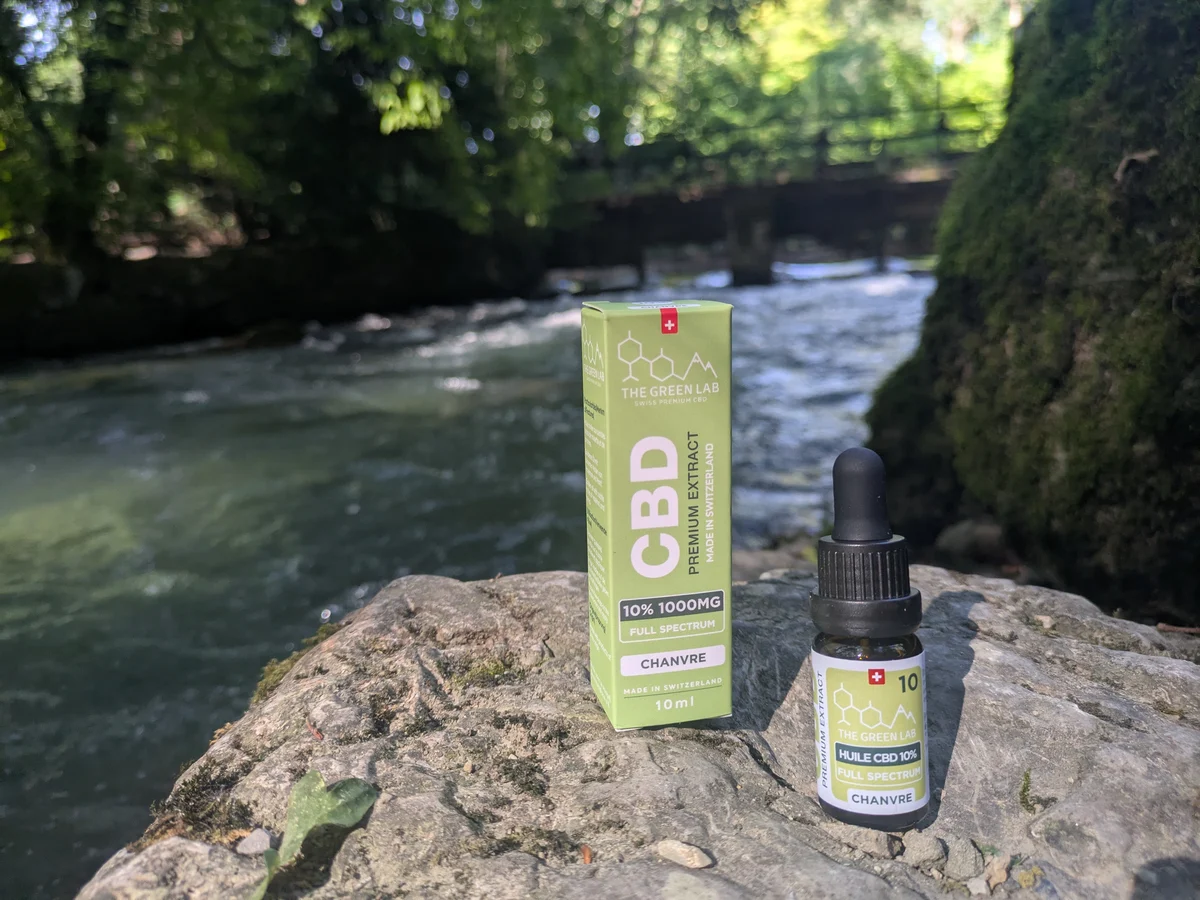
Our oils are presented on the CBD oils page, including the Full Spectrum Hemp oil, and our flowers on the CBD flowers page.
Our laboratory
The crude extracts we buy contain less than 1% total THC, and we process them in Gland, from winterisation to bottling. The cannabinoid levels of our oils are checked regularly by an external laboratory. Discover the laboratory →
Frequently asked questions
Is CBN present in fresh hemp?
Hardly at all. CBN forms when THC oxidises, through contact with air, light and heat. A reference study noted that fresh, carefully dried material contains none; its content increases with storage time.
Where does CBN come from?
From the breakdown of THC. No enzyme in the plant makes it: it appears as THC oxidises over time. The ratio of CBN to THC has even been used to estimate the age of stored cannabis samples.
What is THCV?
Tetrahydrocannabivarin, a homologue of THC whose side chain has three carbon atoms instead of five. Detected in 1970 and isolated in 1971, it generally remains a very minor compound, except in certain hemp populations originating from China or southern Africa.
What is the difference between CBD and CBDV?
CBDV, or cannabidivarin, has the same architecture as CBD with a shorter side chain, of three carbons instead of five. It is made by the same enzymes, from a short-chain precursor, and is usually present only in trace amounts.
Is CBN classified as a narcotic in Switzerland?
Pure CBN, yes, and so is THCV: both belong to derivative group no. 303 of the BetmVV-EDI, and only their industrial or scientific use is exempt from controls. Swissmedic specifies that CBN occurring naturally in hemp is not affected, as long as it is neither added nor enriched. CBDV is not part of this group.