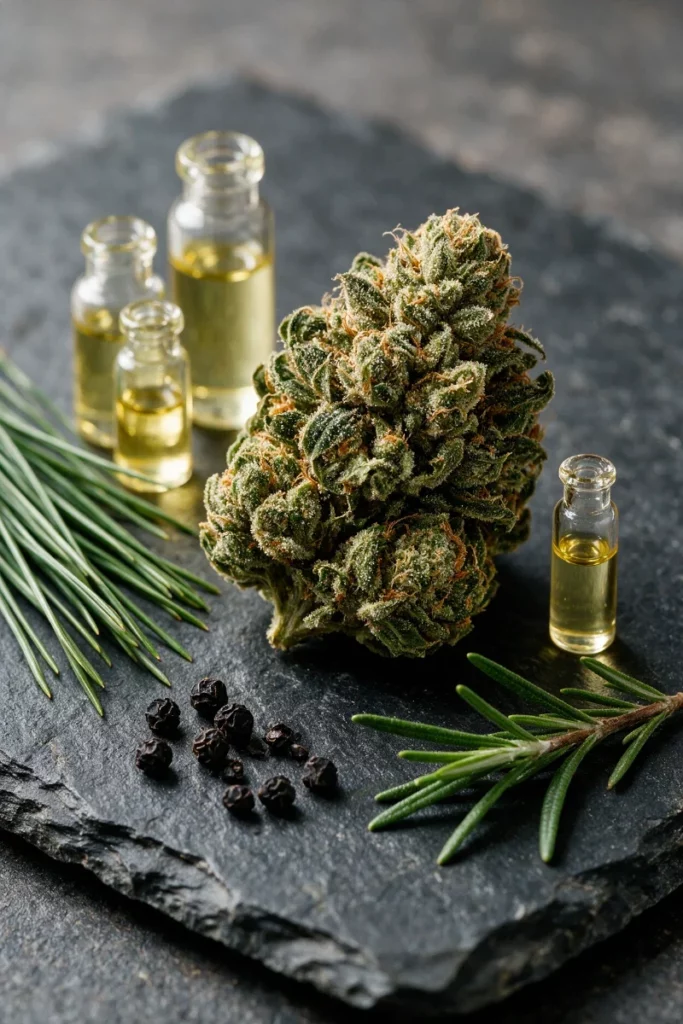
Hemp resin contains other families of molecules besides cannabinoids. Terpenes give each variety its scent, and flavonoids belong to the large family of plant pigments. This article presents these two families, how the plant makes them and what becomes of them during drying, storage and distillation.
On this page
What a terpene is
Terpenes are built from building blocks of five carbon atoms. Two blocks give a monoterpene, with ten carbons, such as myrcene or limonene; three blocks give a sesquiterpene, with fifteen carbons, such as beta-caryophyllene. The plant assembles these blocks into geranyl pyrophosphate or farnesyl pyrophosphate, which enzymes called terpene synthases then convert into a wide variety of molecules.
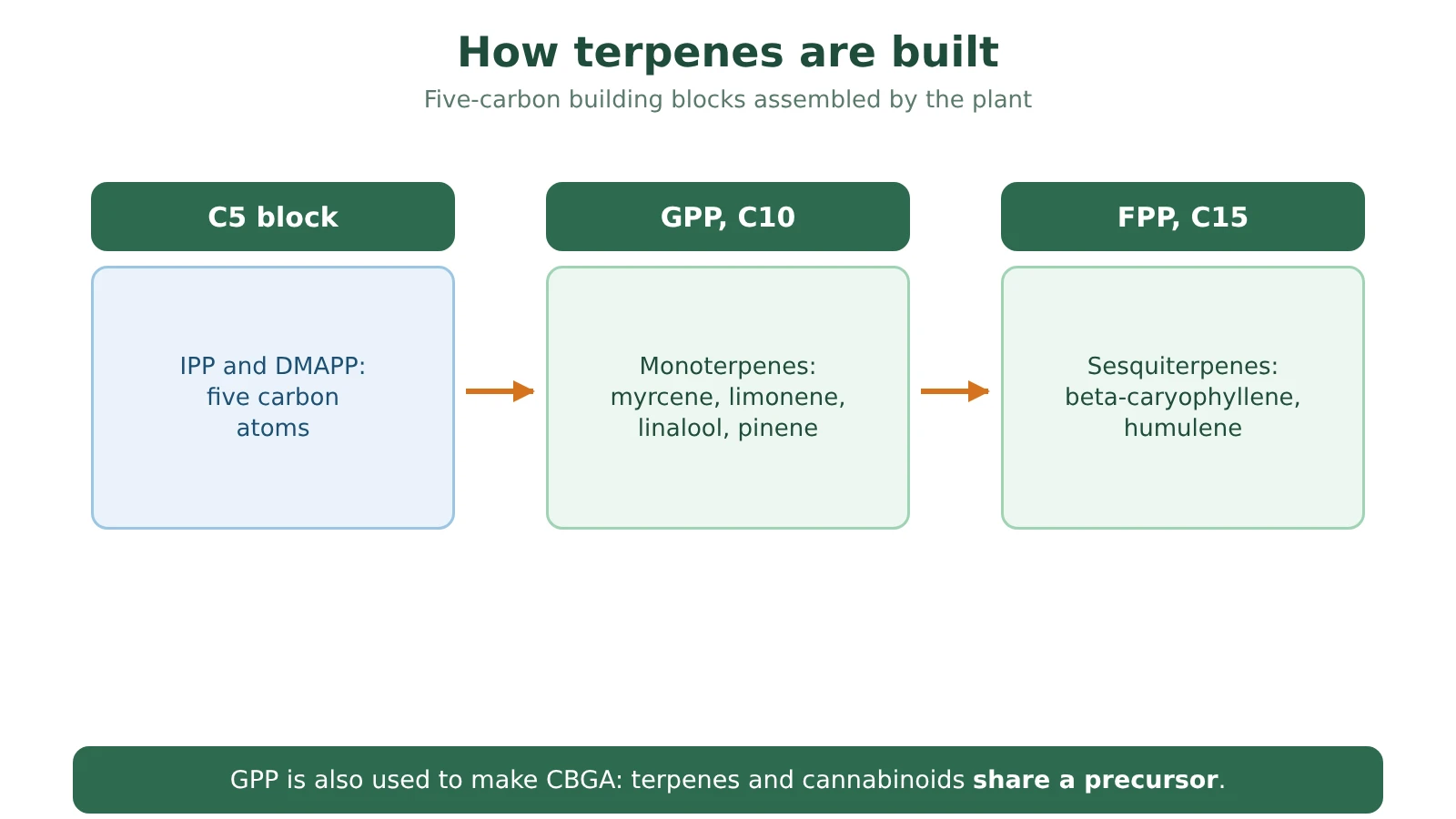
Geranyl pyrophosphate is also used to make CBGA, the cannabinoid precursor presented in our article on CBG. Terpenes and cannabinoids therefore share part of their pathway, as our guide to hemp cannabinoids shows.
Terpenes in hemp
In hemp, terpenes form in the glandular trichomes, in the same resin as the cannabinoids. More than 150 different terpenes have been described in cannabis resin, and a 2020 review lists more than 200 volatile compounds depending on the genotype.
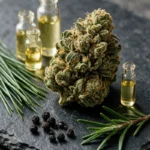
A few of them turn up almost everywhere. Myrcene, beta-caryophyllene and alpha-humulene are present in most varieties; alpha-pinene, limonene and linalool are also common, and terpinolene is abundant in some. Their combination gives each flower its scent, as becomes clear when comparing two varieties of CBD flowers.
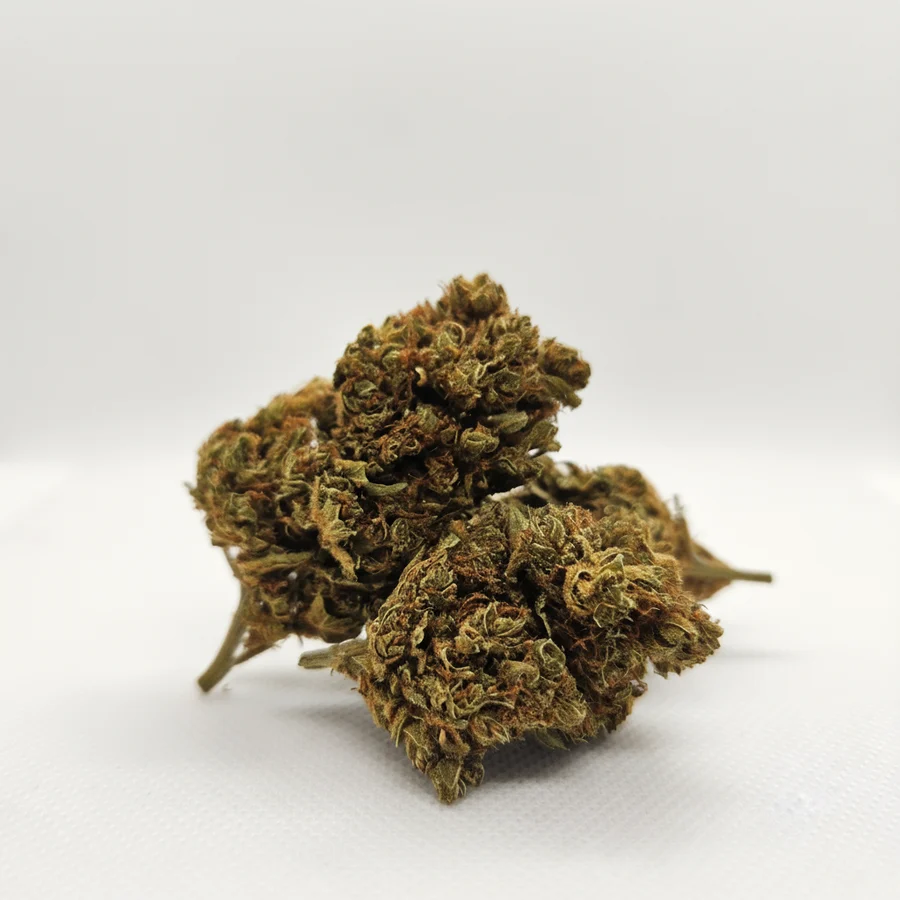
These molecules are volatile, but not all to the same degree. Myrcene boils at around 167 °C, limonene at around 176 °C, linalool at around 198 °C and beta-caryophyllene at around 256 °C: monoterpenes evaporate more easily than sesquiterpenes.
What drying and storage do to them
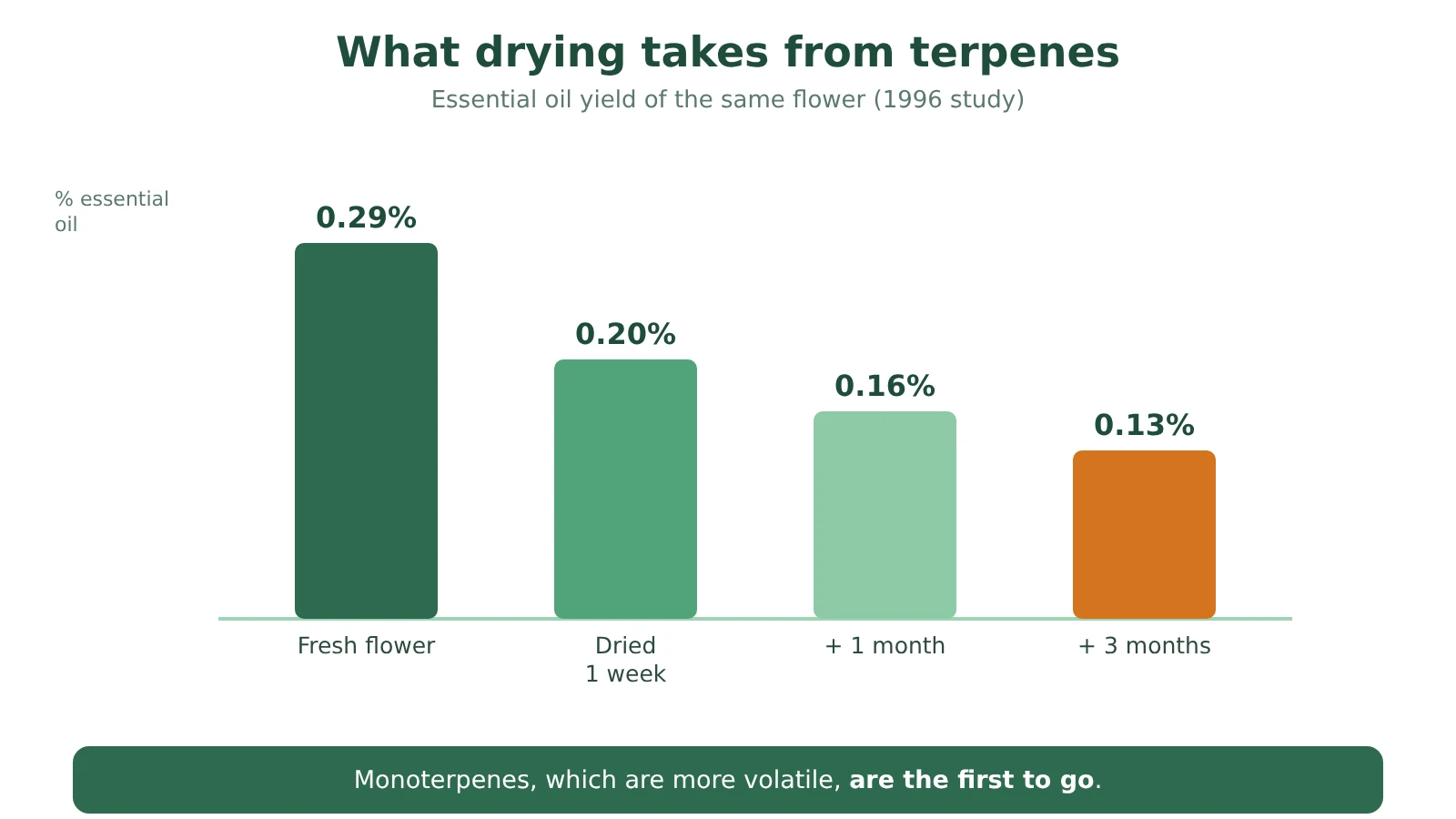
Drying causes part of the terpenes to be lost, more monoterpenes than sesquiterpenes. In a 1996 study, the essential oil yield of the same flower dropped from 0.29% when fresh to 0.20% after one week of air drying, then to 0.13% after three months of storage. Over the same period, the share of myrcene in this oil declined markedly while that of beta-caryophyllene increased.
Storage continues this trend. A 2020 study that followed flowers and extracts for one year found a rapid decline in terpenes under all the conditions tested, from −80 °C to room temperature. The heat that decarboxylates cannabinoids, described in our article on acidic forms, also makes the lightest terpenes evaporate. Our article on storing CBD products sets out the practical steps that limit these losses.
Point to watch
Terpenes evaporate easily: a bottle or jar left open loses part of its scent. Closing it after use and keeping it away from heat limits these losses.
Terpenes, extraction and distillation
Extraction methods do not all carry terpenes over in the same way. A 2024 study compared several methods: hydrodistillation gave the greatest diversity of terpenes, supercritical CO₂ the highest cannabinoid concentrations, and ethanol the largest share of acidic cannabinoids.
Purification changes the profile further. Winterisation mainly removes waxes and fats, and distillation separates compounds according to their volatility; terpenes, far more volatile than cannabinoids, do not follow the same path. A 2020 review notes that obtaining an oil containing all of the plant’s natural terpenes is almost impossible, and that some manufacturers separate the terpenes and then reintroduce them into the finished product. Our article on Full Spectrum, Broad Spectrum and isolate explains what these steps mean for each spectrum.
Flavonoids and cannflavins
Flavonoids form a large family of plant pigments, built on a skeleton of fifteen carbon atoms: two aromatic rings linked by a third. Around twenty have been identified in hemp, mainly flavones and flavonols such as apigenin, luteolin, kaempferol and quercetin, either free or bound to sugars.
Hemp also has characteristic flavonoids, the cannflavins. The name was proposed in 1985. Cannflavins A and B were described in 1986 as flavones carrying a geranyl or prenyl chain, and cannflavin C in 2008.
In 2019, researchers identified the pathway that produces them. The plant converts luteolin into chrysoeriol, then an enzyme, CsPT3, attaches a geranyl chain to it to give cannflavin A, or a prenyl chain to give cannflavin B. Cannflavin A has also been reported in another plant, Mimulus bigelovii, whereas cannflavins B and C are known only in hemp.
Terpenes and flavonoids complete the profile drawn by the cannabinoids, and partly explain why two oils with the same CBD percentage do not smell the same. Our oils are presented on the CBD oils page, including the Hemp oil, formulated on hemp seed oil.
Our laboratory
In our laboratory in Gland, we carry out winterisation at −80 °C and vacuum short-path distillation, two steps that determine the final profile of an extract. Our crude extracts contain less than 1% total THC, and the cannabinoid levels of our oils are regularly checked by an external laboratory. Discover the laboratory →
Frequently asked questions
What is a terpene?
A molecule built from building blocks of five carbon atoms. Monoterpenes have ten carbons, sesquiterpenes fifteen. In hemp, they form in the trichomes, together with the cannabinoids, and give each variety its scent.
What are the main terpenes in hemp?
Myrcene, beta-caryophyllene and alpha-humulene are found in most varieties. Alpha-pinene, limonene and linalool are also common, and terpinolene is abundant in some. The proportion of each one varies from variety to variety.
Do terpenes disappear during drying?
Partly. Drying mainly removes monoterpenes, which are more volatile than sesquiterpenes. In a 1996 study, the essential oil yield of a flower dropped from 0.29% when fresh to 0.13% after one week of drying followed by three months of storage.
What is a cannflavin?
A flavonoid characteristic of hemp. Cannflavins A and B, described in 1986, are flavones carrying a geranyl or prenyl chain; cannflavin C was described in 2008. The plant makes them from luteolin.
Does a CBD oil contain terpenes?
It depends on the extract and the process. A Full Spectrum extract can retain part of the plant’s terpenes; distillation and purification remove a large share of them, and an isolate contains none.