In the journal Neuropsychopharmacology, two US researchers place the strongest clinical evidence on CBD in rare, treatment-resistant childhood epilepsies, where a CBD medicine is approved by several health agencies. For anxiety, addiction or psychosis, they describe smaller, shorter trials with varying results. Their shared conclusion: CBD is “neither a miracle nor a menace”. This is an expert opinion that discusses existing studies, without providing new data. Here is what they write. To place this type of study and its level of evidence, see reading and understanding a CBD study.
| The study at a glance | |
|---|---|
| Original title | Cannabidiol at the crossroads: panacea, placebo, or problem? |
| Journal | Neuropsychopharmacology, vol. 51, no. 8, pp. 1363-1368 |
| Date | 18 April 2026 (online publication) |
| Authors | L. Cinnamon Bidwell (University of Colorado Boulder) and Ryan Vandrey (Johns Hopkins University School of Medicine, Baltimore), United States |
| Type | “Circumspectives” article: two expert opinions set against each other and then brought together, with no new data |
| Funding | Not specified. Ryan Vandrey reports being a paid consultant for Charlotte’s Web and Syge Medical. L. Cinnamon Bidwell reports no conflicts of interest |
| Level of evidence | ●○○○ 1 out of 4: expert opinion, which discusses existing studies |
| Full text | Open access on PubMed Central |
On this page
Two viewpoints, one shared conclusion
The article appears in the journal’s “Circumspectives” section: two expert viewpoints on the same question, presented and then brought together. The first highlights what studies have measured, the second what they do not yet allow us to conclude. The whole piece draws on 57 references.
CBD (cannabidiol), a molecule from hemp, is widely perceived as safe and effective, both for diseases and for general wellbeing. The authors point out that CBD products differ in format, composition, route of administration, dose and quality control, which makes the studies harder to interpret.
First view: what the studies have measured
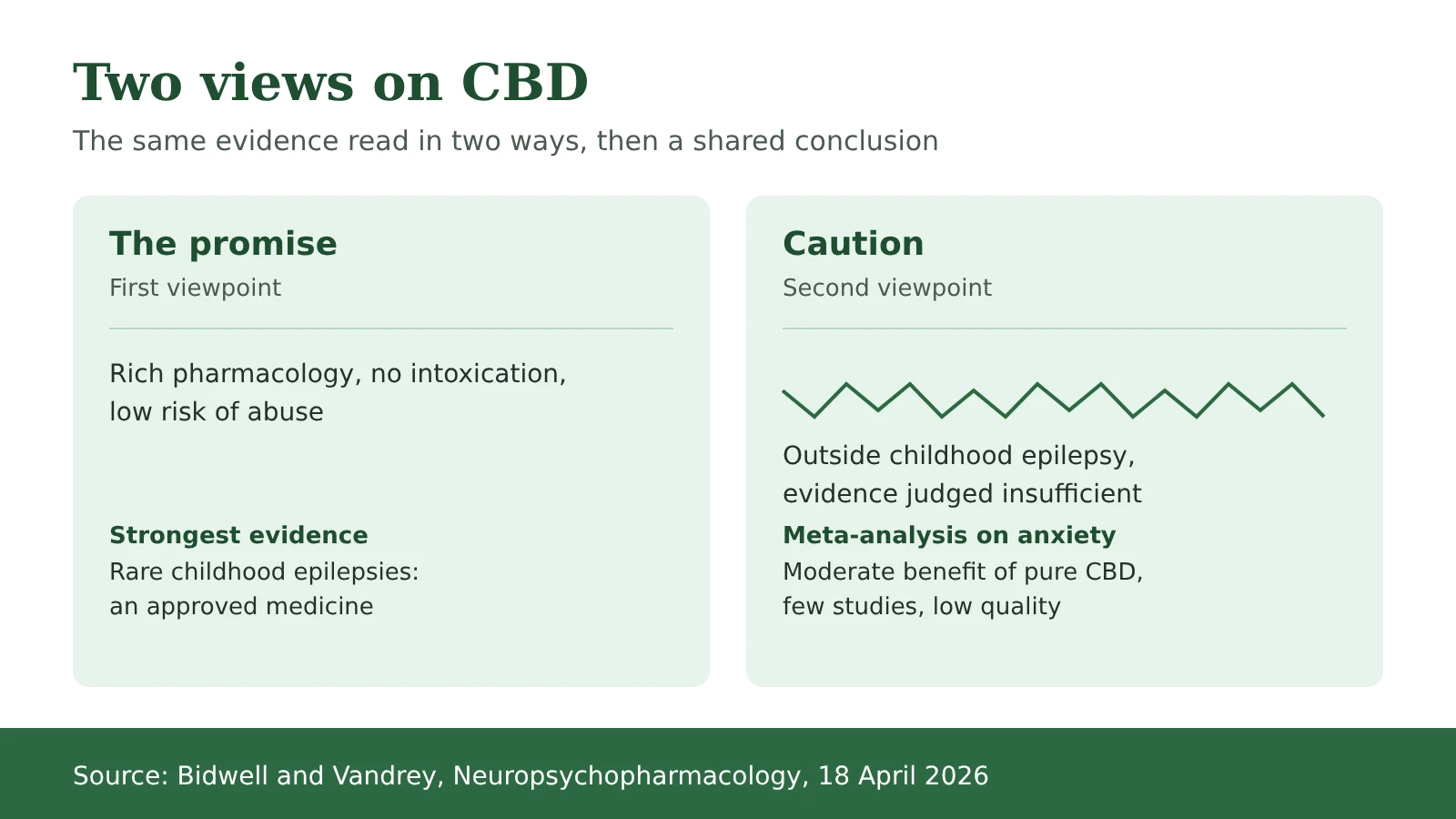
According to the first viewpoint, laboratory and clinical studies consistently show that at therapeutic doses, CBD is not intoxicating, unlike THC, and carries a low risk of abuse. The molecule acts on many targets, including serotonin receptors, the endocannabinoid system and pathways linked to pain and inflammation. In animals and in early human trials, anti-inflammatory, anxiety-related, nerve-protective and antipsychotic effects have been observed.
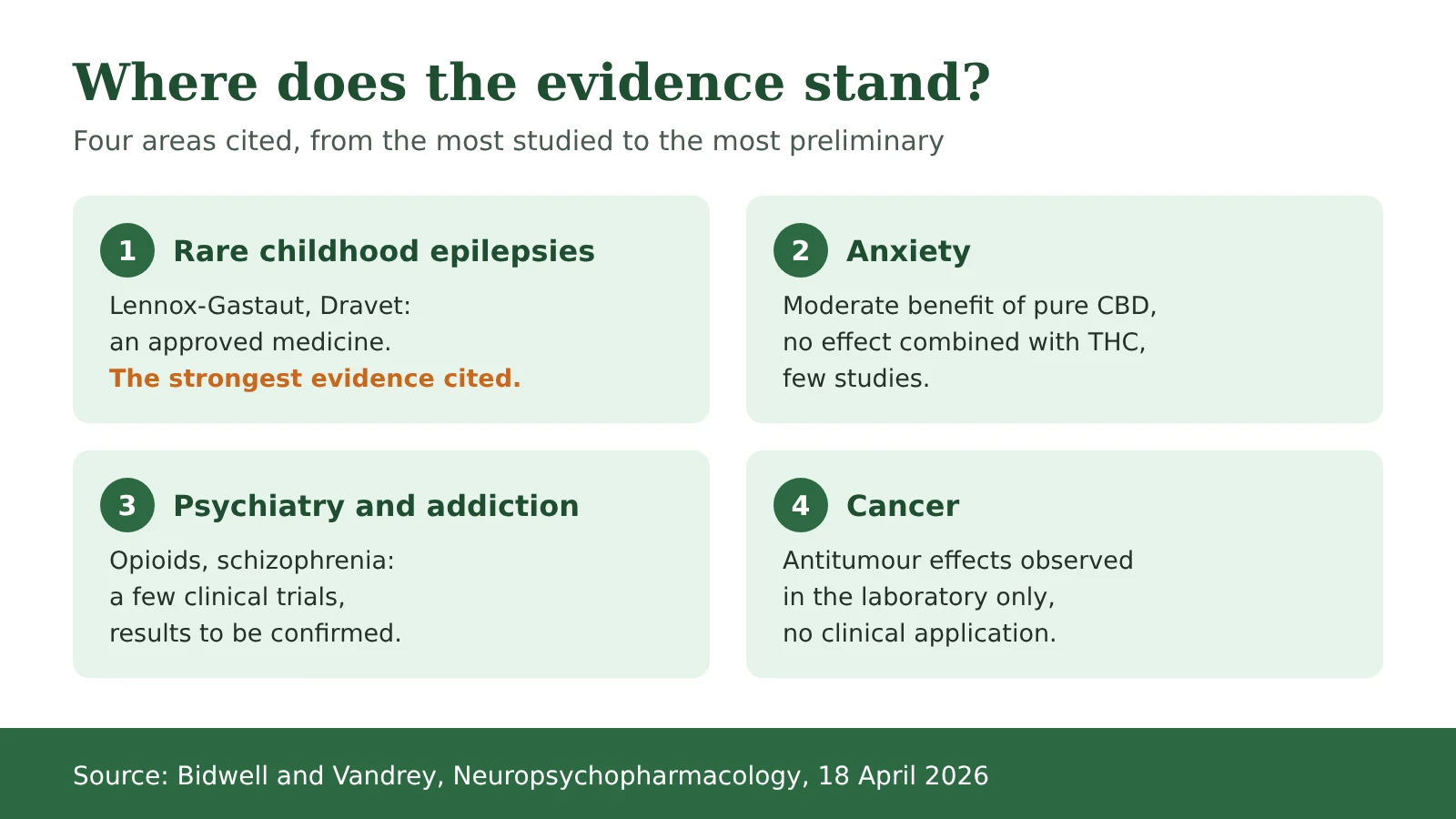
The most robust result concerns rare, treatment-resistant childhood epilepsies (Lennox-Gastaut and Dravet syndromes): a CBD medicine, Epidiolex, is approved for them by several health agencies. Other trials have looked at psychiatric disorders. In people dependent on opioids, one trial measured a reduction in cue-induced drug craving and in anxiety. In schizophrenia, one trial reported antipsychotic effects with a favourable side-effect profile. Other studies are looking at social anxiety, post-traumatic stress and addiction.
This first viewpoint stresses that CBD’s safety profile could matter where some usual treatments carry a risk of dependence, and that low-risk options are lacking for young people. It notes that the number of ongoing trials is growing. It also acknowledges that the link between these mechanisms and a benefit for patients has yet to be established, which it attributes to research that is still young.
What the article shows and does not show
The second viewpoint takes stock of the limitations. Outside childhood epilepsy, the evidence is judged insufficient and the mechanism of action has not been established. Most trials involve healthy adults, a single dose, few participants and a short duration. Large observational studies often survey long-term users, which biases the results.
The examples cited illustrate this. A meta-analysis on anxiety disorders found a moderate benefit of pure CBD in social or generalised anxiety and no effect when it was combined with THC; its authors noted that the studies were few and of low quality. A review on cancer describes antioxidant and antitumour effects of CBD, observed in the laboratory only. In young people with an alcohol use disorder, a single dose of CBD was well tolerated, with no measurable effect.
Added to this are a high placebo effect, often inadequate control groups and few direct comparisons with existing treatments. The authors conclude that trials with repeated doses and larger samples are needed.
Point to watch
This article is an expert opinion: it discusses existing studies without providing new data, and does not state who wrote each viewpoint. Ryan Vandrey reports being a paid consultant for Charlotte’s Web and Syge Medical. The funding of the article is not specified.
Under the “CBD” label, very different products
Under the “CBD” label, the authors list products to inhale, to swallow, to apply to the skin, or even to insert rectally or vaginally. The industry sorts them into three categories, which say nothing about dose or quality.
| Category | What it contains according to the industry | THC |
|---|---|---|
| Full spectrum | Crude plant extract: CBD, other “minor” cannabinoids, terpenes and flavonoids | In small amounts |
| Broad spectrum | CBD, “minor” cannabinoids, terpenes and flavonoids | Absent in principle |
| Isolate | CBD alone, with at most traces of other compounds | Absent in principle |
Composition (see hemp terpenes and flavonoids), format and route of administration change how CBD is absorbed and how it acts. For the authors, a result therefore applies to the specific product tested in the trial, not to “CBD” in general.
As for quality, analyses of commercial products have repeatedly found contents that differ from the label, highly variable concentrations between similar products and potentially harmful contaminants.
Safety: what the authors point out
According to the authors, a single dose of CBD is generally associated neither with intoxication nor with impaired functioning, and its safety margin is wide. They nevertheless point to risks that are often underestimated. Many products sold as “CBD” also contain THC, in highly variable proportions. While it has no notable effect in most healthy adults, small amounts of THC have caused significant adverse events in some patients.
Prolonged exposure to high doses of CBD has sometimes impaired liver function. This risk depends on the dose, frequency, age and other treatments; the authors state that it can be managed by monitoring the liver. Taken orally, CBD also inhibits liver enzymes (CYP450) that break down many medicines: this is a topic to discuss with your doctor. Finally, one study suggests that oral CBD could worsen the adverse effects of THC in patients with schizophrenia, contrary to a widespread belief.
Common ground and the roadmap
Both viewpoints recognise that CBD has therapeutic potential in some psychiatric and neurological disorders, and in other areas of medicine. They cite its lack of intoxication, its low risk of abuse and its safety profile, which in their view make it a candidate for study where conventional treatments fall short. For therapeutic use, they consider the guidance of a health professional necessary, because of interactions, the effect on orally taken THC and the risk to the liver.
They also explain why studies contradict each other. The effective dose probably varies with what is being measured, the population and the duration. The same dose produces very different blood levels depending on the format, the route of administration, metabolism and body composition. And many effects observed in the laboratory occur at concentrations far removed from human use.
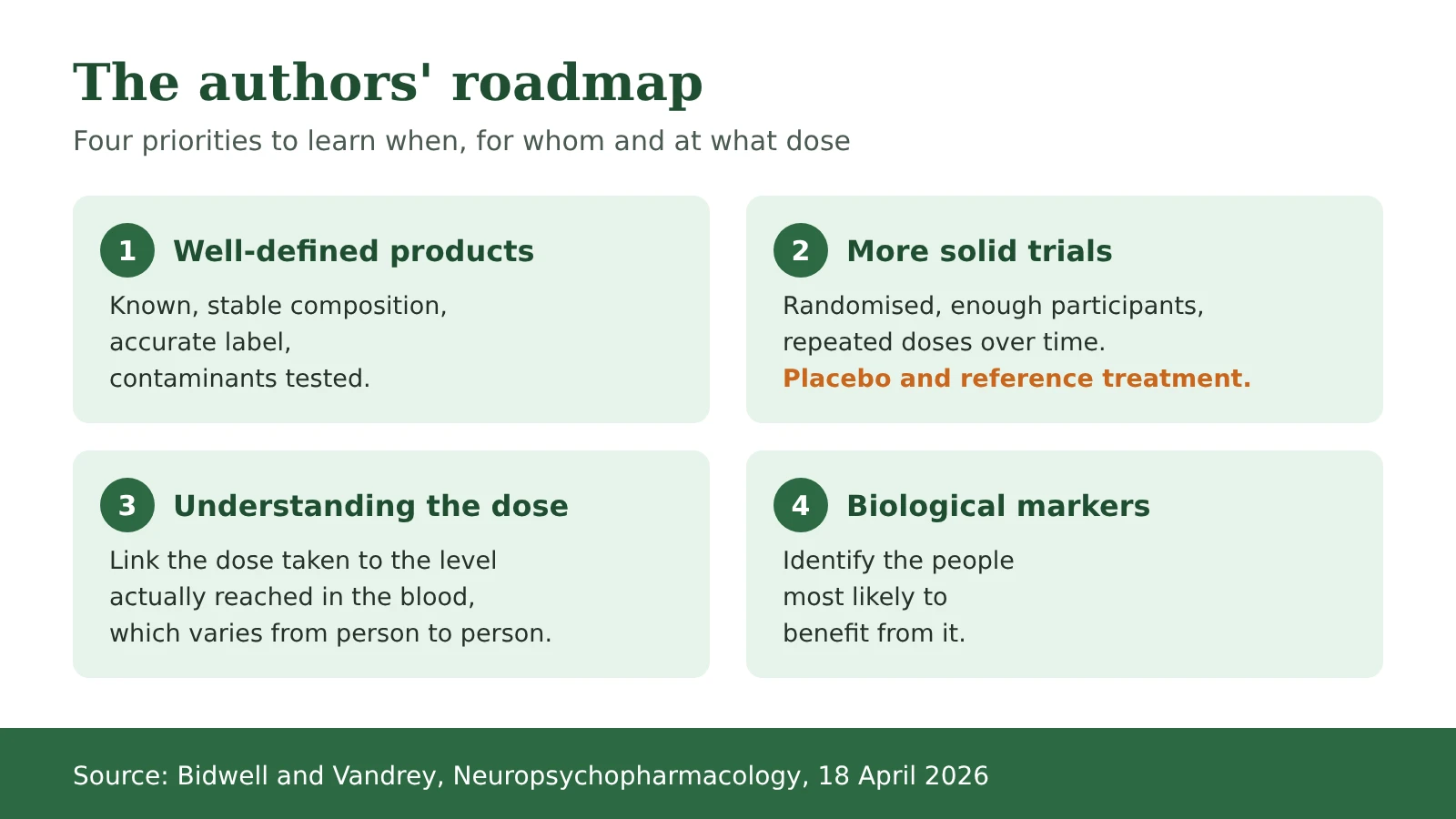
Their roadmap: randomised trials of sufficient size, with repeated doses, outcomes that matter in real life, a placebo and, where possible, a reference treatment. Then studies on dosing, biological markers to identify who might benefit, and quality standards: labelling of CBD, THC and other cannabinoids, contaminant testing, stronger oversight. Large cohorts followed over time could also identify signals to be checked afterwards in trials. Their criticism of quality does not target pharmaceutical-grade products or those made under strict regulatory control.
And in Switzerland?
The CBD medicine cited by the authors is also approved in Switzerland: Swissmedic has authorised it under the name Epidyolex, for the treatment of epilepsy. This pharmaceutical-grade medicine, prescribed by a doctor, is in no way comparable to the CBD products sold freely in Switzerland, which are not medicines. The article mainly describes the situation in the United States. Since 1 August 2022, Swiss doctors can prescribe cannabis-based medicines without special authorisation from the Federal Office of Public Health (FOPH); Swissmedic oversees their production and trade, and basic health insurance reimburses them only in exceptional cases.
CBD products sold freely contain less than 1% total THC (see what this threshold measures) and fall under other laws, set out in our guide to Swiss legislation. From 1%, hemp is a narcotic and its non-medical use is prohibited. Finally, the blood THC limit for driving there is 1.5 µg/L (see travelling and driving with CBD).
In summary
The two researchers place the strongest evidence on CBD in rare childhood epilepsies, where a CBD medicine is approved. For anxiety, addiction and psychosis, they describe trials that are often small and short, with varying results, and call for longer and larger studies; for cancer, observations are limited to the laboratory. On safety, they note a wide margin, with three points to be aware of: the THC present in some products, interactions and the liver. They describe the evidence as “modest but growing” and urge researchers to proceed “not with hype, but with humility and evidence”.
What the science says
Independent summary of a scientific publication. It does not describe The Green Lab products and is not health advice.
Frequently asked questions
In which area is the evidence on CBD strongest?
According to the two researchers, the strongest clinical evidence concerns rare, treatment-resistant childhood epilepsies, such as Lennox-Gastaut and Dravet syndromes: a CBD medicine is approved for them by several health agencies. For anxiety, addiction or schizophrenia, the existing trials are smaller or shorter, and their results vary.
What do studies say about CBD and anxiety?
A meta-analysis cited by the authors measured a moderate benefit of pure CBD in social or generalised anxiety, and no effect when it was combined with THC. Its main limitation: its authors judged the studies to be few and of low quality. Longer and more robust trials are still needed before conclusions can be drawn.
Why do results vary between CBD products?
Products differ in format, route of administration, composition and quality. These differences change how CBD is absorbed and how it acts. The authors therefore consider that a result applies to the specific product tested in the trial, not to “CBD” in general. This is the benchmark to keep in mind when comparing studies.
What do the authors say about the safety of CBD?
They describe a wide safety margin, with no intoxication and a low risk of abuse. They also point out that some products contain THC, that prolonged high doses have sometimes impaired liver function, and that CBD taken orally can alter how many medicines are broken down, a point to discuss with your doctor.
Is the effect of CBD just a placebo?
The authors do not say so: they point out that a CBD medicine is approved for rare childhood epilepsies. They also note that the placebo effect is high in CBD trials and that suitable control groups are often missing. Hence their call for randomised, long, adequately sized, placebo-controlled trials.