In Switzerland, CBD oils and balms sold as cosmetics follow the Cosmetics Ordinance. Their packaging must show the intended use, the list of ingredients, durability, the batch number and the responsible person. Here is how to read this information, and what a cosmetic label is not allowed to say.
On this page
Why a CBD oil carries a cosmetic label
A CBD product has no status of its own: it takes that of the category under which it is sold. As our guide to using a CBD product explains, an oil declared as a cosmetic is used on the skin, and its label is governed by the Cosmetics Ordinance. A cartridge or an e-liquid falls under another framework, the Tobacco Products Act, which we cover in our article on CBD vapes.
CBD hemp extracts are not authorised as foods in Switzerland, as our article why a CBD oil is not a food supplement explains. That is why our oils are declared and presented as cosmetics, from the packaging to our website.
Cosmetic status also involves work upstream that does not show on the label: a product information file with a safety report, good manufacturing practice and, for CBD, no intermediate product above 1% total THC.
The mandatory information, item by item
The cantonal laboratories’ guidance sheets summarise the requirements of the Cosmetics Ordinance. The information must appear in a clearly visible place, be legible and indelible, and be written in at least one official language.
| Item | What it tells you |
|---|---|
| Intended use | What the product is for, where this is not clear from its presentation |
| Ingredients | The full list, in descending order of quantity |
| Responsible person | Name and address of the manufacturer, importer, distributor or person responsible for the product |
| Durability | A date, or a period of use after opening |
| Storage | Any special conditions to respect |
| Batch number | The reference of the production run the product comes from |
| Precautions for use | Warnings specific to the product, shown separately |
The directions for use go with the intended use. For a cosmetic, they name an area of skin and a way of applying the product. Together with the period after opening, this is the most useful item in everyday use.
Reading the list of ingredients
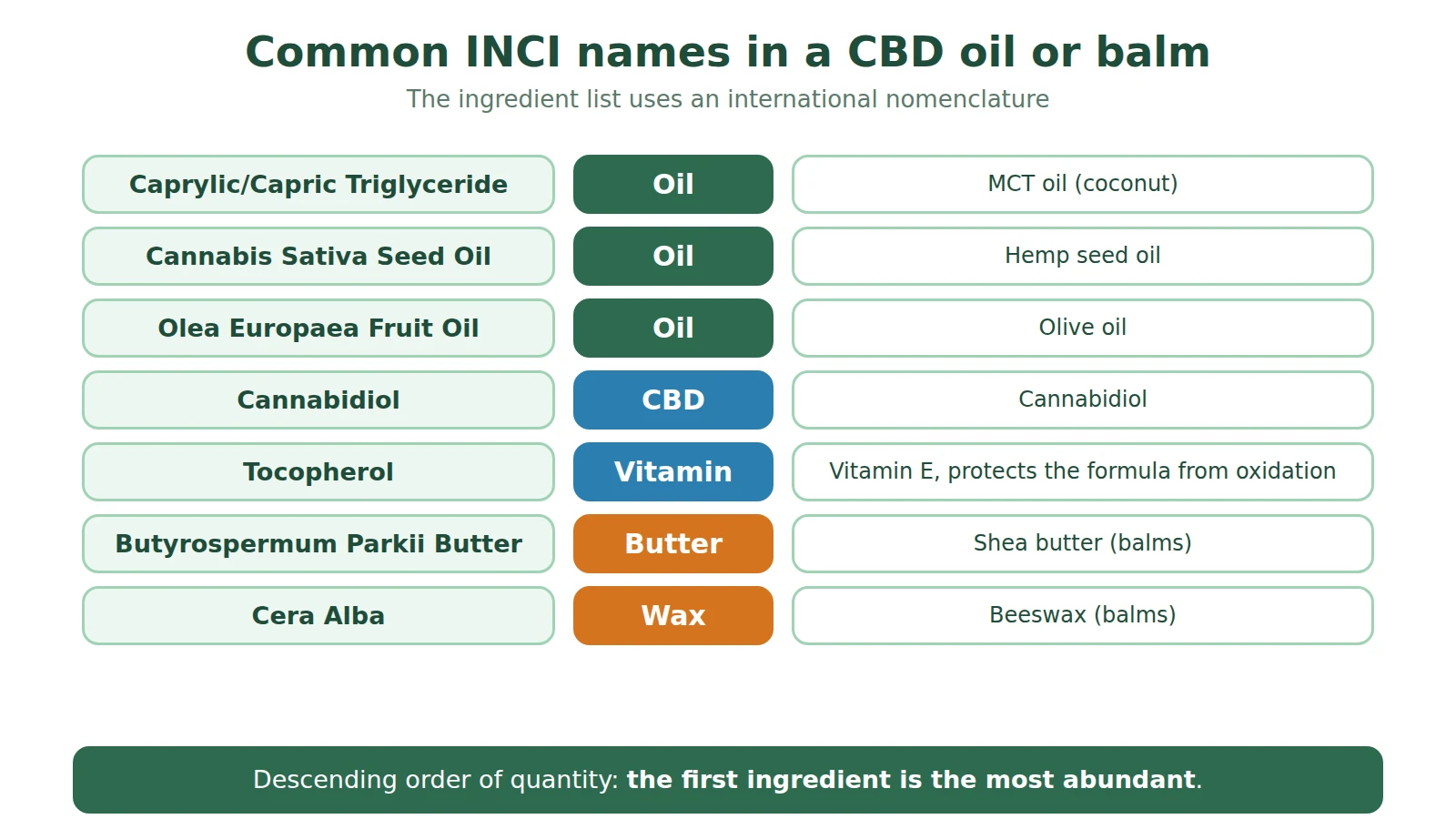
The list starts with the word “Ingredients” and follows descending order of quantity. Ingredients present at less than 1% may be listed at the end in any order. It uses a common nomenclature, in practice the international INCI names, in English or Latin, identical in every country.
In a CBD oil, the first ingredient is almost always the carrier oil, since it makes up most of the volume. Its INCI name can be puzzling: MCT coconut oil appears as Caprylic/Capric Triglyceride, hemp seed oil as Cannabis Sativa Seed Oil, olive oil as Olea Europaea Fruit Oil. CBD itself is called Cannabidiol.
The list says what the product contains, not how much. For CBD, the stated percentage gives the content: on our bottles, an oil at 20% contains 200 mg of CBD per millilitre.
Hourglass or open jar: two ways of showing durability
A cosmetic that keeps for less than 30 months carries a “best before end” date, introduced by these words or by an hourglass symbol. Beyond 30 months, the date is not mandatory: the packaging then shows how long the product can be used once opened, with an open-jar symbol followed by a number of months, such as “6M” or “12M”.
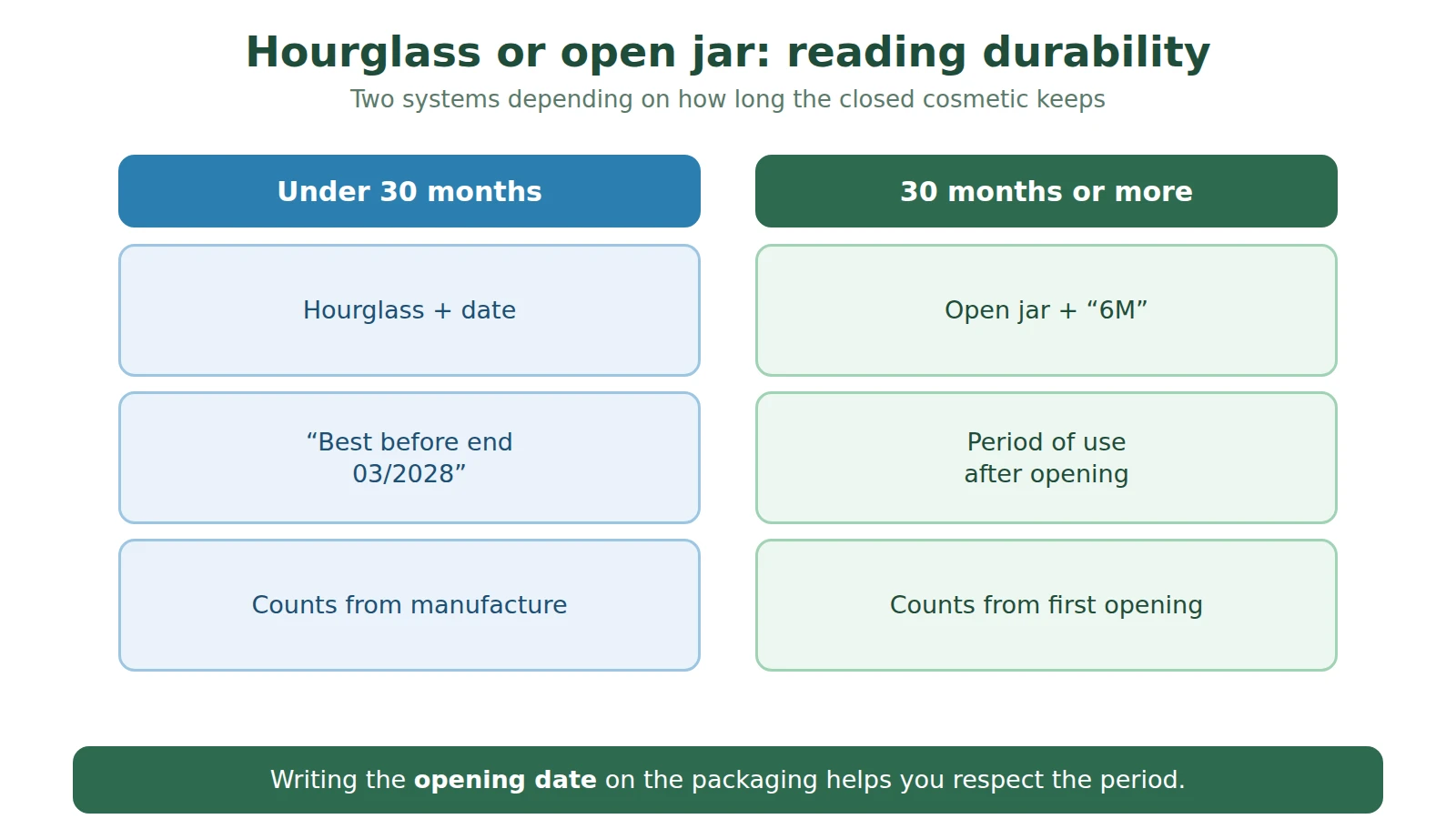
The period after opening runs from the day the bottle or jar is first opened. Writing the opening date on the packaging helps you keep track. The air that enters each time it is opened and light age the carrier oil; our article on storing CBD products sets out the right habits.
What a cosmetic label cannot say
The label of a cosmetic may not attribute any curative, soothing or preventive property to the product. A cosmetic cleans, protects, perfumes or cares for the skin, and its claims stop there. Any claims it makes must also be justifiable and must not mislead.
These rules also cover the way use is presented. A cosmetic oil comes with an area of application and a way of applying it, like any skincare product.
Point to watch
The directions and the period after opening often appear on the box or the leaflet, not only on the bottle. Keep the packaging for as long as you use the product.
The case of balms
A CBD balm follows exactly the same rules. Its ingredient list often starts with vegetable oils and butters, followed by waxes: shea butter (Butyrospermum Parkii Butter), beeswax (Cera Alba) or plant waxes. As it comes in a jar, it often carries an open-jar symbol.
A jar calls for a little hygiene: clean fingers, a lid closed after each use and respect for the period after opening. Our balms are not made in our laboratory in Gland, but they are subject to the same labelling obligations as our oils.
All our oils are declared as cosmetics: Sublime on MCT coconut oil, Hemp on hemp seed oil and Broad Spectrum on olive oil, all on our CBD oils page.
Our laboratory
Our oils are formulated and bottled in our laboratory in Gland, following good manufacturing practice, with a product information file for each formula. Their cannabinoid levels are checked regularly by an external laboratory. Discover the laboratory →
Frequently asked questions
What does the open-jar symbol with “6M” mean?
It shows the period of use after opening: here, six months from the day the product is first opened. This symbol replaces the date on cosmetics that keep for more than 30 months while closed. Writing the opening date on the packaging helps you keep track.
Why does CBD appear as “Cannabidiol”?
The ingredient list of a cosmetic uses a common nomenclature, in practice the INCI names. CBD is listed as Cannabidiol, MCT coconut oil as Caprylic/Capric Triglyceride and hemp seed oil as Cannabis Sativa Seed Oil.
Why does the CBD content not appear in the ingredient list?
The ingredient list gives the order of the components, not their quantity. The CBD content is read from the percentage stated on the product: on our bottles, an oil at 20% contains 200 mg of CBD per millilitre, or 2,000 mg in a 10 ml bottle.
In which language must the label be written?
The mandatory information must appear in at least one official language of Switzerland. The ingredient list uses an international nomenclature, the same from one country to another, which explains its English or Latin names.
Who is the “responsible person” named on the packaging?
It is the manufacturer, importer, distributor or person responsible for the product on the market. Their name and address appear on the packaging, so that the authorities and users know whom to contact.