

Switzerland is preparing a law to regulate cannabis for non-medical use. The bill is moving slowly, and it regularly makes the news. What does it plan, where does it stand, and what does it change for CBD? The answer to the last question is simple: nothing, according to the text itself. Here is the situation on 1 October 2026.
On this page
Where the bill comes from
The bill stems from a parliamentary initiative submitted in 2020 by National Councillor Heinz Siegenthaler, registered as number 20.473. It calls for the cannabis market to be regulated rather than keeping the ban on non-medical use. The Social Security and Health Committee of the National Council (SSHC-N) is responsible for drafting the text.
In the meantime, the Narcotics Act has opened up on two points. Since 2021, it has allowed scientific pilot trials of regulated cannabis sales, within a limited and controlled framework. Since 1 August 2022, medical cannabis can be prescribed without an exceptional authorisation from the FOPH. For non-medical use, nothing has changed: cannabis with 1% total THC or more remains a narcotic.
What the preliminary draft plans
In February 2025, the committee adopted a preliminary draft federal act on cannabis products. Its stated aim is to reduce the harmful effects of cannabis on health and to protect minors, by strictly regulating a market that exists anyway. Cannabis would remain a narcotic, but its cultivation, manufacture and sale would be regulated for adults.
The explanatory report, dated 3 July 2025, sets out the main lines. An adult could grow at most three flowering female plants at home. Sales could not pursue any profit: they would go through authorised points of sale and, online, through a single concession holder appointed by the Confederation. Advertising would be banned outright and packaging would be plain. An incentive tax would make the most harmful products more expensive, and cultivation and manufacture would require a federal licence.
Supply to minors would remain prohibited, as would driving under the influence of cannabis, with the same zero tolerance on the road as today.
Where the bill stands
The preliminary draft was put out to consultation from 29 August to 1 December 2025. The report on the results, published in May 2026, lists 162 submissions. On 8 May 2026, the committee decided by 16 votes to 8 with one abstention to continue the work, while noting that most cantons reject the draft in its current form. It asked a subcommittee to rework it.
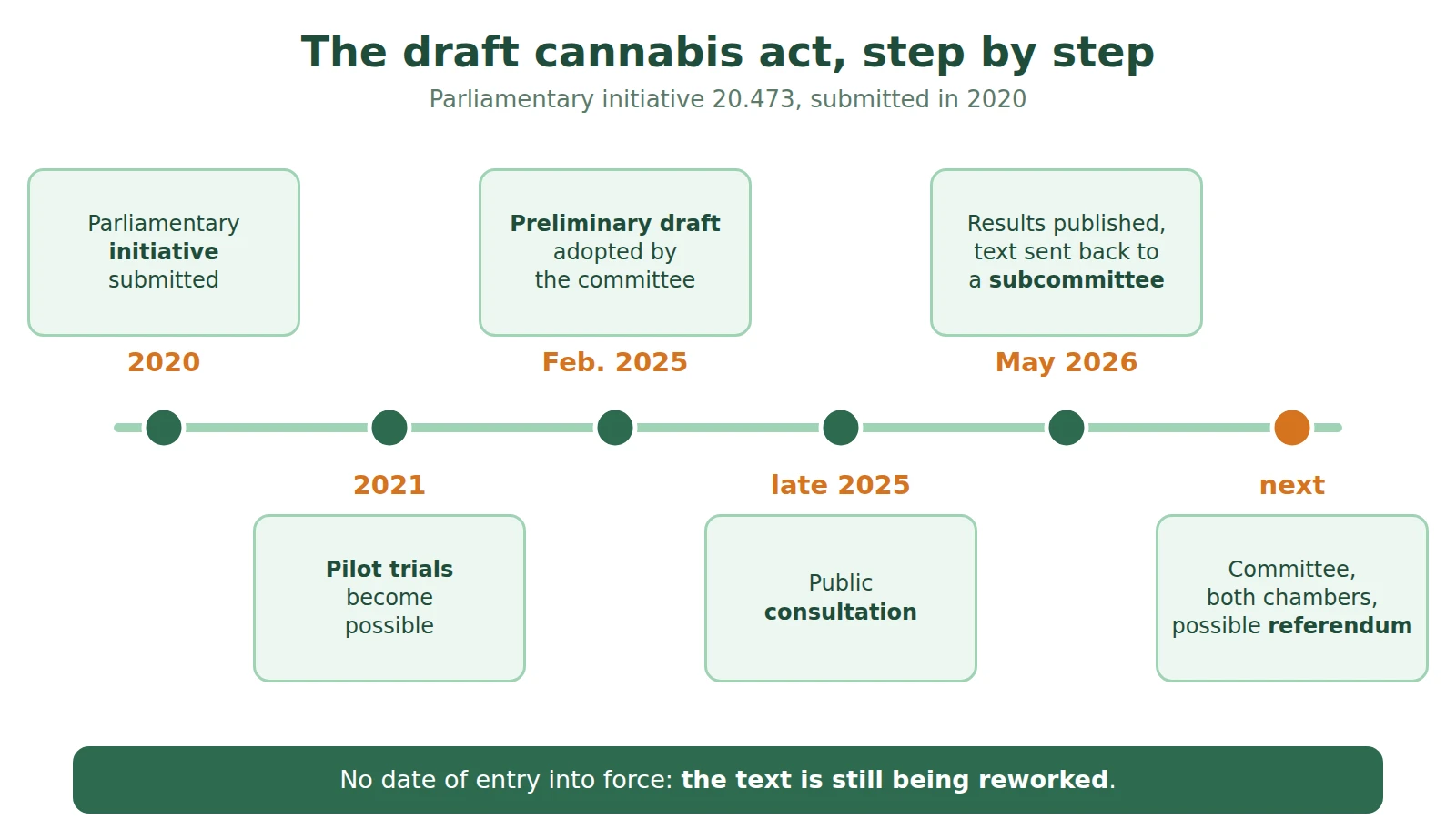
The text will then have to go back to the committee, before being debated by the National Council and the Council of States. Like any federal act, it could be put to a referendum. No date of entry into force has been set.
Point to watch
Nothing is in force yet. A bill in consultation or in committee does not change the applicable law: today, cannabis with 1% total THC or more remains a narcotic, except for medical use and authorised pilot trials.
Why CBD is not affected
The explanatory report says it plainly: products with a THC content below 1%, such as CBD products, are not covered either. The 1% total THC threshold is kept as the boundary between the two regimes.
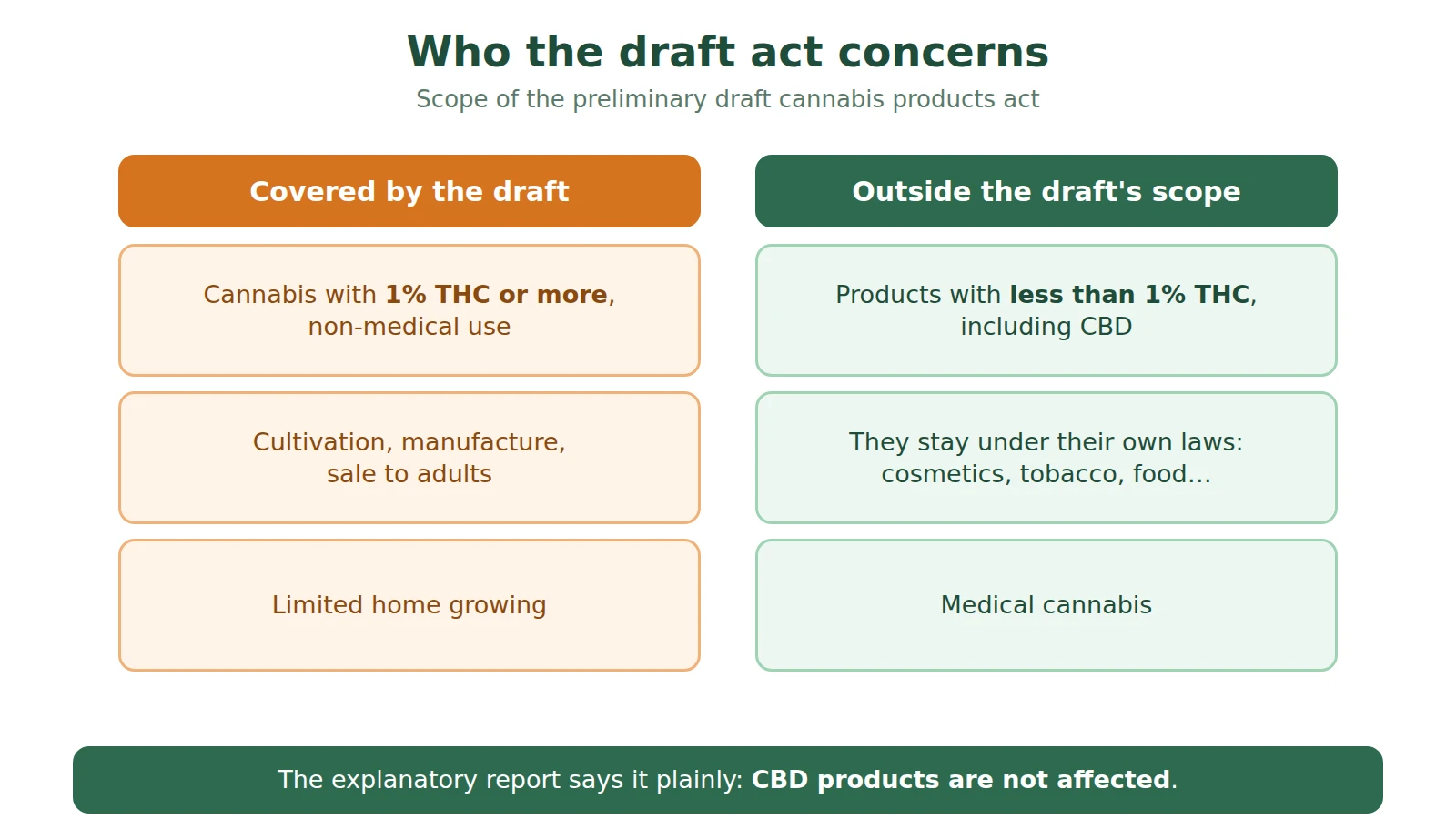
CBD products therefore remain governed by the laws that already apply to them: cosmetics law for oils and balms, the Tobacco Products Act for flowers, hash and vapes, and food and chemicals law depending on the case. We explain what this threshold measures in our article on the 1% THC threshold.
What does not change in the meantime
Until the act is adopted and in force, the current framework applies in full. Cannabis with 1% total THC or more remains a narcotic, apart from medical use and authorised pilot trials. On the road, the THC limit in the blood stays the same, whatever product the THC comes from, as we detail in our article on travelling and driving.
For the CBD market, the story is one of continuity: the threshold set in 2011 has survived every reform, and the current bill does not plan to touch it. We trace these steps in our history of CBD in Switzerland.
The cannabis products bill targets cannabis for non-medical use, with 1% THC or more. It provides for regulated access for adults, with no profit and no advertising, but it is still being reworked and has no date of entry into force. CBD products, for their part, remain outside its scope and keep their own rules. Our guide to Swiss CBD law presents them product by product.
Our laboratory
All our products stay below 1% total THC, the limit the bill keeps. Our oils are made in Gland from crude extracts below this threshold, and their cannabinoid levels are checked regularly by an external laboratory. To find out more, discover our laboratory.
Further reading: why a CBD oil is not a food supplement.
Also in our shop: all our CBD oils.
Frequently asked questions
Will cannabis be legalised in Switzerland?
A bill plans to regulate cannabis for non-medical use by adults, but it is still being reworked in committee. It will have to be adopted by both chambers and could be put to a referendum. No date of entry into force has been set.
Does the bill concern CBD?
No. The explanatory report states that products with a THC content below 1%, such as CBD products, are not affected. The 1% threshold is kept.
What does the bill plan for sales?
According to the explanatory report, sales would not pursue profit, through authorised points of sale and, online, through a single concession holder appointed by the Confederation. Advertising would be banned and packaging plain.
Will people be able to grow cannabis at home?
The preliminary draft provides that an adult could grow at most three flowering female plants at home. It is only a draft: today, growing cannabis with 1% THC or more remains prohibited.
What are pilot trials?
Since 2021, the Narcotics Act has allowed scientific trials of regulated cannabis sales within a limited and controlled framework. The bill plans to end this regime once the new regulation is in place.