CBD sold freely in Switzerland, below 1% total THC, does not have the same status abroad. Of the 143 countries we reviewed, around forty allow it, often with a much lower THC limit, and 62 ban it. The map and table below give the situation in October 2026, country by country, so you can plan a trip without unpleasant surprises.
On this page
The map of CBD around the world
Each colour stands for one set of rules. Dark green marks the few countries that, like Switzerland, tolerate up to 1% THC. Mid green shows a lower limit, usually 0.2 or 0.3%. Pale green means free sale under tight conditions: products sold in pharmacies, flowers banned or prior authorisation. Yellow, orange and red mark the countries where CBD is only accepted without THC, only on prescription, or not at all.
Click a country to show its details below the map: THC limit, status of flowers and level of risk for a traveller. The Europe button zooms in on the continent. Countries in grey have no clear rule. For the Swiss framework itself, our guide to what Swiss law says about CBD covers each product category.
Click a colour in the legend to show only those countries.
Legal status: October 2026. General information, not legal advice.
THC almost always decides
In most countries, the problem is not CBD itself but the traces of THC that come with it. A Full Spectrum hemp extract naturally contains a small amount. In Switzerland, the 1% total THC limit leaves a comfortable margin. Elsewhere, the same bottle can exceed the local limit without anything changing in its composition. Our article on what the 1% THC limit really measures explains how this figure is calculated.
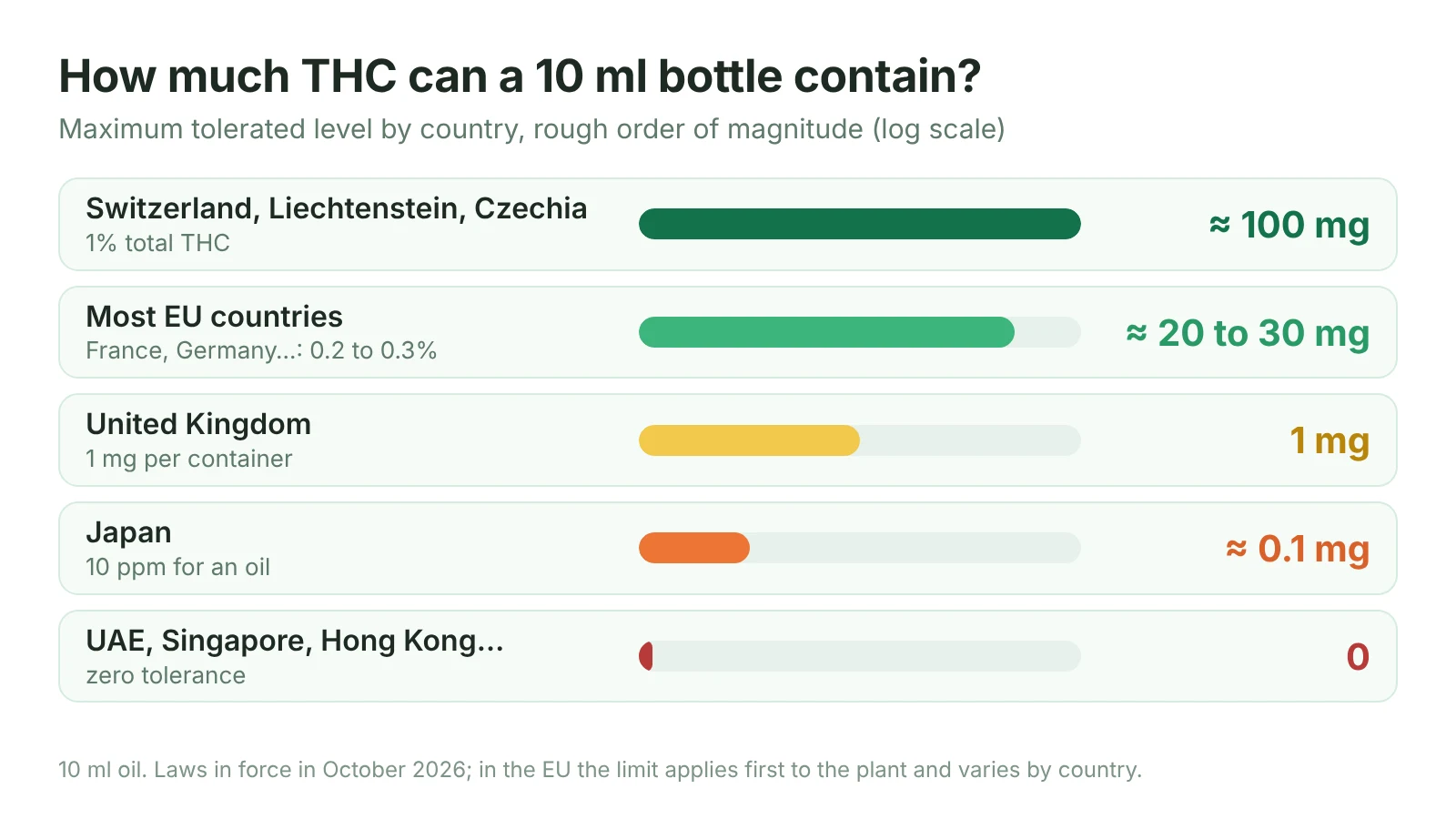
Limits are not all expressed in the same way. The European Union starts from the cultivated plant, at 0.2 or 0.3%, and each member state then sets its own rules for finished products. The United Kingdom counts in milligrams: no more than 1 mg of THC per container, while a 10 ml oil at 0.2% already holds about twenty. Japan goes down to 10 ppm for an oil, or 0.001%.
This is why it helps to know the spectrum of your product. A Full Spectrum keeps all the cannabinoids of the plant, THC included. A Broad Spectrum or an isolate has it removed during production. The difference is explained in detail in our article on Full Spectrum, Broad Spectrum and isolate.
When CBD itself is banned
Some countries do not stop at THC. For them, any extract of the cannabis plant is a narcotic, whatever its composition. This is the case in Russia, most of Central Asia, Monaco, Hong Kong since February 2023, Singapore and the Gulf states. The UK government’s travel advice even names CBD, cosmetics included, among the products that are illegal in the United Arab Emirates.
Other countries keep CBD within the medical channel. In Norway, Finland, Australia, New Zealand, Brazil or Chile, it is only available on prescription. An oil bought freely in Switzerland has no status there, even without THC.
Finally, several European countries target certain product forms rather than CBD in general. Italy has banned trade in hemp flowers since 2025 and Greece their sale since May 2026. Portugal now keeps extracts within the channel authorised by its pharmaceutical agency, and shops have been raided this year.
The country-by-country table
The table lists the 143 countries on the map, grouped by region and sorted alphabetically. The “THC limit” column gives the limit that applies to products or, failing that, to the plant. The “Risk” column sums up what awaits a traveller who arrives with a CBD oil, from simple confiscation to long prison sentences.
No country matches your search.
Europe: European Union, EFTA and United Kingdom
| Country | CBD status | THC limit | CBD flowers | Risk for travellers |
|---|---|---|---|---|
| Andorra | Unclear | not set for products | grey area | moderate |
| Austria | Legal, tightly regulated | 0.3% | grey area | moderate |
| Belgium | Legal, tightly regulated | 0.2% | allowed | low |
| Bulgaria | Unclear | not set for products | banned | moderate |
| Croatia | Legal | 0.2% (plant) | grey area | low |
| Cyprus | Legal, tightly regulated | 0.3% | not specified | moderate |
| Czech Republic | Legal (up to 1%) | 1% | allowed | low |
| Denmark | Legal, tightly regulated | 0.2% | banned | moderate |
| Estonia | Legal, tightly regulated | below 0.3% | grey area | moderate |
| Finland | Prescription only | not applicable (prescription only) | banned | high |
| France | Legal | 0.3% | allowed | low |
| Germany | Legal | 0.3% (plant) and abuse clause | grey area | low |
| Greece | Legal, tightly regulated | 0.2 to 0.3% | banned | moderate |
| Hungary | Legal, tightly regulated | 0.2% | grey area | high |
| Iceland | Prescription only | not applicable (prescription only) | banned | high |
| Ireland | Tolerated without THC | 0 (no detectable THC) | grey area | moderate |
| Italy | Legal, tightly regulated | 0.2% (plant), flowers banned | banned | high |
| Latvia | Tolerated without THC | 0 (no detectable THC) | not specified | high |
| Liechtenstein | Legal (up to 1%) | 1% total THC | grey area | low |
| Lithuania | Legal, tightly regulated | 0.3% (plant), 0 for smoking products | banned | moderate |
| Luxembourg | Legal | 0.3% (whole plant) | grey area | low |
| Malta | Legal | 0.2% | allowed | low |
| Monaco | Banned | none (zero tolerance) | banned | high |
| Netherlands | Legal | 0.05% (enforcement practice) | grey area | low |
| Norway | Prescription only | not applicable (prescription only) | banned | high |
| Poland | Legal | 0.3% (flowering tops) | grey area | low |
| Portugal | Prescription only | not applicable (prescription only) | banned | moderate |
| Romania | Tolerated without THC | 0 (no detectable THC) | banned | high |
| San Marino | Prescription only | not applicable (prescription only) | banned | moderate |
| Slovakia | Legal | 0.3% (unconfirmed) | grey area | moderate |
| Slovenia | Legal | 0.2% (plant) | grey area | low |
| Spain | Legal, tightly regulated | 0.3% | grey area | low |
| Sweden | Tolerated without THC | 0 (no detectable THC) | banned | high |
| Switzerland | Legal (up to 1%) | 1% total THC | allowed | low |
| United Kingdom | Legal, tightly regulated | no more than 1 mg of THC per bottle | banned | moderate |
Eastern Europe, the Balkans, Turkey and Central Asia
| Country | CBD status | THC limit | CBD flowers | Risk for travellers |
|---|---|---|---|---|
| Albania | Unclear | not set for products | banned | high |
| Armenia | Banned | none (zero tolerance) | banned | high |
| Azerbaijan | Banned | none (zero tolerance) | banned | high |
| Belarus | Banned | none (zero tolerance) | banned | very high |
| Bosnia and Herzegovina | Tolerated without THC | 0 (no detectable THC) | banned | moderate |
| Georgia | Unclear | not set for products | banned | high |
| Kazakhstan | Banned | none (zero tolerance) | banned | very high |
| Kosovo | Banned | none (zero tolerance) | banned | high |
| Kyrgyzstan | Banned | none (zero tolerance) | banned | high |
| Moldova | Unclear | not set for products | banned | moderate |
| Montenegro | Unclear | not set for products | banned | moderate |
| Russia | Banned | none (zero tolerance) | banned | very high |
| Serbia | Tolerated without THC | 0 (no detectable THC) | banned | moderate |
| Tajikistan | Banned | none (zero tolerance) | banned | very high |
| The Republic of North Macedonia | Legal, tightly regulated | 0.2% (above that, prescription) | banned | moderate |
| Turkmenistan | Banned | none (zero tolerance) | banned | very high |
| Türkiye | Legal, tightly regulated | 0.3%, in pharmacies | banned | high |
| Ukraine | Tolerated without THC | 0 (isolate only) | banned | moderate |
| Uzbekistan | Banned | none (zero tolerance) | banned | very high |
The Americas
| Country | CBD status | THC limit | CBD flowers | Risk for travellers |
|---|---|---|---|---|
| Argentina | Prescription only | 1% (hemp), registered products | banned | moderate |
| Bahamas | Banned | none (zero tolerance) | banned | high |
| Barbados | Prescription only | not applicable (prescription only) | banned | moderate |
| Belize | Unclear | not set for products | grey area | moderate |
| Bolivia | Banned | none (zero tolerance) | banned | very high |
| Brazil | Prescription only | 0.2%, on prescription | banned | moderate |
| Canada | Legal, tightly regulated | regulated as cannabis | allowed | high |
| Chile | Prescription only | not applicable (prescription only) | banned | moderate |
| Colombia | Legal (up to 1%) | below 1% | banned | low |
| Costa Rica | Legal, tightly regulated | below 1% | grey area | moderate |
| Cuba | Banned | none (zero tolerance) | banned | very high |
| Dominican Republic | Banned | none (zero tolerance) | banned | high |
| Ecuador | Legal (up to 1%) | below 1% | grey area | moderate |
| El Salvador | Banned | none (zero tolerance) | banned | high |
| Guatemala | Unclear | not set for products | banned | high |
| Honduras | Banned | none (zero tolerance) | banned | high |
| Jamaica | Legal, tightly regulated | below 1% (hemp) | allowed | moderate |
| Mexico | Prescription only | restricted to medical uses | banned | moderate |
| Panama | Prescription only | not applicable (prescription only) | banned | high |
| Paraguay | Prescription only | 0.5%, on prescription | banned | moderate |
| Peru | Prescription only | not applicable (prescription only) | banned | moderate |
| Trinidad and Tobago | Unclear | not set for products | grey area | moderate |
| United States | Legal | 0.3% until 10 December 2026, then 0.4 mg per container | grey area | moderate |
| Uruguay | Legal, tightly regulated | 10 ppm in cosmetics | grey area | low |
| Venezuela | Banned | none (zero tolerance) | banned | very high |
Asia and the Pacific
| Country | CBD status | THC limit | CBD flowers | Risk for travellers |
|---|---|---|---|---|
| Australia | Prescription only | on prescription (CBD ≥ 98%) | banned | moderate |
| Bangladesh | Banned | none (zero tolerance) | banned | very high |
| Bhutan | Banned | none (zero tolerance) | banned | high |
| Cambodia | Banned | none (zero tolerance) | banned | high |
| Fiji | Unclear | not set for products | banned | high |
| French Polynesia | Unclear | not set for products | grey area | moderate |
| Hong Kong | Banned | none (zero tolerance) | banned | very high |
| India | Legal, tightly regulated | none at national level | banned | moderate |
| Indonesia | Banned | none (zero tolerance) | banned | very high |
| Japan | Tolerated without THC | 10 ppm for an oil (0.001%) | banned | high |
| Laos | Legal, tightly regulated | 0.2% (registered products) | banned | high |
| Macao | Banned | none (zero tolerance) | banned | high |
| Malaysia | Banned | none (zero tolerance) | banned | very high |
| Maldives | Banned | none (zero tolerance) | banned | very high |
| Mongolia | Banned | none (zero tolerance) | banned | high |
| Myanmar | Banned | none (zero tolerance) | banned | very high |
| Nepal | Banned | none (zero tolerance) | banned | high |
| New Zealand | Prescription only | on prescription | banned | moderate |
| Pakistan | Unclear | not set for products | banned | high |
| People's Republic of China | Banned | none (zero tolerance) | banned | high |
| Philippines | Banned | none (zero tolerance) | banned | very high |
| Singapore | Banned | none (zero tolerance) | banned | very high |
| South Korea | Banned | none (zero tolerance) | banned | very high |
| Sri Lanka | Banned | none (zero tolerance) | banned | high |
| Taiwan | Prescription only | 10 ppm, on prescription | banned | very high |
| Thailand | Legal, tightly regulated | 0.2% (registered extracts) | banned | moderate |
| Vietnam | Banned | none (zero tolerance) | banned | very high |
Middle East and Africa
| Country | CBD status | THC limit | CBD flowers | Risk for travellers |
|---|---|---|---|---|
| Algeria | Banned | none (zero tolerance) | banned | high |
| Bahrain | Banned | none (zero tolerance) | banned | very high |
| Botswana | Banned | none (zero tolerance) | banned | high |
| Cameroon | Banned | none (zero tolerance) | banned | high |
| Cape Verde | Banned | none (zero tolerance) | banned | high |
| Cote d'Ivoire | Banned | none (zero tolerance) | banned | high |
| Egypt | Banned | none (zero tolerance) | banned | very high |
| Eswatini | Banned | none (zero tolerance) | banned | high |
| Ethiopia | Banned | none (zero tolerance) | banned | high |
| Ghana | Banned | none (zero tolerance) | banned | high |
| Iran | Banned | none (zero tolerance) | banned | very high |
| Iraq | Banned | none (zero tolerance) | banned | very high |
| Israel | Unclear | not set for products | banned | moderate |
| Jordan | Banned | none (zero tolerance) | banned | high |
| Kenya | Banned | none (zero tolerance) | banned | high |
| Kuwait | Banned | none (zero tolerance) | banned | very high |
| Lebanon | Unclear | not set for products | banned | high |
| Lesotho | Prescription only | not applicable (prescription only) | banned | moderate |
| Madagascar | Banned | none (zero tolerance) | banned | high |
| Malawi | Legal, tightly regulated | 1% (hemp) | banned | high |
| Mauritius | Banned | none (zero tolerance) | banned | very high |
| Morocco | Legal, tightly regulated | 0% in cosmetics | banned | high |
| Namibia | Banned | none (zero tolerance) | banned | high |
| Nigeria | Banned | none (zero tolerance) | banned | high |
| Oman | Banned | none (zero tolerance) | banned | very high |
| Qatar | Banned | none (zero tolerance) | banned | very high |
| Rwanda | Banned | none (zero tolerance) | banned | high |
| Saudi Arabia | Banned | none (zero tolerance) | banned | very high |
| Senegal | Banned | none (zero tolerance) | banned | high |
| Seychelles | Prescription only | not applicable (prescription only) | banned | very high |
| South Africa | Legal, tightly regulated | 0.001% (and 20 mg of CBD per day) | grey area | low |
| Tanzania | Banned | none (zero tolerance) | banned | very high |
| Tunisia | Banned | none (zero tolerance) | banned | high |
| Uganda | Prescription only | not applicable (prescription only) | banned | high |
| United Arab Emirates | Banned | none (zero tolerance) | banned | very high |
| Zambia | Unclear | not set for products | banned | high |
| Zimbabwe | Legal, tightly regulated | below 1% (hemp) | banned | high |
Destinations that call for caution
In the Gulf and South-East Asia, zero tolerance is far from theoretical. In Bahrain, two people were sentenced in 2026 to 15 years in prison for importing CBD oil. Singapore, Malaysia, Indonesia and Vietnam impose very heavy penalties for narcotics, CBD included. For these destinations, no CBD product should be in your luggage.
Japan accepts CBD, but its 10 ppm limit makes an ordinary European oil illegal. South Korea classes CBD as a narcotic, and its Supreme Court confirmed this in 2025, even for CBD taken from stalks or seeds.
In Canada, CBD is regulated like cannabis: you can buy it locally in licensed shops, but you may not cross the border with it, in either direction. In the United States, hemp CBD is legal at federal level up to 0.3% THC. This rule changes on 11 December 2026: the limit becomes 0.4 mg of total THC per container, and each state keeps its own rules.
Closer to home, the United Kingdom is the most common trap. Pure CBD is unrestricted there, but almost any Full Spectrum oil exceeds the 1 mg THC limit per bottle. Sweden, Ireland and Romania accept no THC at all in finished products. Liechtenstein, on the other hand, applies the same limit as Switzerland.
Point to watch
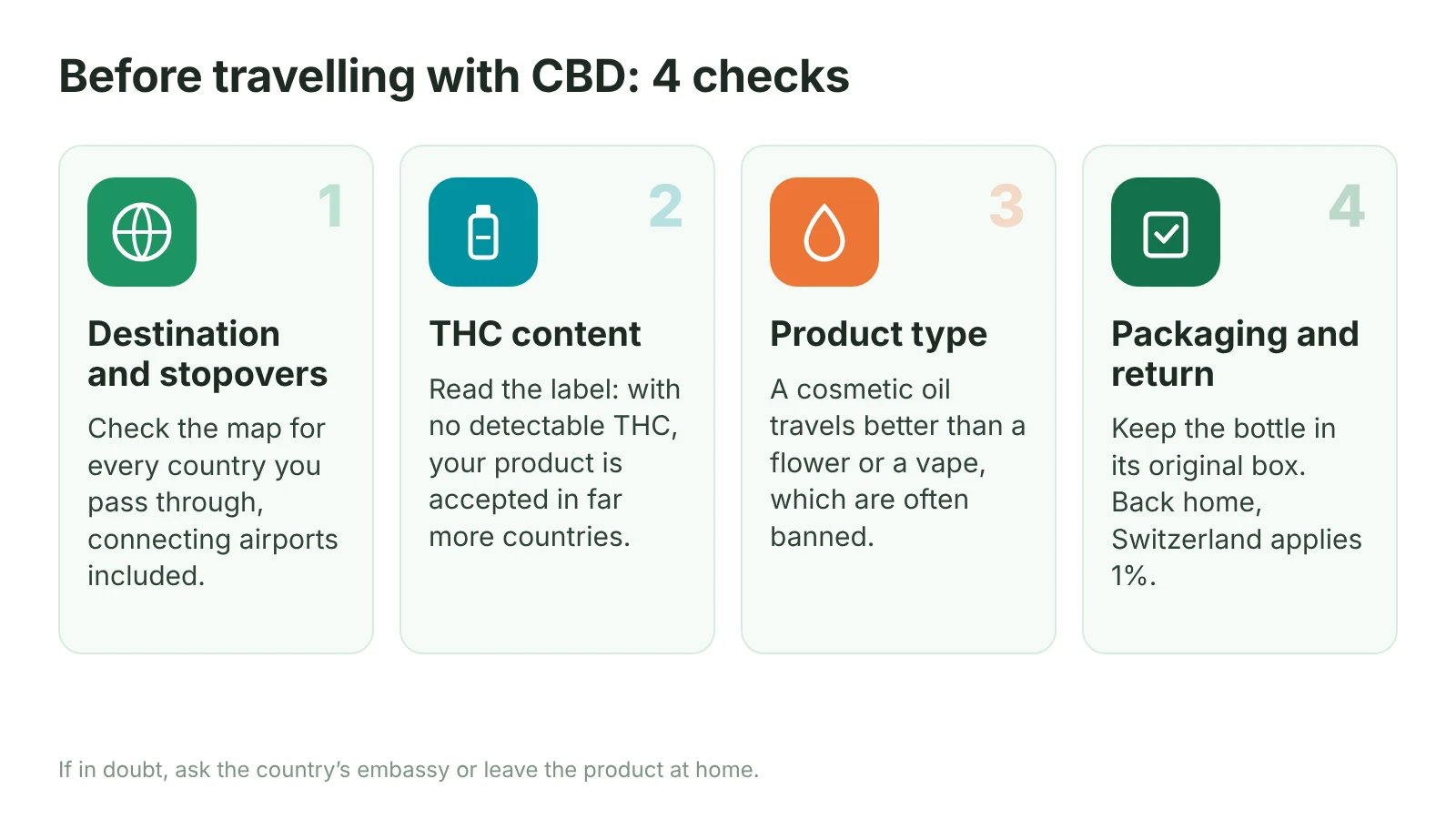
A stopover counts as entering the country. During a connection in Dubai, Doha or Singapore, luggage and passengers can be checked even without going through customs. Check every airport on your route, not just the final destination.
Travelling with an oil: our advice
To a country shown in green on the map, a cosmetic CBD oil in its original packaging, in a personal quantity, usually travels without difficulty. Keep the box and the label, which state the composition. In countries where THC must stay very low or at zero, a product with no detectable THC opens up many more options.
Our Broad Spectrum oils are made from an extract from which THC has been removed, and our analyses detect none: this is the range to choose when travelling to a low-tolerance country. For countries in yellow, orange or red, no formulation solves the problem, and the product stays at home.
Flowers and vapes travel far less well. CBD flowers are treated as cannabis in much of the world, even where oils are accepted, and several countries ban vaping devices themselves, such as Singapore, Thailand and the Maldives. Their Swiss framework is explained in our article on CBD flowers, hash and vapes under the Tobacco Products Act.
In countries where CBD is sold freely, buying locally is often the simplest option, since the product then follows local rules. On your way back, Swiss law applies: a product bought abroad must stay below 1% total THC. Customs and driving rules are covered in our article on travelling and driving with CBD.
Laws that change quickly
The landscape shifts from one year to the next. The United States moves to a per-container limit on 11 December 2026. Italy’s Constitutional Court is due to rule on the flower ban on 9 February 2027. In Germany, a proposal to raise the limit to 1% is being debated in the Bundestag, and Austria will restrict flower sales to tobacconists from 2029. Thailand, which liberalised cannabis in 2022, took back control of it in 2025.
For around thirty countries, mostly in the Balkans, Central Asia and parts of Africa, no text clearly addresses CBD. We have classified them with caution. Before you leave, the safest reflex is still to check with the country’s embassy or the travel advice of the Swiss Federal Department of Foreign Affairs (FDFA). This table is general information and does not replace legal advice; its update date is shown below the map.
Our laboratory
Our oils are formulated in Gland from crude extracts containing less than 1% total THC, and their cannabinoid content is regularly checked by an external laboratory. They are declared as cosmetics and made according to good manufacturing practice. Discover the laboratory →
Frequently asked questions
Can I fly with CBD oil?
Yes, if your destination and every stopover country accept it. In Europe, a cosmetic oil below the local THC limit, kept in its original packaging, usually passes without difficulty. In the cabin, the 100 ml liquids rule applies as for any bottle. For the Gulf or South-East Asia, it is better to take nothing.
Is CBD legal throughout the European Union?
There is no single rule. The EU sets a 0.3% THC limit for cultivated hemp, then each member state decides for finished products. France and Germany allow oils below 0.3%, Italy bans the trade in flowers, Sweden accepts no THC and Portugal keeps extracts within the medical channel.
Can I take a CBD oil to the United Kingdom?
Pure CBD is unrestricted there, but a product may not contain more than 1 mg of THC per container. A 10 ml Full Spectrum oil almost always contains more and then becomes a controlled product. Only a product with no detectable THC, in its original packaging, travels to the United Kingdom with peace of mind.
Which countries ban CBD completely?
Of the 143 countries reviewed, 62 ban it. They include the Gulf states, Singapore, Indonesia, Malaysia, Hong Kong, Russia, most of Central Asia and a large part of Africa. In these countries, even a CBD cosmetic can lead to arrest: leave your products in Switzerland.
Is CBD legal in Japan?
Yes, but with one of the lowest THC limits in the world: 10 ppm for an oil, or 0.001%, since December 2024. An ordinary Swiss or European oil exceeds this limit and becomes a narcotic. Only a product whose analysis confirms the absence of THC can enter Japan.
What happens when I return to Switzerland with a product bought abroad?
Swiss law applies from the border: the product must stay below 1% total THC. Above that, it is treated as a narcotic, even if it was legal in the country where you bought it. Keep the packaging and, if possible, proof of its composition in case of a customs check.