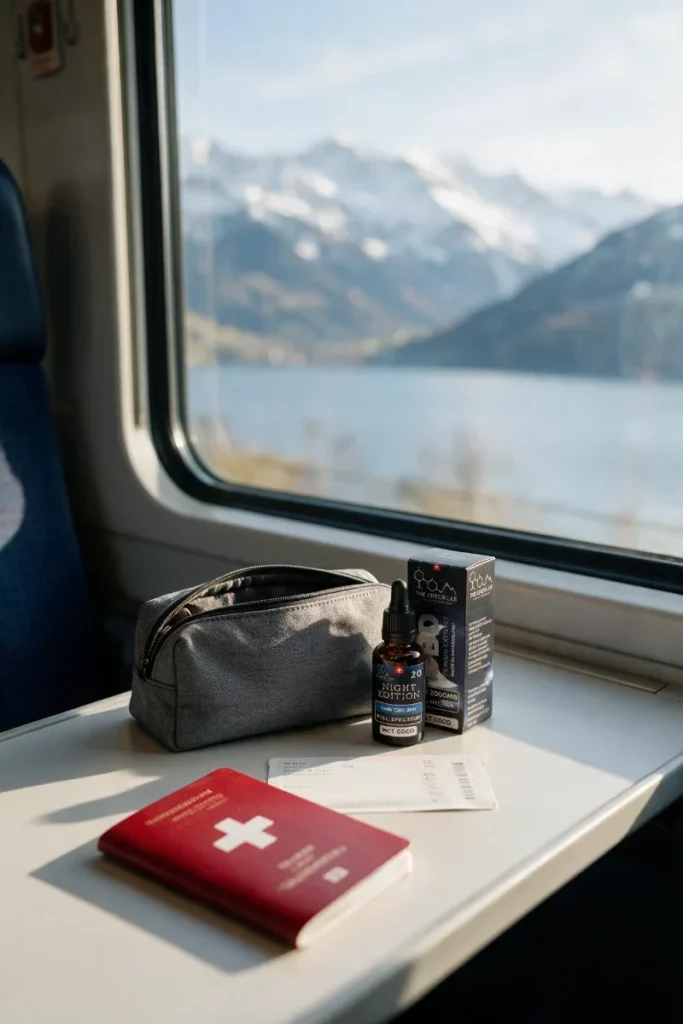
A CBD product that is legal in Switzerland is not necessarily legal elsewhere, and a legal product is not free of THC. Both points matter as soon as you cross a border or get behind the wheel. Here is what the rules say, and why the 1% threshold is not enough to answer.
On this page
The 1% threshold stops at the border
The 1% total THC threshold is a Swiss rule. Outside our borders, each country sets its own THC limit and its own rules for CBD products. The Federal Office of Public Health (FOPH) points out that people who take CBD products abroad risk criminal prosecution, precisely because these limits differ from one country to another.
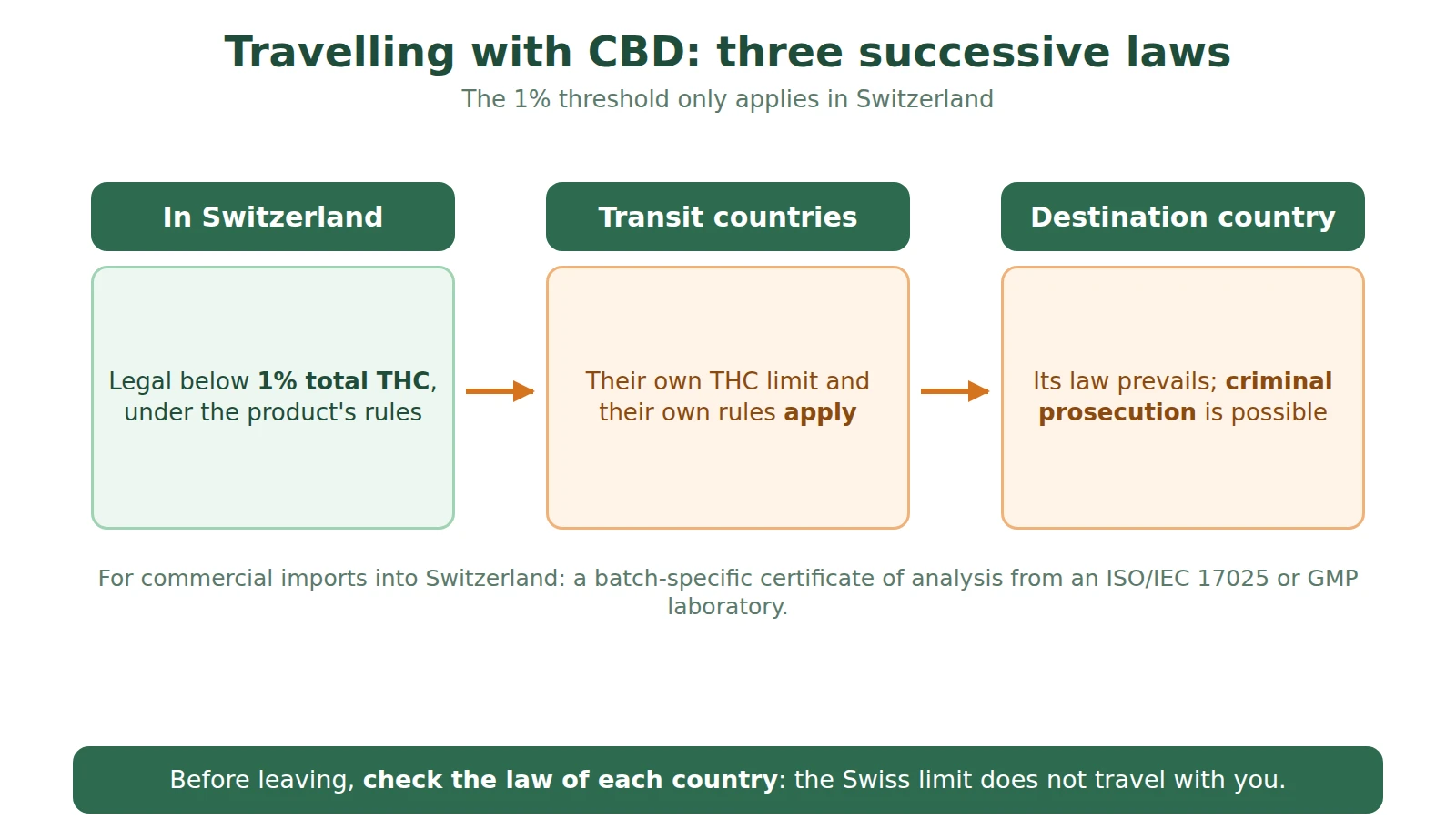
The 0.3% figure often quoted for the European Union does not settle the matter. It comes from EU agricultural law and concerns the hemp varieties grown and imported raw hemp. For finished products, each member state applies its own rules.
Before you leave
The only reliable reference is therefore the law of the destination country, and of the countries you cross, including during a train transit or a stopover. The country’s official representations and its customs authorities are best placed to explain the rules in force.
The form of the product matters too: a flower, a hash, an e-liquid and an oil are not subject to the same rules from one country to another. A product bought legally in Switzerland may be banned elsewhere. When in doubt, the safest option is not to take it.
Coming back to Switzerland
Conversely, the Swiss rule applies to any hemp product entering Switzerland: it must stay below 1% total THC, whatever country it was bought in. A product above the threshold is a narcotic in Switzerland, even if it was sold legally elsewhere. We detail what this figure measures in our article on the 1% THC threshold.
For commercial imports, the authorities also expect a batch-specific certificate of analysis covering the actual consignment, issued by an accredited laboratory (ISO/IEC 17025) or one recognised under good manufacturing practice.
Why a legal product can contain THC
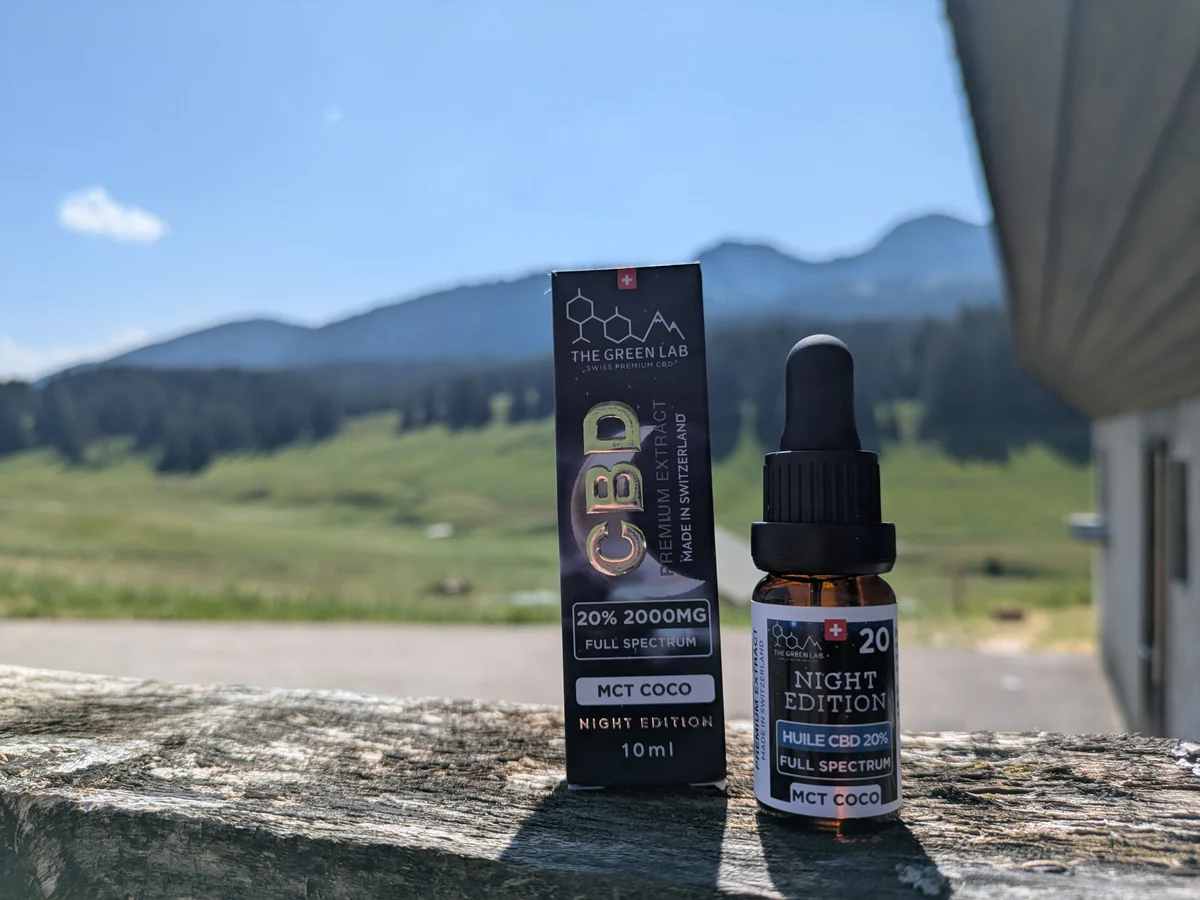
The Swiss threshold does not require THC to be absent: it sets a ceiling. A flower, a hash or an oil can therefore contain THC, as long as its total content stays below 1%. In a so-called Full Spectrum oil, the extract keeps all the plant’s cannabinoids, THC included, within the legal limit. In common usage, a Broad Spectrum oil is made by removing THC from the extract, and an isolate is purified CBD.
These terms are not defined by any official text, as we explain in our article on spectrums, and only an analysis shows what a product actually contains. For drivers, these differences do not change the rule: what counts is the amount of THC in the blood, not the product label.
At the wheel: a rule that only measures THC
On the road, the Swiss rule does not mention CBD, only THC. The Road Traffic Act leaves it to the Federal Council and the Federal Roads Office to set limit values: for THC, it is 1.5 micrograms per litre of blood. This figure corresponds to the level from which the substance’s presence in the blood can be reliably demonstrated.
The Federal Supreme Court confirmed this rule in 2021: above the limit value, unfitness to drive is presumed, and the Court saw no reason to revisit this case law.
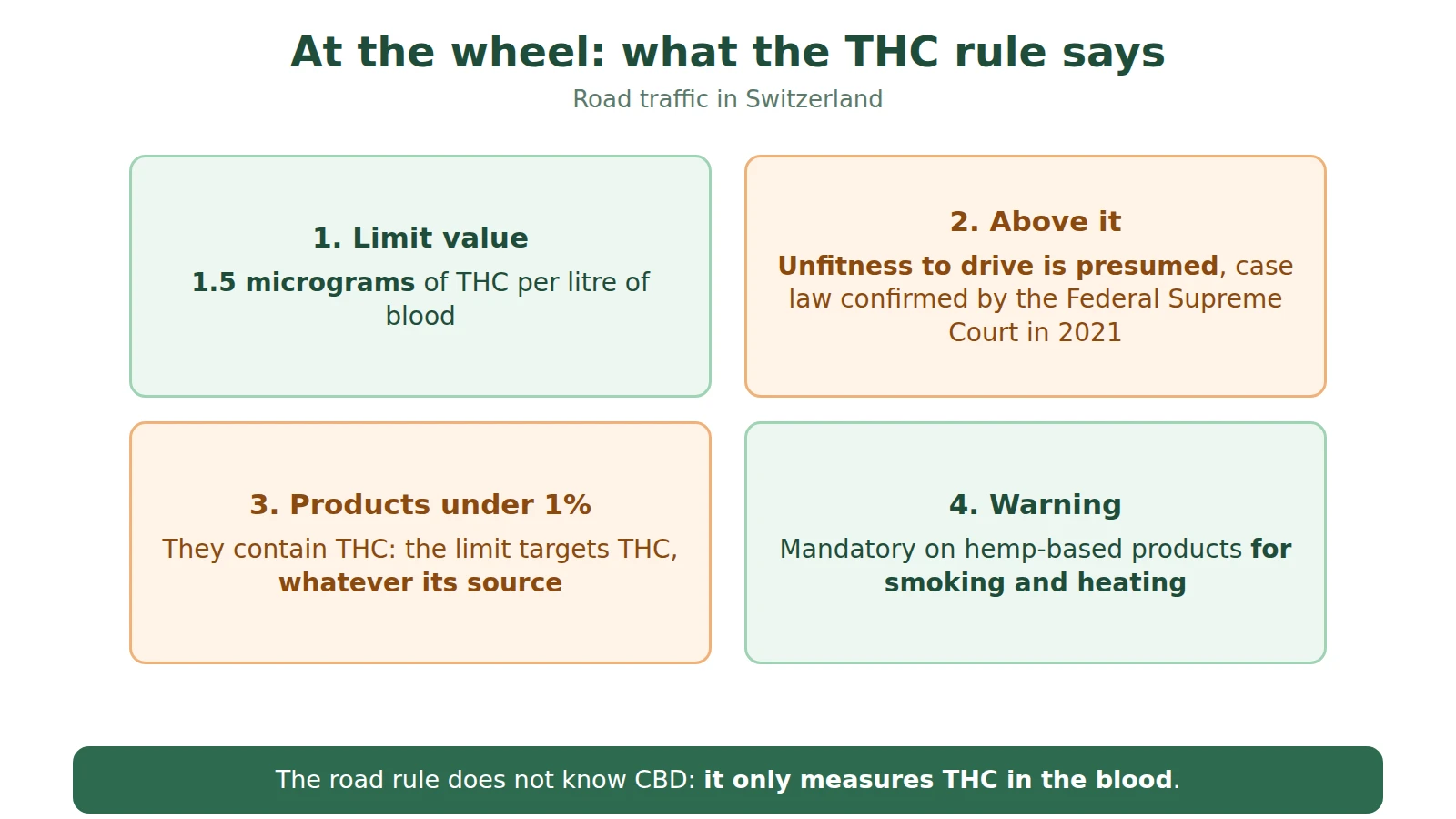
Yet a product under 1% total THC is not a THC-free product. The limit targets the THC present in the blood, whatever its source. That is why the Tobacco Products Ordinance requires the following warning on hemp-based products for smoking and heating: the product may impair your ability to drive. It also advises against driving after use. We present the other obligations for these products in our article on the Tobacco Products Act.
Point to watch
Legal does not mean THC-free. A product under 1% total THC may contain some, and the road rule makes no distinction based on the source of the THC measured in the blood. Abroad, a product that is legal in Switzerland can lead to prosecution.
Travelling or driving with CBD therefore means switching rules. At the border, the Swiss 1% threshold gives way to the law of the destination country and of the countries crossed. At the wheel, the question is no longer whether the product is legal, but whether THC is present in the blood above 1.5 micrograms per litre. Our guide to Swiss CBD law brings together the other rules, product by product.
Our laboratory
Our oils are made in Gland from crude extracts containing less than 1% total THC, and their cannabinoid levels are checked regularly by an external laboratory. Below the threshold does not mean THC-free: our Full Spectrum oils contain some, within the legal limit. To find out more, discover our laboratory.
Further reading: the Swiss cannabis bill and why a CBD oil is not a food supplement.
Also in our shop: all our CBD oils and our CBD flowers.
Frequently asked questions
Can I take a CBD oil on a trip?
It depends on the law of the destination country and of the countries you cross, which set their own THC limits and their own rules. The FOPH points out that people who take CBD abroad risk criminal prosecution. No Swiss document protects you abroad.
Is CBD legal everywhere in Europe?
No, there is no single rule. The often-quoted 0.3% comes from EU agricultural law and concerns cultivated varieties and imported raw hemp. For finished products, each state applies its own rules.
Can I drive after using a CBD product?
The road rule targets THC, with a limit value of 1.5 micrograms per litre of blood. A product under 1% total THC can contain THC, and hemp-based products for smoking and heating carry a warning advising against driving after use.
What happens above 1.5 micrograms of THC per litre of blood?
Unfitness to drive is presumed. The Federal Supreme Court confirmed this case law in 2021.
Can I bring CBD bought abroad back to Switzerland?
The Swiss rule applies: the product must stay below 1% total THC. Above that, it is a narcotic in Switzerland, even if it was sold legally in the country of purchase.