
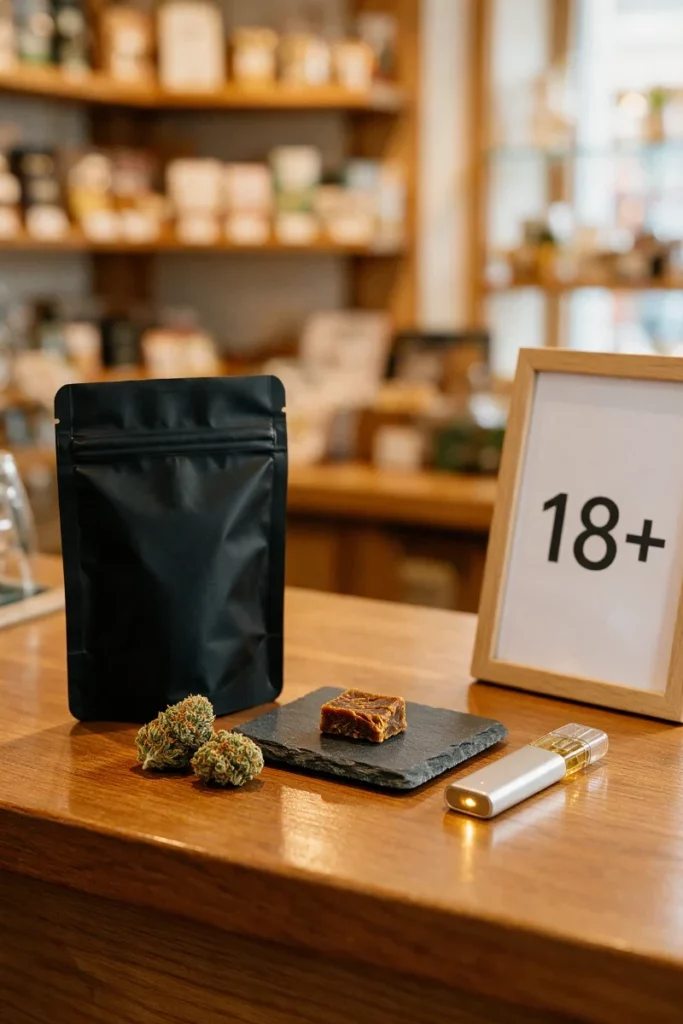
Since 1 October 2024, CBD flowers and hash for smoking, like CBD e-liquids and vapes, fall under the Federal Tobacco Products Act, with or without nicotine. Minimum age, notification, warnings, tax, advertising, cantonal rules: here is what the Act requires, and what it does not change.
On this page
Which CBD products are covered
The Tobacco Products Act (TobPA), in force since 1 October 2024, does not only cover tobacco. It covers herbal products for smoking, including hemp flowers and hash under 1% total THC, as well as electronic cigarettes with and without nicotine, refill liquids included. A CBD e-liquid or cartridge therefore falls within its scope, even without a trace of nicotine.


The federal authorities’ enforcement guide states that adding CBD to electronic cigarettes and refill liquids is in principle permitted. The Act does, however, prohibit any ingredient with a psychotropic effect: hemp under 1% total THC is considered to have no such effect, which makes it compatible with these products.
The Tobacco Products Act adds to the existing rules; it does not replace them. A flower, a hash or an e-liquid must always stay below 1% total THC, as we explain in our article on the 1% THC threshold.
What the Act requires
For these products, the Act sets out a common set of obligations that apply to the manufacturer, the importer and the seller.
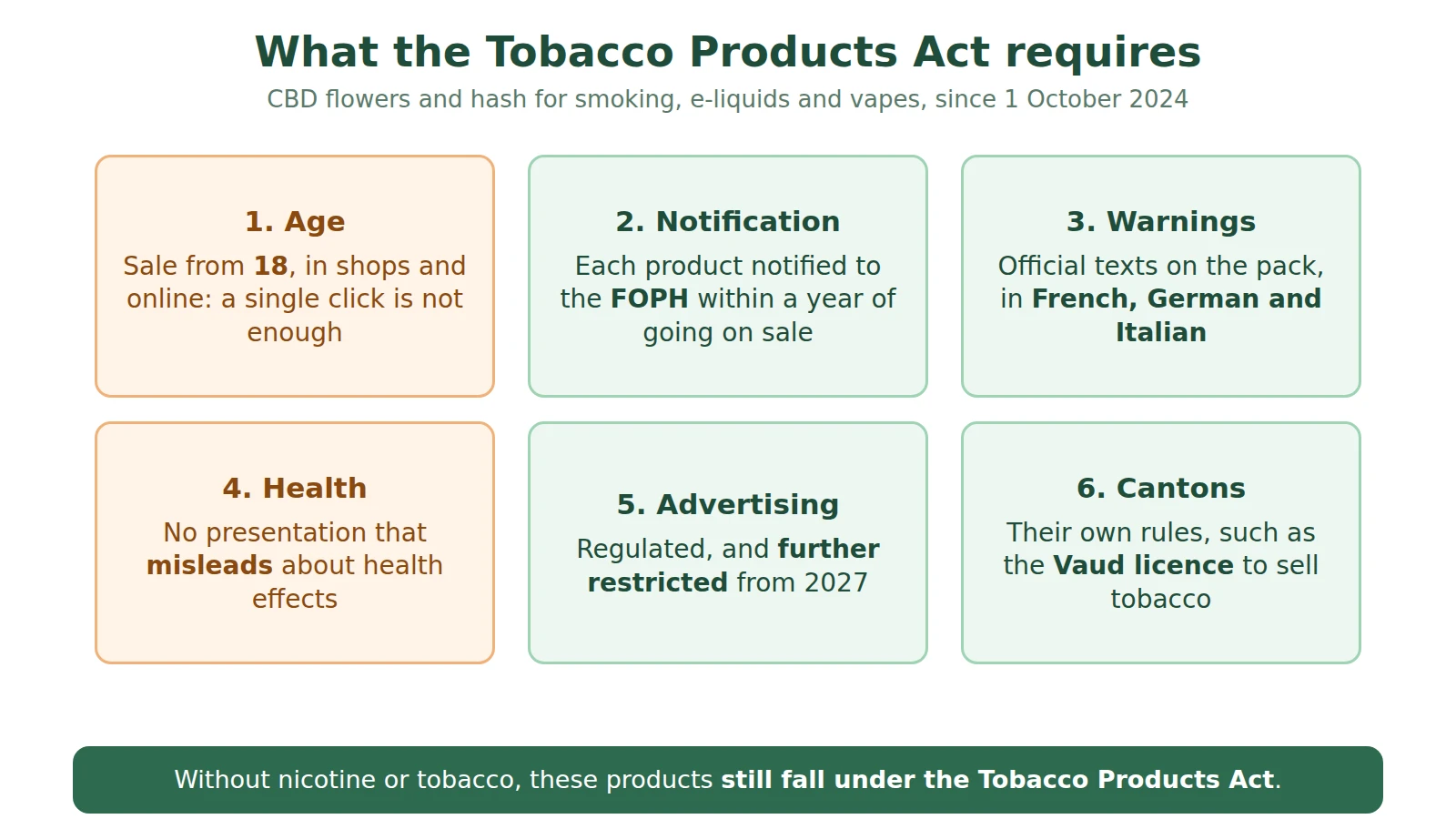
The most visible concerns age. These products may only be supplied to people aged 18 or over, in shops and online. The Federal Office of Public Health (FOPH) states that, for online sales, it is not enough to ask buyers to confirm with a single click that they are 18. A draft revision of the ordinance, put out to consultation at the end of 2025, provides for age checks using an official identity document for online sales and vending machines.
Each product must also be notified to the FOPH within a year of going on sale, and the notification updated if anything changes. The packaging carries official warnings in French, German and Italian. For herbal products for smoking and heating that contain hemp, one of them concerns driving: the product may impair your ability to drive. Refill liquids must also follow the labelling rules of chemicals law, with a safety data sheet. Finally, no presentation may mislead about health effects.
Tobacco tax: a misconception to correct
CBD flowers do not pay tobacco tax. The regulation of the Federal Office for Customs and Border Security (FOCBS) explicitly excludes legal cannabis flowers and products for smoking that contain no tobacco. The Federal Supreme Court ruled in 2020 that there was no legal basis for treating them as tobacco.
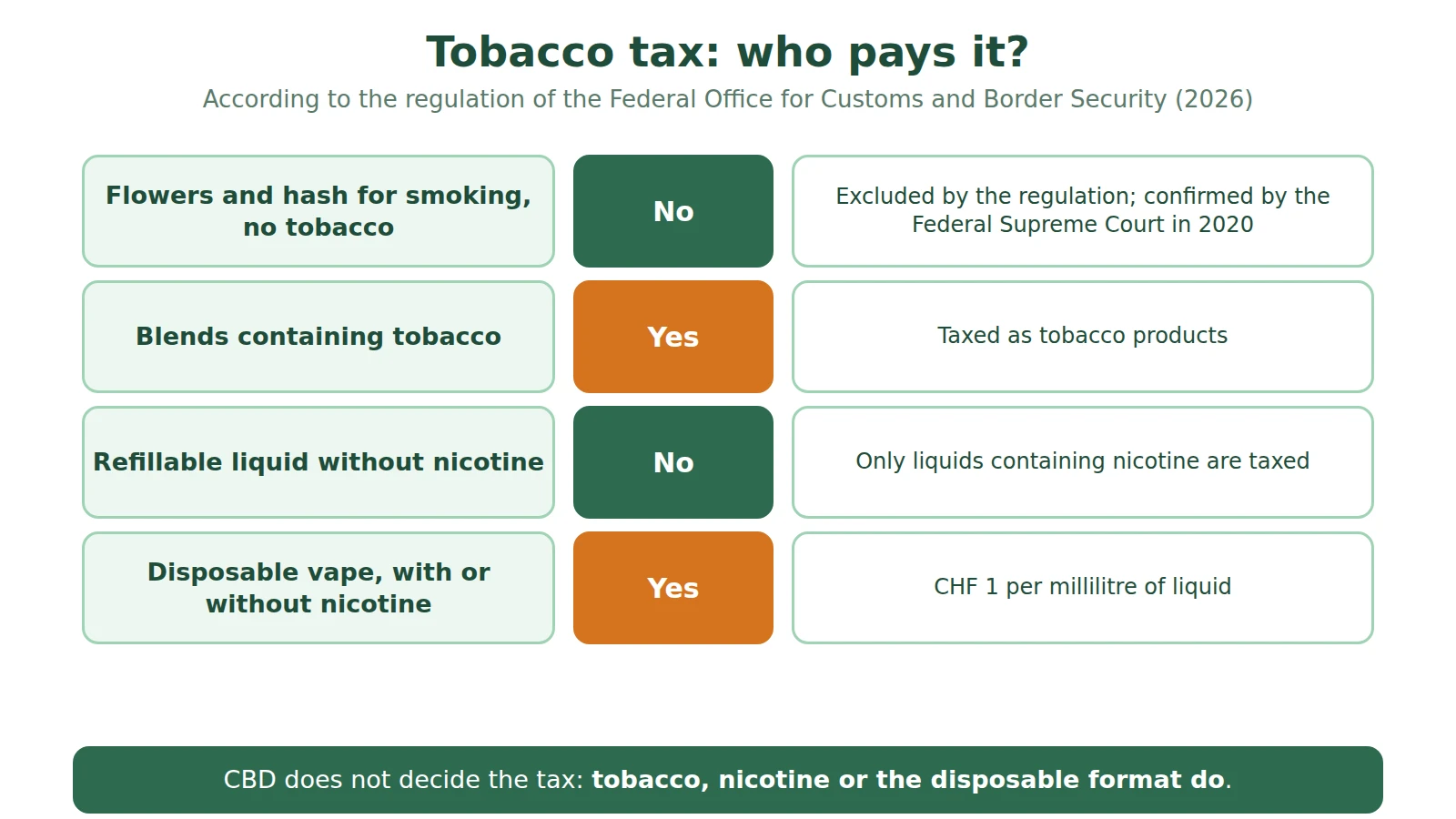
For electronic cigarettes, nicotine or the format decides. Since 1 October 2024, the tax covers liquids containing nicotine and disposable electronic cigarettes, with or without nicotine, taxed at CHF 1 per millilitre of liquid. The regulation makes no exception for CBD: a disposable CBD vape is therefore taxed, whereas a refillable liquid without nicotine is not.
E-liquids and disposable vapes
Unlike “aromatic” oils, CBD e-liquids do not have to be denatured: the federal enforcement guide expressly excludes them from that obligation, which targets oils sold as chemical products.
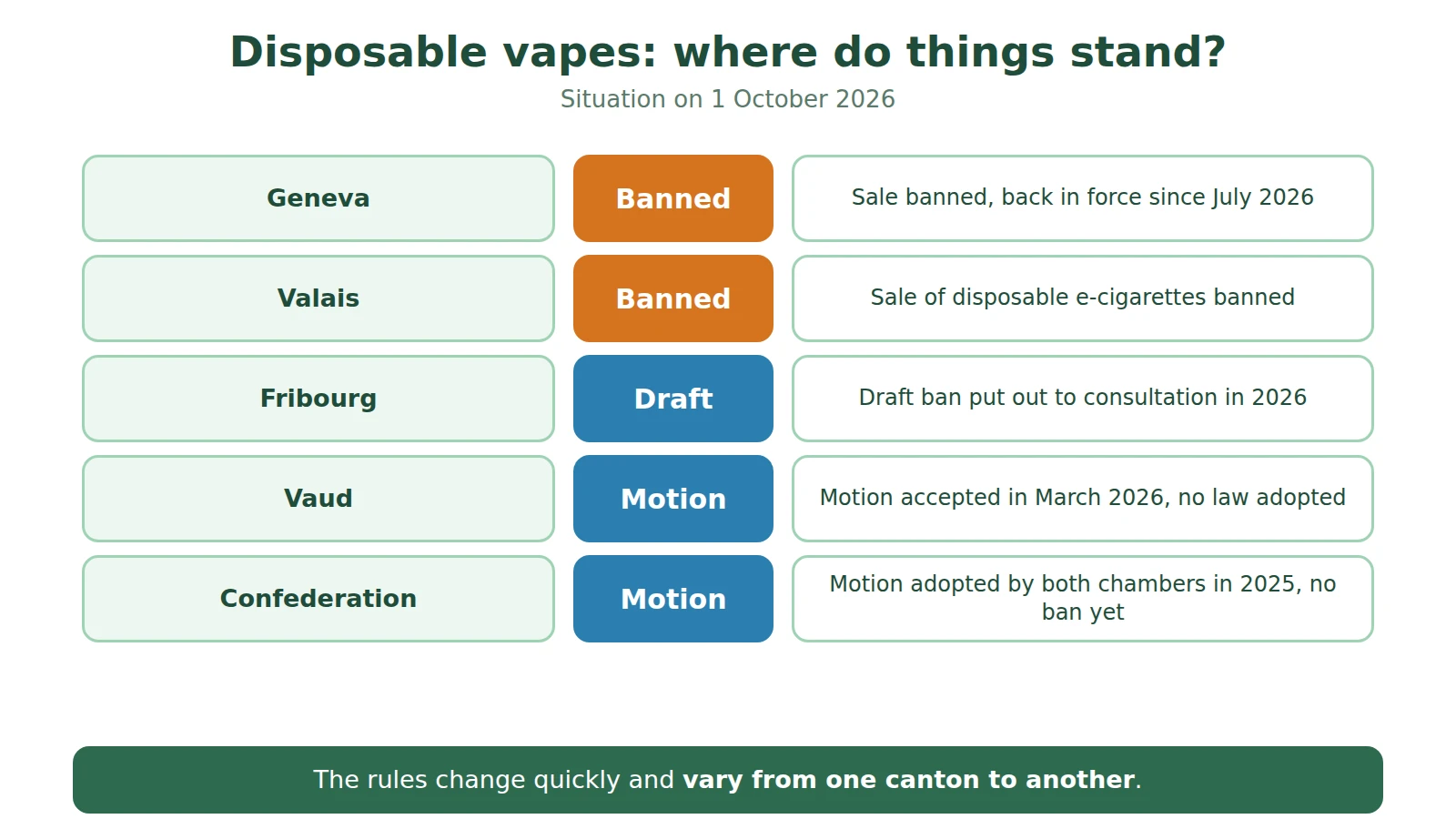
Disposable vapes are subject to a growing number of bans, with rules that change quickly and vary from one canton to another. Here is the situation on 1 October 2026.
Finally, a vape is also an electronic device with a battery. Every seller must take back used batteries free of charge, and electrical and electronic equipment is subject to an organised take-back scheme, financed by an advance recycling fee.
Cantons and advertising
The cantons add their own rules. In the canton of Vaud, selling hemp for smoking under 1% THC or electronic cigarettes, with or without nicotine, requires a retail tobacco licence. The application is made to the municipality, the licence is issued by the prefecture for five years, and a poster must be displayed at the point of sale.
Advertising is regulated too, for all products covered by the Act. A revision adopted on 20 June 2025, following the popular initiative “Children and young people without tobacco advertising”, is due to enter into force in early 2027: online advertising will only be possible behind an age check, advertising will disappear from points of sale, and the press will be limited to titles read almost exclusively by adults.
Point to watch
Without nicotine or tobacco, a CBD product for smoking or vaping still falls under the Tobacco Products Act. For online sales, the FOPH points out that a simple tick box is not enough to check the buyer’s age.
For CBD flowers, hash and vapes, the Tobacco Products Act has added a layer of rules to the 1% THC threshold: sales restricted to adults on every channel, notification to the FOPH, official warnings, regulated advertising and cantonal licences. Tobacco tax, for its part, does not depend on CBD: it applies as soon as there is tobacco, nicotine or a disposable format. Our guide to Swiss CBD law places these rules among those for other products.
Our laboratory
Our e-liquids and cartridges are prepared in our laboratory in Gland, from extracts containing less than 1% total THC. Our CBD flowers, our hash and our CBD vapes are reserved for adults. To find out more about how we work, discover our laboratory.
Further reading: why a CBD oil is not a food supplement, travelling and driving with CBD and the Swiss cannabis bill.
Frequently asked questions
Are CBD flowers subject to tobacco tax?
No, as long as they contain no tobacco. The FOCBS regulation excludes legal cannabis flowers and products for smoking without tobacco, and the Federal Supreme Court ruled in 2020 that there was no legal basis for taxing them. Blends with tobacco are taxed.
Do you have to be 18 to buy a CBD e-liquid?
Yes. All products covered by the Tobacco Products Act, CBD e-liquids included, are reserved for people aged 18 or over, in shops and online.
Does a CBD e-liquid have to be denatured?
No. The federal enforcement guide excludes e-liquids from the denaturing obligation, which targets CBD oils sold as chemical products, known as aromatic or scented oils.
Are disposable CBD vapes banned in Switzerland?
Not at federal level on 1 October 2026: a motion was adopted by both chambers, but no ban is in force. Geneva and Valais already ban the sale of disposable e-cigarettes, and other cantons are preparing rules. Disposables, with or without nicotine, pay tobacco tax.
Why is there a driving warning on flowers?
The Tobacco Products Ordinance requires it for herbal products for smoking and heating that contain hemp. It does not apply to CBD electronic cigarettes.